
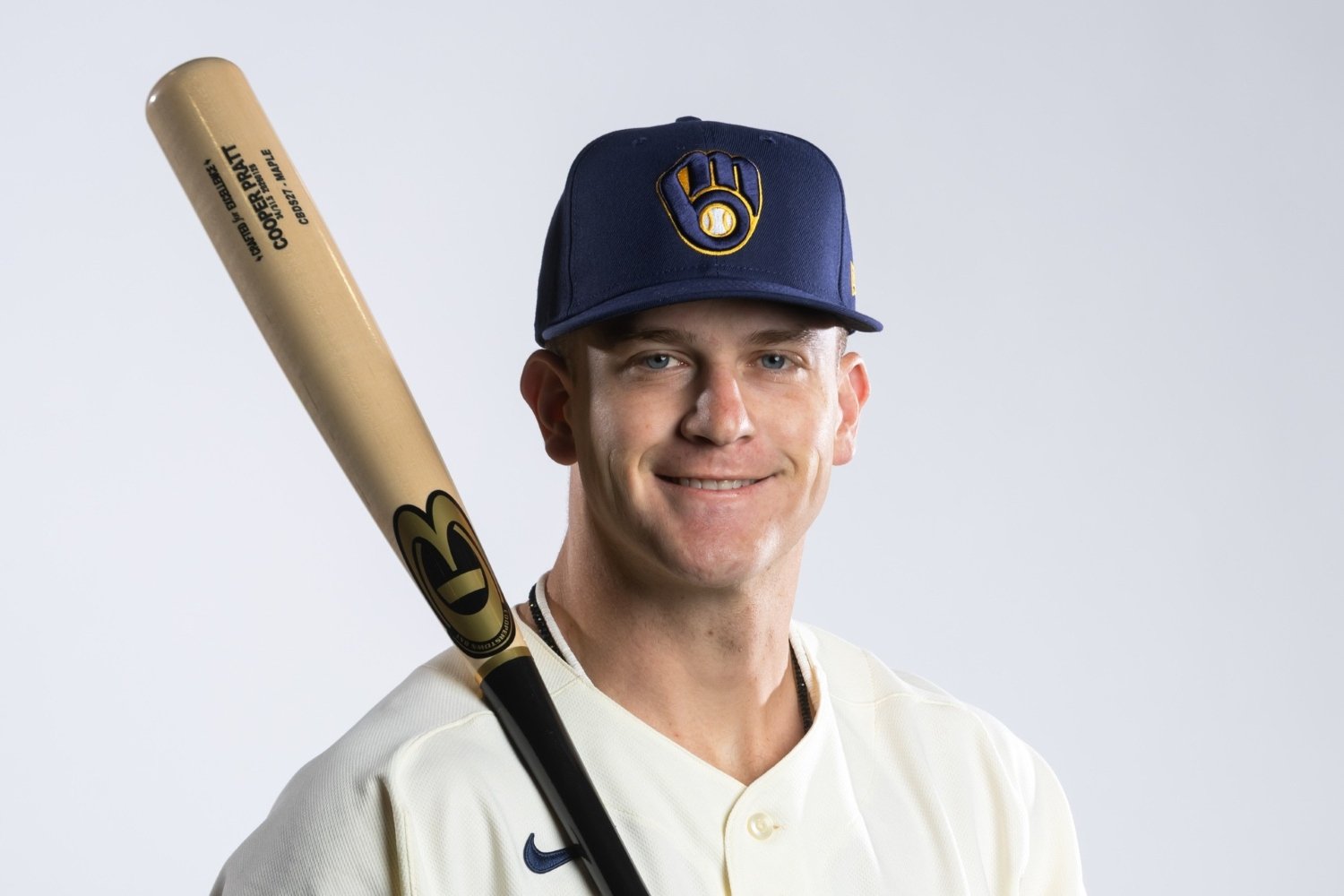
It’s not often a player signs an eight-year deal (plus two club options), worth $50 million guaranteed, after just three games in Triple-A. It’s even more rare when that player was a sixth-round pick out of high school less than three years ago. But the Brewers aren’t betting on what Cooper Pratt has already done. They’re betting on what he’s going to do.
A Foundation Built on Instincts
To understand this move, start with some of the traits that don’t show up on Pratt’s FanGraphs page: his instincts, leadership qualities, and baseball IQ. Pratt is one of the most instinctive players in the organization, and that shows up everywhere. He doesn’t need top-of-the-scale tools to impact the game because his internal clock, positioning, and decision-making consistently put him in the right place on both sides of the ball.
Defensively, that translates into a player who already looks like a long-term shortstop. The range plays above the raw speed, thanks to strong first steps and advanced reads off the bat.
On the bases, it’s the same story. He went 31-for-36 on stolen bases in 2025, not because he’s a burner, but because he understands timing, pitchers, and situations. Those kinds of instincts are scalable to higher levels.
On the leadership side of things, according to Adam McCalvy, “(Pratt) spent the spring trying to learn Spanish to better communicate with Latin American teammates.” That’s the type of person and personality the Brewers are drawn to, and really appreciate in their clubhouse.
When teams hand out early extensions, they’re often paying for traits they believe will age well. Instincts, defensive value, and baseball IQ are at the top of that list, and just so happen to be the greatest strengths of Pratt. This is a profile Milwaukee has come to trust, develop, and ultimately build a large part of their team around.
Bat-to-Ball Ability
Offensively, Pratt’s profile is not built on loud power. It’s built mainly on his bat-to-ball skills.
In Double-A in 2025, he posted a 108 wRC+ in the Southern League, while spending most of the season as a 20-year-old. That matters. The raw .691 OPS doesn’t jump off the page, but the added context of the Southern League’s hitting environment clarifies the picture. He was producing above league average in one of the tougher hitting environments in the minors, against older competition.
Pratt struck out just 15.2 percent of the time, while walking at a 12.7% clip. That combination points to a hitter who controls at-bats, puts the ball in play, and doesn’t give away plate appearances. His 22.3% whiff rate reinforces that this is real bat-to-ball ability.
The Brewers have had a lot of success leaning into this archetype before, with hitters who can make consistent contact, manage the zone well enough, and let the rest of their game add value.
There’s also a level of consistency in his swing that evaluators trust. It’s controlled, repeatable, and adaptable across pitch types. That gives him a high floor offensively, even as other parts of the profile continue to develop.
Defensive Value at a Premium Position
Shortstop defense still carries weight, and Pratt checks a lot of boxes. He projects as an above-average defender at the position, with a chance to be even better. For an organization that prioritizes run prevention, that matters. The arm is a separator, too. Pratt can make throws from multiple angles with accuracy, giving him a toolset teams trust on the left side of the infield.
If Pratt can provide steady offense and plus defensive value at shortstop, that’s an everyday player. If the bat takes another step, it’s more than that.
Milwaukee has shown a willingness to invest early in up-the-middle players they believe in. Pratt fits that philosophy almost perfectly.
The Big Questions: Impact and Approach
For all the strengths in the profile, the biggest X-factor remains Pratt’s power (or lack thereof). Pratt’s 101.2-MPH 90th-percentile exit velocity points to below-average game power right now. He hit eight home runs in 527 plate appearances in 2025, and much of his offensive value came from contact and on-base ability, rather than damage.
However, that’s where some physical projection comes in. There’s room on Pratt’s frame to add strength, and more importantly, there’s a path to impact through bat speed gains. If he can add even fringe-average power, the entire profile changes. Suddenly, you’re looking at a shortstop who gets on base, puts the ball in play, runs well, and does enough damage to matter.
The approach is another piece of that puzzle. Pratt’s chase tendencies, particularly against breaking balls away, can undercut his strong contact skills. Improving swing decisions would allow him to tap into more favorable counts and better pitches to drive.
Those are developmental areas for Pratt, not huge red flags, at least at this moment. And clearly, the Brewers believe in their ability to help him make the needed adjustments.
Why the Brewers Moved Now
Of course, this extension isn’t about anything the Brewers’ brass saw in three games in Triple-A. It’s about taking a calculated risk on a player they view as a long-term major-league contributor.
Pratt offers a relatively high floor built on contact, defense, high baseball IQ, and instincts. He brings a high likelihood of high-level defense at a premium defensive position. He also still has youth on his side, which means physical development can still be part of the equation. Finally, he has clear and attainable paths to achieving some of the offensive growth that the team will be looking for.
If the power comes, the deal looks like a bargain for Milwaukee. If it doesn’t fully arrive, there’s still a realistic outcome where Pratt is an everyday shortstop who contributes in multiple ways, and this deal is more than reasonable for an everyday infielder in the prime of his career.
What Comes Next
Pratt will continue to face upper-level pitching in Triple-A, where he will look to translate the same underlying skills against better arms, and hopefully start to tap into some of the power. This could expedite his promotion to MLB a bit, but it doesn’t seem like that’s the main impetus for the deal—as it often is, with extensions like these.
Still, if the contact quality ticks up and the approach tightens, he could push his way into Milwaukee sooner, rather than later. The defensive value gives him a path to the majors even without major offensive gains, but the ceiling will be determined by how much impact the bat develops.
The Brewers didn’t wait for an answer on the bat. They decided they already had enough to go off of to make Cooper Pratt a core member of the big-league team for the next 8-10 years.
What do you think of the Cooper Pratt extension? Let us know!
Interested in learning more about the Milwaukee Brewers’ top prospects? Check out our comprehensive top prospects list that includes up-to-date stats, articles and videos about every prospect, scouting reports, and more!