
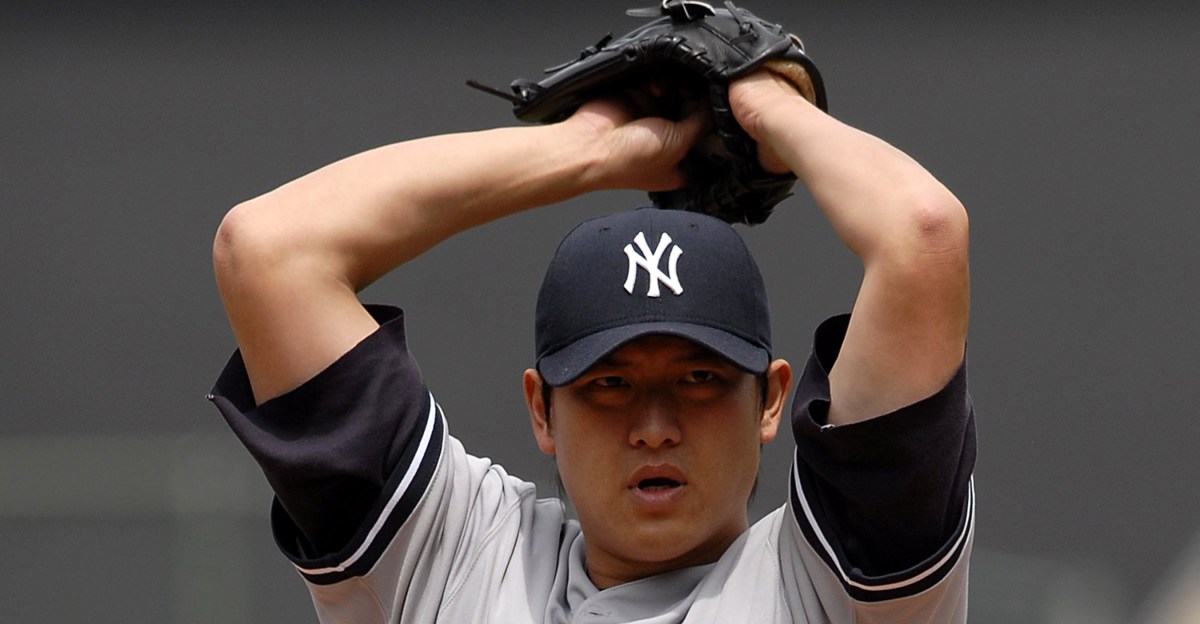
If you watched any of the Little League World Series in the late 2000s, you will recall the number of times you saw Chien-Ming Wang listed as a favorite player. The legend began 46 years ago today in Taiwan’s oldest city, long before he became a household name in New York or a symbol of pride across his home country.
Chien-Ming Wang
Born: March 31, 1980 (Tainan City, Taiwan)
Yankees Tenure: 2005-09
Wang’s path toward the major leagues started to take shape in 1999, when he helped lead Taiwan to a silver medal at the World Port Tournament. He posted a 1.59 ERA in the event, allowing just six hits and striking out six over 5.2 innings, a performance that caught the attention of MLB scouts. The Yankees saw enough to invest, signing him in May of 2000 for a reported $1.9 million bonus.
At the time he was not viewed as a future ace, and no one from Taiwan had ever made it to the majors. In fact, Wang was not considered one of the top amateur players in his own country at the time. What he became was gradually built one worm-burner after another. Shoulder surgery derailed Wang’s second season with the club, so he really jumpstarted his journey to the Bronx in 2002.
Wang worked his way methodically through the Yankees’ minor league system, refining the pitch that would ultimately define his career. With the help of Yankees instructors, he developed a heavy sinker that transformed him from a conventional pitcher into something far more unique. As Wang worked his way through the system, his identity was clear: He was not going to overpower hitters; he was going to overwhelm them with movement, forcing contact and turning at-bats into groundballs.
That identity carried him to the majors in 2005. And he did not arrive quietly.
Wang made his MLB debut on April 30, 2005, becoming just the third Taiwan-born player in MLB history after Dodgers bench outfielder Chin-Feng Chen and Rockies pitcher Chin-hui Tsao. He fired seven innings of two-run ball against the Devil Rays, grinding them down.
Indeed, Wang quickly proved he belonged, going 8–5 with a 4.02 ERA across 17 starts, recording a 1.246 WHIP, a 0.7 HR/9, and a 63.9-percent groundball rate — second in the majors among all pitchers with at least 100 innings to only the next year’s NL Cy Young Award winner, Brandon Webb. He gave the Yankees exactly what they needed in that moment, innings, stability, and a glimpse of something more.
Wang broke out in 2006, going 19–6 with a 3.63 ERA across 218 innings in 33 starts, tying for the Major League lead in wins and finishing second to Twins ace Johan Santana in AL Cy Young voting. He did it with just 76 strikeouts, relying instead on elite contact management. He led the Junior Circuit in groundball rate at 62.8 percent and allowed just 12 home runs all season (an MLB-best 0.5 HR/9), a reflection of how dominant his sinker truly was.
In a rotation that included Hall of Famers Mike Mussina and Randy Johnson (and big money Carl Pavano), Wang became the constant. The kid was not just part of the rotation; he was leading it.
And he backed it up in 2007.
Wang again won 19 games, going 19–7 with a 3.70 ERA, allowing just nine home runs all season, good for a 0.4 HR/9, and continuing to dominate with his sinker-heavy approach. Across those two seasons, he went a combined 38–13, establishing himself as one of the most reliable and valuable pitchers in baseball. It was just unfortunate that the Yankees were a dynasty in twilight and consigned to three consecutive ALDS losses, so the postseason resume was not there. It didn’t help that he looked worn down by the end of 2007, when Cleveland pummeled him twice in a four-game ALDS loss.
Nonetheless, Wang’s strategy for success was clear: he did not overpower hitters. He controlled them. And heading into 2008, it looked like more was coming.
Wang opened the 2008 campaign in dominant form, jumping out to an 8–2 record and once again anchoring the Yankees’ rotation. He became the fastest pitcher to reach 50 career wins in decades, doing so in just 85 starts, and looked every bit like a pitcher entering his prime.
It felt sustainable. It felt as repeatable as Wang’s smooth hands over head delivery. It felt like as long as the infield defense could remain steady behind him a legendary career was destined.
Then, during interleague play in Houston on June 15, 2008, everything changed. Fans of the era might want to avert their eyes:
Wang was allowed to reach base on an ineffective bunt that led to a force out, and he later scored on a Derek Jeter single. Immediately after crossing home plate, the Yankees’ ace hopped in pain, reached for Robinson Canó’s baggie jersey, and as his hand rested on his knee every fan held their breath. Ultimately, Wang needed help to get off the field.
The diagnosis was severe: Wang suffered a sprained Lisfranc ligament and a partial tear of a tendon in his right foot. This sparked a wave of calls for the universal designated hitter, but it would be more than a decade before that rule would be put into place. (Five years after this, Houston joined the American League and there never would’ve been a pitcher batting there anyway.)
What initially felt like a fluke injury became the turning point of Wang’s career. He missed the rest of the 2008 season began a long rehabilitation that altered his mechanics and eventually led to shoulder and arm issues.
Wang attempted to return in 2009, but the effects of the injury were immediate and difficult to overcome. Across 12 starts, he went 1–6 with a 9.64 ERA, as the command never fully returned and his sinker flattened out. The pitcher who had built his success on precision and movement suddenly could not replicate either. By the end of the season, the Yankees made the difficult decision to non-tender him, bringing his chapter in the organization to a close. The ace was gone as quickly as he had arrived. However, Wang went out with a ring—a teastament to all the hard work and quality innings he gave them in the years before ’09—and the organization has not secured one since.

NEW YORK – NOVEMBER 04: (L-R) C.C. Sabathia, Nick Swisher, Robinson Cano, Chien-Ming Wang and Jorge Posada of the New York Yankees celebrate after their 7-3 win against the Philadelphia Phillies in Game Six of the 2009 MLB World Series at Yankee Stadium on November 4, 2009 in the Bronx borough of New York City. (Photo by Jim McIsaac/Getty Images) Getty Images
What followed was not a clean ending, or a ride off into the sunset, but a long and difficult fight.
Wang’s comeback took years. After leaving the Yankees, he spent time with the Nationals, Blue Jays, and Royals, along with multiple minor league stops and extended rehab assignments. He returned to the majors in 2011 with Washington, again in 2013 with Toronto after starring for Taiwan in the World Baseball Classic, and later in 2016 with Kansas City, nearly eight years after the injury that changed everything.
Nearly a decade later, he was still chasing it. That persistence became the second half of his career. The documentary Late Life captures that stretch, showing a former ace grinding through the minors with uncertainty, driven by the belief that he still had something left.
It was not glamorous. But it mattered. Because he did make it back. And in doing so, he showed something just as meaningful as his peak. Who he was. Not just the ace, but the competitor who refused to walk away.

MIYAZAKI, JAPAN – MARCH 01: Bullpen coach Chien-Ming Wang #40 of Team Chinese Taipei poses for a photo during the Team Chinese Taipei photo day at Phoenix Seagaia Resort on Sunday, March 1, 2026 in Miyazaki, Japan. (Photo by Yuki Taguchi/WBCI/MLB Photos via Getty Images) MLB Photos via Getty Images
Today, Wang remains in the game as a coach, most recently working with the Taiwanese team in the 2026 World Baseball Classic, helping guide the next generation of pitchers from his home country.
That legacy is now formally recognized as well. In 2024, Wang was inducted into the Taiwan Baseball Hall of Fame, receiving over 90 percent of the vote in recognition of both his big-league success and his impact on the game in Taiwan. He remains the most accomplished Taiwanese player in MLB history.
For a time, Chien-Ming Wang was not just the Yankees’ ace. He was one of the most effective pitchers in baseball and the standard for a generation of Taiwanese players. Wang was also a homegrown product, And long after that ended, he showed what it meant to keep going.
Happy birthday, Chien-Ming Wang.
See more of the “Yankees Birthday of the Day” series here.