
Image credit:
Colt Emerson (Photo by Brandon Sloter/Getty Images)
This week has been a lucrative one for high school shortstops from the 2023 MLB Draft class.
On Monday, Bob Nightengale first reported that the Brewers have agreed to an eight-year, $50.75 million contract extension with shortstop Cooper Pratt. There are also two club options with escalators that could extend the life and the total package of the deal, but Pratt, ranked No. 50 in Baseball America’s Top 100 Prospects, is now guaranteed a little over $50 million.
On Tuesday, Robert Murray broke the news that Mariners shortstop prospect Colt Emerson, the No. 7 prospect in the Top 100, agreed to an eight-year, $95 million deal with Seattle that includes a club option for a ninth year and has performance escalators that could push the total deal as high as $130 million.
This is the time of year that these extensions happen, and they are a perfect example of how prospect rankings—both public and teams’ internal evaluations—play a role in these deals.
Neither Pratt nor Emerson has played a game in the major leagues. Both are in Triple-A, and both are expected to reach the majors this season.
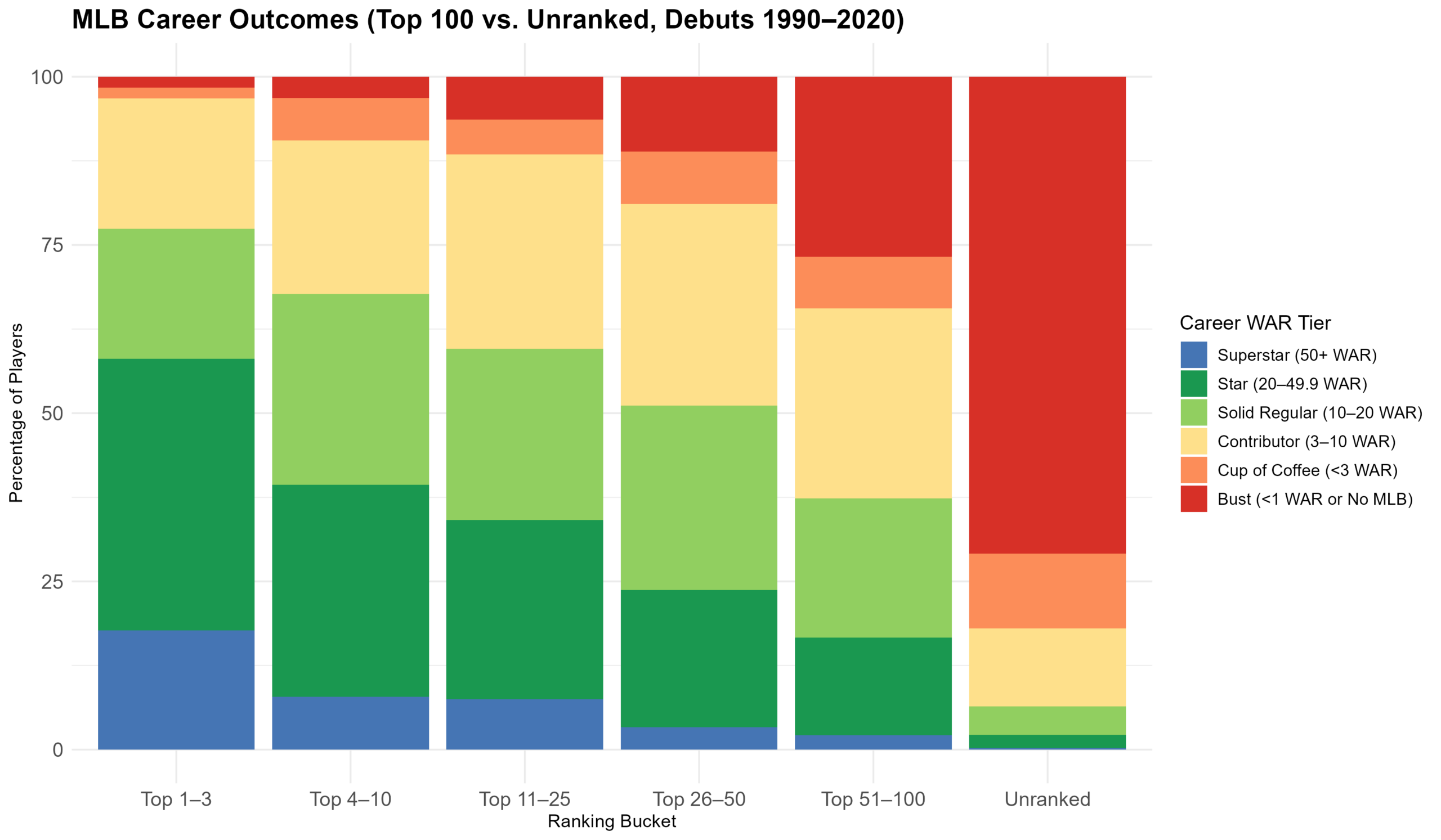
We conducted a study at Baseball America last year that looked at the success rate of every Top 100 Prospect from 1990-2020. One goal of the exercise was to illustrate just how different the career decision is between the one Pratt made and the one Emerson made.
Pratt ranks No. 50 on the Baseball America Top 100. He also ranked 50th last year. He is at the extreme lower end of the 26-50 bucket in our study, but he fits within it. Among the Top 100 Prospects who ranked 26-50th since the BA list was first rolled out in 1990, 3.3% have become superstars (50+ career WAR), 20.4% became stars (20-49.9 career WAR), 27.4% became solid regulars (10-19.9 career WAR), 30% became contributors (3-9.9 career WAR), 7.8% had a cup of coffee (<3 career WAR) and 11.1% produced less than 1 career WAR.
So, historically, Pratt is running a one-in-four risk of forfeiting tens of millions of dollars in earnings if he becomes a star or superstar. If he becomes a solid regular and produces an Ian Desmond-like career, he’ll likely end up making less than he would have made without the extension over the next eight seasons, but by much more modest amounts. For Pratt, it was hard to turn down $50-plus million guaranteed right now for a coin flip’s chance of making $80 million over the next eight years.
If Pratt ends up being more like Brendan Rodgers, then he’s secured generational levels of wealth and come out well ahead in the process. If he ends up having a career like Keston Hiura or Scott Kingery (another player who took an early long-term extension), then betting against long-term stardom will prove to be very wise.
Before we continue, we should note that, any time we divide players into buckets like this, there is a chance of influencing results because of how parameters are set. In this case, Pratt ranks in the final spot of the aforementioned 26-50 prospect grouping. So, for further testing, we also looked at data for prospects divided into 21-40 and 41-60 brackets. The result? Doing so did not significantly change the results of players of Pratt’s ranking range.
Ok, now on to Emerson, who, like Pratt, is a high school shortstop figuring to reach the major leagues this year. He is one year younger (20 vs. 21), even if both were 2023 MLB draftees. But Emerson ranks seventh in the Top 100. That’s a pretty big jump from 50th, and it means Emerson’s risk vs. reward calculations for his career are very different.
Whereas middle-of-the-pack Top 100 players like Pratt have roughly a 25% chance to become a star, players ranking in the No. 4-10 range have a 40% chance of stardom and a 2-in-3 chance of being at least a long-term solid regular. Yes, there have been plenty of players who ended up falling short of those career labels, but only 3% of this group has failed to produce 1+ career WAR. Less than 10% fails to reach 3 career WAR.
To further illustrate these career trends, here’s a look at how players in Pratt and Emerson’s ranking buckets have turned out during first 30 years of the Baseball America Top 100 Prospects list:
Potential
OutcomeCooper PrattColt EmersonSuperstar3.3%7.9%Star20.4%31.5%Solid Regular27.4%28.4%Contributor30.0%22.8%Cup Of Coffee7.8%6.3%Bust11.1%3.2%
Clearly, both the Mariners and Emerson’s camp have made similar calculations. It’s why Emerson’s deal is for almost twice as much money as Pratt’s in guaranteed money. Both Emerson and Pratt are among the best in the minors, but Emerson is a significantly better prospect than Pratt, which raises the chances he will be a star and the likelihood of being at least a solid regular.
As such, Emerson is likely risking more than Pratt, even with a much larger guaranteed salary as part of this new deal. And there’s one other factor that drives up how much Emerson can make in his extension.
Prior to this deal, Emerson would have likely reached free agency going into his age-27 or age-28 season, depending on when the Mariners called him up this year. Players who hit free agency that young generally do better in their free agent contracts because teams are more comfortable paying position players for peak years in their late 20s than they are players in their early-to-mid 30s. Consider that three of the four largest current MLB contracts were signed by players at age 26 or 27. The other is Shohei Ohtani. It’s also why only one college draftee (Aaron Judge) ranks among the top 10 largest current MLB contracts.
And again, Emerson’s chances of stardom are significantly higher. If he ends up being a 3-4 WAR (or more) player year after year, then this contract will end up being a bargain for the Mariners.
This is why these types of long-term extensions, while potentially quite good for individual players, are potentially a problem for the MLB Players Association as a whole. When Juan Soto was arbitration-eligible as a star 25-year-old, it helped reset the market for all other players. The same was true when Soto signed his 15-year, $765 million free agent contract with the Mets heading into his age-26 season.
When Ronald Acuña Jr. signed an eight-year, $100 million extension with a pair of additional club options in 2019, he was heading into his age-21 season. The deal ensured Acuña lifetime financial security, but it also meant he never went to arbitration, which would have helped raise other salaries. With his current deal, he’ll make $17 million a year this year, next year and the year after that. He will be eligible for free agency heading into his age-31 season in 2031. Without the extension, he would have been a free agent before this season as a 28-year-old.
Thanks to reaching free agency so early, Soto will make nearly as much this year ($47.5 million) as Acuña will make over the next three seasons. For the Mariners and the Brewers, the risk of Emerson or Pratt failing to meet expectations is a modest one that fits within the parameters of a nine-figure payroll.
If a player outplays his contract extension, it’s surplus value for the team. If the player fails to produce at the levels set in the contract, it’s a few million dollars a year in lost value. The risk for the team is spread across dozens and dozens of players. The Mariners’ six-year, $24 million extension with first baseman Evan White proved to be a failure, but that miscalculation barely affected the team in any tangible way.
For individual players, they only get one career. There is no opportunity to spread out the risk. One career-altering injury—like what happened to ex-Mariners outfielder Kyle Lewis and his knee early in his MiLB career—can change everything.
So, it’s often logical to forgo the chances of even larger salaries down the line in exchange for the security of many millions right now. But how much you get paid in those extensions is very dependent on age and prospect status, as Emerson and Pratt’s extensions demonstrate.