
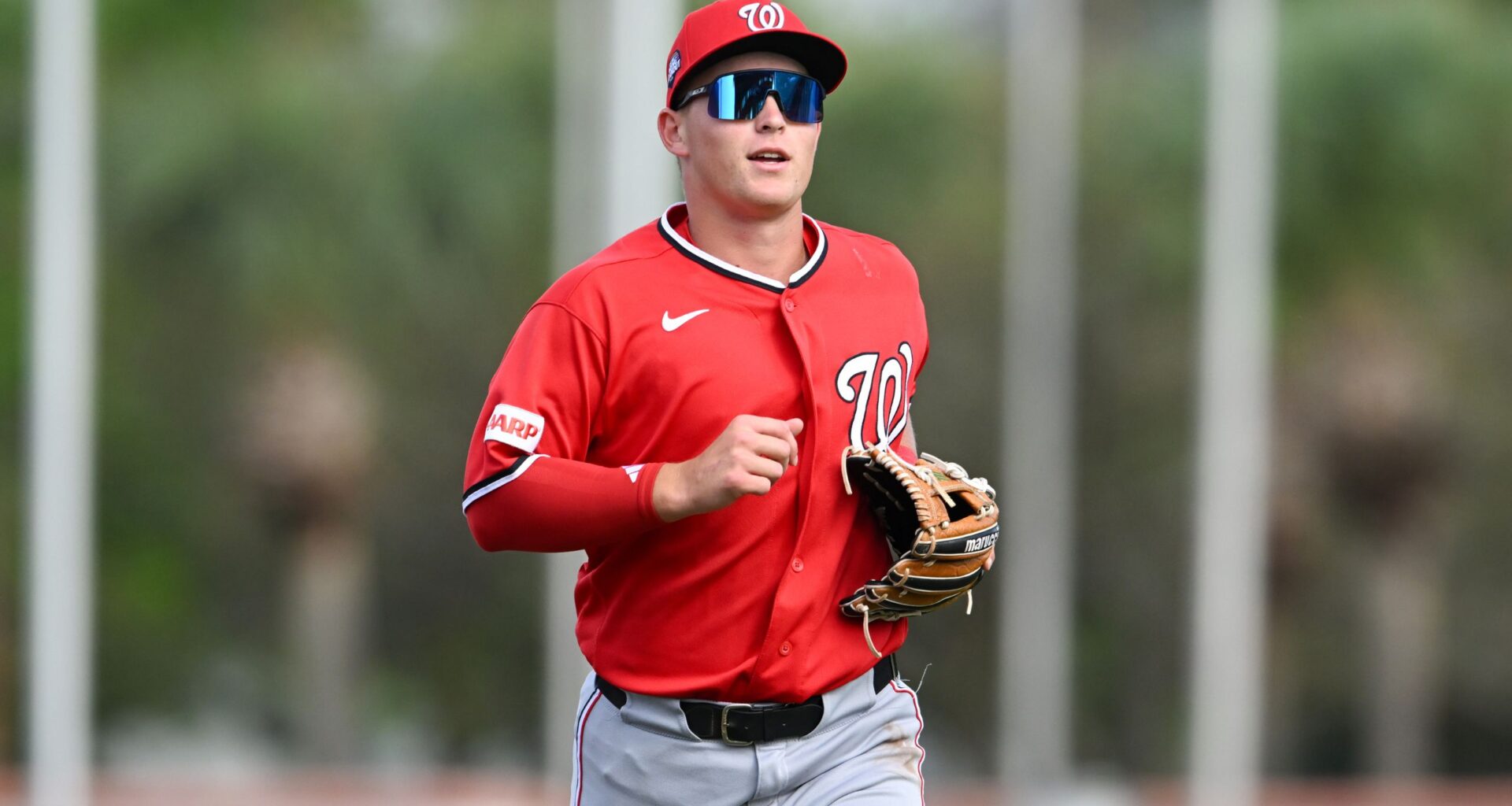
Image credit:
Eli Willits (Photo by Nick Cammett/Diamond Images via Getty Images)
Spring training is over. The Triple-A and major league seasons have begun, and the curtain is set to rise on the Double-A and Class A seasons on Thursday. After scouring the backfields and covering all 30 Spring Breakout games, we set about finding as many players who made noise on the big fields and behind the chain-link fences away from the games under the lights.
The end result is an annual benchmark of our preseason prospect coverage—an in-depth rundown of buzz-worthy players who impressed scouts during spring training.
Last year’s version of this piece featured some of the first whispers about Konnor Griffin before he rose to the No. 1 spot on BA’s Top 100 Prospects list, high praise for Mets fireballer Nolan McLean, inklings of a burgeoning Mariners beast Ryan Sloan and mentions of Marlins lefty Thomas White, among many, many others.
This year’s version runs the gamut from the obvious—Sloan, Pirates righthander Seth Hernandez and Braves lefty Cam Caminiti are all Top 100 Prospects—to the anonymous (for now), like Phillies converted catcher Anderson Navas, Yankees catcher Eric Genther and White Sox righty Gabe Davis.
Read on below for scouting buzz on these 50 prospects who drew scouts’ praise this spring, as presented in alphabetical order, and stay tuned for part two of our annual rundown, which will feature another player (or two) to watch from each of the 30 clubs.
Hayden Alvarez, OF, Angels
Alvarez was an up-arrow player in a 2025 season spent mostly in the Arizona Complex League, but scouts were a little bit split about how real he was as a prospect. No longer. Those with doubts are now more optimistic thanks to a body that has taken more strength and a swing that has gotten shorter and more direct. He’s also shown the knack for making solid contact with two strikes and lashing line drives the opposite way. He’ll need to pull the ball with more authority as he moves up the ladder, but he’s clearly made developmental strides. He has the burst to get to balls in all directions in center field, and there’s a chance he can stick at the position.
Kevin Alvarez, OF, Astros
The Astros have signaled their confidence in Alvarez, who ranked No. 6 among prospects in the Dominican Summer League in 2025. Scouts see a player with a chance to be an above-average hitter with average power. He’s twitchy and athletic and has a chance to stick in center field, but his plus arm strength would be a weapon in right field if he moved over in deference to a more natural defender up the middle. He’s a solid route-runner, too, which should aid his chances of staying in center, where there would be less pressure to produce more impact than scouts currently project.
Sam Antonacci, 2B/OF, White Sox
If you watched the Arizona Fall League, you were intrigued by Antonacci. If you watched the World Baseball Classic, that feeling grew. Now, Antonacci is on the cusp of the big leagues and is one of the bigger up-arrow prospects in Chicago’s system. Scouts see a player who is bigger and stronger, with the increased bat speed and impact to match. A player who formerly got the most out of a scrappier skill set now has the potential to hold down an everyday role. His defense might have to improve to get there, but his offensive improvements give him a clearer path to his debut.
Joshua Baez, OF, Cardinals
In 2025, Baez authored one of the sport’s best rebound campaigns. He crushed the ball across High-A and Double-A and put himself firmly back on the prospect map. Early indications this spring are that the past season was no fluke. Evaluators saw a player who’s grown into his body and become leaner and more muscular and has done wonders to improve his pitch recognition. The power is unquestioned, and he put together a streak of five straight days with home runs. He’s a hard-nosed defender who would fit nicely in either corner but could be playable in center field with his revamped body.
William Bergolla Jr., 2B, White Sox
When he was with the Phillies, Bergolla made his bones on contact ability and the chops to stick up the middle. He was traded to the White Sox in 2024 and produced roughly the same profile in his first full year with Chicago, spent entirely at Double-A, in 2025. In the early days of this season, however, his game appears to have taken a jump. He spent the offseason training to add bat speed, and now his meager power has ticked up a bit and could translate into plenty of doubles. Bergolla will play all season at 21 years old, and his blend of contact, defense and speed should help him land in big league box scores for a long time.
Anderson Brito, RHP, Rays
Brito was part of the trade that sent Brandon Lowe, Mason Montgomery and Jake Mangum to Pittsburgh and also netted outfielder Jacob Melton for Tampa Bay. The righthander was outstanding in 2024 in the Dominican Summer League and then was one of the best pitchers in the 2025 Arizona Complex League. Questions about his size and effortful delivery remain, but there’s little doubt about the quality of his stuff. He brings his fastball up to 97 mph with plenty of life and backs it with two breaking balls that can draw empty swings. The high-intensity nature of his operation could lend itself to the bullpen, but he would provide plenty of value in that role.
Juneiker Caceres, OF, Guardians
Caceres has been excellent at each stop in his pro career. The lefty-hitting outfielder blends hittability, patience and enough power into a package that should allow him to profile in a corner-outfield spot. He takes solid at-bats, doesn’t expand the strike zone often and has the aptitude to get the pitch he wants and turn it into a line drive somewhere. A lack of speed and arm strength might limit him to left field, but his skill set would likely be enough to hit toward the top of the order in front of burgeoning boppers like Chase DeLauter.
Cam Caminiti, LHP, Braves
There’s always money in the banana stand, and there’s always a talented pitching prospect lurking in the Atlanta farm system. Caminiti certainly isn’t obscure, but his rise to prominence last summer came gradually. Now, he stands as the system’s top prospect and one of the best arm talents in the minor leagues. He deals a low-to-mid-90s fastball from a lower arm slot and backs it with a gyro slider and a sweeper as well as a changeup with plenty of bottom. He has feel for his entire mix and plenty of avenues to carve hitters, leaving a path toward the middle of a rotation in a couple of years.
Justin Campbell, RHP, Guardians
In his final season at Oklahoma State, Campbell was teammates with Nolan McLean. Since then, McLean has made his big league debut, starred in the Mets rotation, pitched in the World Baseball Classic and exhausted his prospect eligibility. Campbell has yet to throw an official pitch as a professional. In his few backfield appearances this spring, it looks like there’s still plenty of hope that he can get to the big leagues. The righthander showed off a mid-90s fastball with life through the zone as well as a mid-80s slider with decent finish and a curveball that needs refinement but showed potential. Campbell also mixed in a changeup that flashed average potential and a low-90s cutter that is behind his other pitches. His frame and stuff are in line with what one would expect from a big league starter, and he was around the zone often as well. It’s been three full seasons since Campbell’s last competitive pitch, but the result might be worth the wait.
Yolfran Castillo, SS, Rangers
Castillo jumped on the map two summers ago with an outstanding pro debut that began in the Dominican Summer League and concluded stateside. All of the same traits that helped him bubble are still there, but he’s taken a slower path to a roiling boil. Evaluators noticed a slightly stronger player this spring with the same contact ability and perhaps a touch more impact potential than in years past. He’s still got the action and arm strength to stick at shortstop, which will be key to his future until and unless he adds more power to his profile.
Trevor Cohen, OF, Giants
Cohen was the Giants’ third-rounder from last summer. The Rutgers-bred outfielder started his pro career on a strong note, helping Low-A San Jose to the California League title, and continued a table-setter’s skill set during his first spring training. His lefthanded swing is simple and clean and comes with plenty of barrel accuracy, though his bat path is not conducive to particularly gaudy home run totals. Instead, he sprays line drives and gets on base. He has plenty of speed, which should allow him to stick in center field for now, though he and Dakota Jordan might split those reps at High-A Eugene.
Gabe Davis, RHP, White Sox
Oklahoma State has done an excellent job in recent years of producing big leaguers. Nolan McLean and Carson Benge with the Mets are among a list which also includes Dodgers righty Justin Wrobleski, Victor Mederos and Christian Encarnacion-Strand. Now, the school has a few more players ready to Cowboy up. Davis was the White Sox’s fifth-rounder in 2025 and will make his pro debut this season. On the backfields, he showed an upper-90s heater, a pair of breaking balls that flashed at least average potential and a mid-80s changeup that Davis trusted enough to throw against both righties and lefties. Davis brings plenty of physicality from a 6-foot-9 frame and has the stuff to overwhelm hitters if he can throw more strikes than he did in college.
Kevin Defrank, RHP, Marlins
Defrank ranked behind only Royals wunderkind Kendry Chourio among Dominican Summer League prospects in 2025, and he already looks improved in 2026. The righthander has a body that would look right at home on the gridiron in the SEC, and that uncommon physicality helps him deliver fastballs that sit in the mid 90s and regularly visit triple-digits. He backs the fastball with a sweeper and gyro slider, with the latter ahead of the former at the moment, and the occasional changeup as well. All of his offspeeds will have to take steps forward, but his size and electric right arm should give him plenty of leeway when it comes to overpowering hitters in the Florida Complex League and, eventually, the Florida State League.
James Ellwanger, RHP, Twins
With their third-round pick in 2025, the Twins reached onto the Dallas Baptist roster and plucked Ellwanger, a righthander with a whizbang mix and a frame that could hold more strength. On the backfields and in the Spring Breakout game, Ellwanger paired an upper-90s fastball with a high-velocity changeup that borders on a sinker because of its combination of firmness and powerful movement. He also showed a curveball that could get to above-average with further refinement, as well as a cutter with hard, boring action in on lefties.
Anthony Eyanson, RHP, Red Sox
With their fourth selection among the 2025 draft’s top 100 picks, the Red Sox chose Eyanson, a righthander from LSU. Already, Eyanson has taken significant steps forward. His fastball is coming in a few clicks hotter with cut-ride action through the zone. He backed the pitch with a nasty combination of a slider and a splitter. Each pitch flashed plus, though the slider sometimes had a tendency to show more cutterish break. Eyanson needs to tighten the command of his pitches before he can tap into the highest realms of his ceiling, but the attributes are in place for a midrotation starter.
Angel Feliz, SS, Nationals
After a draft fronted by Eli Willits and a host of trades, the Nationals are bursting with talent on the middle infield. The most gifted true shortstop of them all might be Feliz, who was one of the most talented players on Washington’s team in the Florida Complex League last summer before ending the year with a 30-game stint at Low-A. Scouts tab Feliz as a plus or better defender at shortstop with the plus arm strength necessary for the left side of the infield. He has to improve his swing decisions, but there’s enough bat-to-ball ability to project at as an average defender with fringy power at least. He moves to High-A this season and will likely be one of the youngest players in the South Atlantic League.
Dauri Fernandez, SS, Guardians
In 2025, Fernandez was among a pack of Cleveland infielders who showed arrow-up traits. A year later, he’s separated himself. Though he’s not the most physical or projectable player you’ll find, he just has a knack to hit. He showed it in the Spring Breakout game by taking 99 mph on his hands and dumping it into left field, and he showed it on the backfields, too. There, he peppered line drives across the outfield and showed enough wheels to grab extra bases. Fernandez has a strong arm, athletic actions and should get plenty of chances to stick at shortstop. He’ll be part of a Low-A Hill City team bursting with young, upside-laden talent.
Gavin Fien, SS, Nationals
Fien was part of the package the Rangers sent to Washington in exchange for lefthander MacKenzie Gore. The 2025 first-rounder played just 10 official games with Texas before the deal, but the reputation he carved as an amateur made him an attractive piece to add to a Nationals farm system in the middle of an overhaul. So far, the early returns are solid. Scouts see a player with advanced offensive skills who should produce both hittability and power. He has quick hands and is well balanced throughout his swing and shows the kind of strong hand-eye coordination that helps him be on time against fastballs. The swing is a bit noisy on takeaway, but he is able to get himself back into a sound position to make contact. Defense is a bit of a question mark, and there was plenty of skepticism about whether he’d be able to handle shortstop even before the trade. Fien might wind up in the outfield in the long run, but his bat should help him profile on the grass.
Andrew Fischer, 3B, Brewers
The Brewers have plucked infielders from Tennessee in each of the past two drafts, starting with Blake Burke in 2024 and again with Fischer in 2025. One look at Fischer makes clear he comes to the plate with intent to do damage. His steep swing features vicious, electric bat speed that helps him vaporize baseballs. He posted exit velocities of 111 mph or more twice in the same at-bat during his team’s Spring Breakout game against the Athletics, the second of which resulted in a ringing double into the right-field corner. His approach does appear to be very pull-centric at the moment, but it’s clear he has the tools to bang in the big leagues. He’s a fringier defender at third base and might slide across the infield at some point, but his bat should be enough to profile at either spot.
Tanner Franklin, RHP, Cardinals
Franklin joins Angels righty Nate Snead in the category of Tennessee alums who showed out during spring training. Selected by St. Louis in the third round in 2025—just two rounds after fellow Volunteer Liam Doyle—Franklin was excellent in his team’s Spring Breakout game. There, he showcased a fastball in the mid 90s that peaked at 99 as well as a sharp breaking ball that rode the line between slider and cutter. He was almost solely used as a reliever in college but will be given plenty of chances to start as a pro. His power arsenal and physical frame could help him hold up over the course of a longer workload.
Eric Genther, C, Yankees
The Yankees have done well with late-round or nondrafted free agent catchers in recent years. UDFA Rafael Flores helped them land closer David Bednar from Pittsburgh, and 12th-rounder Ben Rice mashed his way to the big leagues, even if he’s mostly moved out from behind the plate. Genther might be the next in line. Genther caught sparingly at Rhode Island, but New York saw enough to give him another shot at the position as a pro. In limited experience, he looks serviceable. His transfers, arm strength and footwork are fringy enough to keep him alive at the position, and his lefthanded bat has produced plenty of loud contact. The caveat here is that he will be 24 at midseason, so it might be a little while before he faces pitching advanced enough to challenge him.
Henry Godbout, 2B, Red Sox
In the midst of their run of SEC-bred pitchers, the Red Sox plucked Godbout off of a loaded Virginia roster. Both on the backfields and in the Spring Breakout game, the righthanded-hitting infielder showcased a short, quick swing with plenty of avenues for both contact and impact thanks to high-end bat speed and an operation with little wasted movement. Evaluators saw little of him on defense, so there are questions in that department, but there’s little doubting his offensive potential in the early days of his pro career.
Josuar Gonzalez, SS, Giants
Though his spring was cut short by a hamstring injury that kept him out of the Spring Breakout game, Gonzalez showed early that his 2025 star turn in the Dominican Summer League was no fluke. The 18-year-old displayed his signature dazzling defense at shortstop as well as a loose, easy swing from both sides of the plate that should help him create contact now and impact later as he grows into his body. His feet are quick, his arm is strong and there’s plenty of foundation for enough strength gains to complement his electric athleticism. He has all the earmarks of a future star, and should pair with Luis Hernandez to form one of the most exciting tandems in the Arizona Complex League.
Luis Hernandez, SS, Giants
Hernandez was the top prospect available on the 2026 international market and has already proved polished enough to skip the Dominican Summer League and jump straight to the states. He started for San Francisco in the team’s Spring Breakout game, as well. All throughout spring, Hernandez has shown a simple swing with the kind of leverage and thump more commonly associated with a larger-framed player. He has more than enough arm strength to stick at shortstop, but his internal clock might need to be adjusted and scouts would like to see him adjust his arm strength to get on top of the ball more consistently. Still, his hands and feet are sound and should help him stick up the middle. He offers a system on the rise another injection of upside.
Seth Hernandez, RHP, Pirates
The top pitching prospect in the 2025 draft class has a path toward becoming the top pitching prospect in the sport. Veteran evaluators were bowled over by the righthander’s combination of stuff, poise and projectability and saw the potential for a true No. 1 starter. His fastball sizzles and his changeup was a weapon against righties and lefties alike. He shows feel to spin his breaking stuff as well, though both his curve and slider need a bit more consistency at this juncture. He has plenty of time to make those alterations, but the projection is clear: The only obstacle blocking Hernandez’s path to the front of the Pirates’ rotation is named Paul Skenes.
Dasan Hill, LHP, Twins
Hill popped last year during a season among the Class A levels and has taken another step forward this spring. The lefthander works with a full four-pitch complement that allows him to attack north, south, east and west and solve both righthanded and lefthanded hitters. All of his offspeed pitches flash at least average potential and could get a little bit better as he adds strength to a frame with plenty of projection remaining. Hill is already one of the game’s top-flight pitching prospects, but his ceiling might just now be coming into view.
Thatcher Hurd, RHP, Yankees
Hurd was one of a host of physical, college-bred pitchers the Yankees selected two years ago. His pro career was stopped before it began by Tommy John surgery that cost him all of the 2025 season. He’s back on the mound now and showed a low-90s fastball as well as a curveball and slider which each flashed plus over the course of a short outing. He commanded all three offerings well, especially for someone coming back from injury. Hurd probably won’t make his official debut until a little while into the regular season, but he might be the system’s strongest breakout candidate in 2026.
Gage Jump, LHP, Athletics
Jump was one of the biggest risers in 2025, and he shows no signs of slowing down in his sophomore campaign. The LSU product utilizes a hip turn to create plenty of deception, then deals a mix of pitches that grades as above-average or better. He fronts his mix with a lively fastball in the mid 90s and backs it with a sweepy slider, a curveball and a changeup with plenty of bite, as well as a cutter that is on the fringier side. He could stand to command his mix a bit better, but all his offerings play both in and out of the zone. Jump began the year at Triple-A and could reach the big leagues in 2026.
Jansel Luis, 3B, Diamondbacks
Luis has long been one of Arizona’s interesting prospects, but he’s never quite had the bust-out season that propels him to the forefront of the discussion. His 2025 season, spent mostly at High-A Hillsboro, was close to that threshold, but he looks ready for prime time after a strong campaign on the backfields. He’s smoothed his swing from the right side, added lift to his profile and packed on enough strength to project higher impact totals. His entire profile has leveled up, and now he looks like a potential utility player who can lose more than a few baseballs a season with regular playing time.
Esteban Mejia, RHP, Orioles
Mejia made a name for himself last summer as the unquestioned top prospect in the Florida Complex League. His first test at full-season ball showed he needed a little bit more feel and command of his scintillating arsenal, however, and he’ll need to continue to make strides in that department this season. His fastball still regularly visits triple digits, and his slider has plus potential as well. Mejia’s changeup is a little bit behind both of his other offerings, and he’ll need to shorten his arm action if he is to improve the quality and quantity of his strikes. Even so, his pure stuff will give him plenty of runway.
Kade Morris, RHP, Athletics
Acquired from the Mets in the deal that sent Paul Blackburn to Queens, Morris made a star turn in his team’s Spring Breakout contest with the Brewers. He made one mistake over four innings but otherwise silenced a loaded lineup thanks to a mix that allows him to work up, down, in and out and draw plenty of whiffs. He buttressed a mid-90s fastball with a pair of breaking balls and a changeup that allowed him to vex both righties and lefties. Morris began the year in Triple-A but should make his MLB debut at some point this season and fits in nicely as a No. 4 starter who performs above that label on occasion.
Reinold Navarro, LHP, Pirates
Navarro stood out two summers ago in the Dominican Republic and has only gotten better. His body has taken on plenty of the strength that was predicted by a lanky, youthful frame, and his pitches have gained more ferocity as a result. His fastball, which parks in the mid-to-upper 90s, is one of the best in the system already and can rip apart hitters on its own. He backs the heater with a slider and changeup that show flashes of effectiveness but will need more refinement as he moves up the ladder. Even so, Navarro’s fastball is such a singular weapon that it could allow him to dominate lower-level hitters with even moderate strike-throwing improvements.
Anderson Navas, RHP, Phillies
In 2024, Navas was one of the premier prospects in Philadelphia’s international class. He was a catcher then, and was praised for his “phenomenal” arm strength. He didn’t do much over two seasons in the Dominican Summer League, and now has taken that arm strength to the mound. In doing so, he’s revitalized his outlook. Long and lanky, Navas already brings his fastball up to 99 mph and backs it with a slider with varying break—sometimes it looks like a sweeper, sometimes it shows more depth—as well as the occasional changeup. He’s still a work in progress, of course, but a move to the mound has given Navas’ career new life.
Brad Pacheco, RHP, Phillies
Signed out of Venezuela in 2024, Pacheco, to this point, has put together a nondescript career. Nothing overwhelming, but nothing unsightly. This spring, he showed an uptick in stuff that raised eyebrows and his prospect stock. In 2025, his fastball averaged 93 mph. On the backfields, scouts saw him sit between 96-98 mph with sink with a plus slider as a complement. He’ll also flash a fringy split-change, but it needs more development before it becomes a viable weapon. Nevertheless, the velocity jump is enough to put himself on the map.
JoJo Parker, SS, Blue Jays
Toronto’s first-round pick from last summer has lived up to the hype heading into his first full season as a pro. The lefty-swinging infielder has knocked the stitches off the ball most days and shows a swing that should produce plenty of average and power. His early swing decisions have been outstanding, and he’s been unfazed against older, more wizened competition. Whether he sticks at shortstop is a question that will depend on the way his body matures, but his bat shows early signs of profiling at any position on the diamond.
Elian Peña, SS, Mets
Even after a highly productive season in the Dominican Summer League, scouts still had questions about Peña’s ultimate ceiling. They were fairly convinced that he was advanced enough as a hitter to reach the highest level, but the bigger question was where he would land on the diamond. They are still certain he moves off of shortstop thanks to a fairly mature body that is not particularly twitchy, but they also saw reason for encouragement that his offensive profile would play no matter where he suited up on defense. He looks bigger and stronger than he did in 2025, and he has the type of bat speed that should allow him to handle premium velocity. He’ll skip the Florida Complex League and instead suit up for Low-A St. Lucie in his sophomore campaign.
Marcus Phillips, RHP, Red Sox
Phillips was the Saturday starter for the 2025 Tennessee team that littered the early rounds of the draft and will ultimately produce multiple big leaguers. Phillips transferred to Knoxville from an Iowa JC and immediately set about raising his prospect stock. The Red Sox called his name with the 33rd-overall pick and have seen immediate results. Though scouts were high on a glut of Boston’s next pitching prospects, Phillips’ ceiling might be the highest. The righthander is big and physical and deals from a lower slot that allows him to deliver four-seam and sinking fastballs, which he pairs with sliders that he can land for strikes or sweep away from righties. Phillips’ changeup is a little bit behind the rest of the mix, but his present mix points toward a pitcher who could easily fit in the middle of a rotation.
Carlos Rodriguez, RHP, Tigers
Rodriguez signed with Detroit in 2024 and spent the first two seasons of his career in the Dominican Summer League. He’s moved stateside this spring and has already raised some eyebrows. The righthander works with a five-pitch mix fronted by a low-90s fastball that gets carry through the zone out of a higher slot. He backs the heater with a pair of breaking balls that blend together as well as a cutter and a nasty splitter that draws plenty of empty swings. His easy delivery and repeatability suggests above-average control and command and helps him point toward a ceiling as a back-end starter.
Rainiel Rodriguez, C, Cardinals
In two seasons a pro, Rodriguez has established himself as one of the highest-upside catchers in the minors. He bullied his way out of the Florida Complex League almost immediately in 2025, then found his footing in full-season ball after a little bit of an adjustment period. Now, scouts report a player who plays like someone much more veteran and praise the way he handles a pitching staff. His defense is still likely to be just fringy behind the plate, but his bat could make him an all-star.
Jefferson Rojas, SS, Cubs
Rojas has spent time on the Top 100 but did not find a spot on the list to open this season. After a loud spring training, he might not have to wait long to get his spot back. He showed up this spring looking much stronger than his listed weight of 150 pounds, and the extra mass has helped turn his swings into loud noises and long drives. Beyond the added impact, scouts now see a player with the skills to battle at the plate if he gets into pitcher’s counts and do damage on more than mistakes. Even with the added bulk, he still has the range and arm strength to stick at shortstop and mature into a player who can provide value on both sides of the ball.
Zach Root, LHP, Dodgers
Amid a sea of walks in the Dodgers-White Sox Spring Breakout game, Root’s outing was a life preserver. The lefthander—one of two Arkansas products selected by Los Angeles with consecutive picks on the first night of the draft—bedeviled the opposition for three tremendous frames. With a high-effort delivery and an intimidating mound presence, Root went to work dismantling every hitter who stepped in the box. The majority of his pitches were four-seamers and sinkers, with the former pitch sitting at 97 mph and topping at 99 mph while the latter was a hammer in the low 80s that got whiffs on three of five swings. He mixed in sinkers, sliders and changeups, as well, and the only blemish on his line was a swinging bunt from Braden Montgomery.
Ethan Salas, C, Padres
The track of Salas’ career would make it seem like he’s more seasoned, but in reality he’s younger than the crop of college players who will be drafted this coming summer. After a season that was almost completely washed out due to injury in 2025, Salas this spring looked primed for a revival. He showed off all of his upside in his team’s Spring Breakout game in front of a packed house at Mesa’s Sloan Park, including a long home run and a pair of runners caught stealing. Scouts also noted some mechanical tweaks to his load and lower half usage that could lead to more impact. There’s little doubt about his ability to stick behind the plate thanks to an already-polished skill set and a strong passion for the position.
Ryan Sloan, RHP, Mariners
Velocity. Spin. Physicality. Feel to pitch. Sloan has it all and then some. His skill set and mound presence are designed to stuff hitters in lockers for innings at a time. Sloan’s fastball sits in the upper 90s and can touch 100 mph with plenty of late burst. His slider can land in the zone or surge into the lefthanded batter’s box. His cutter can zip armside onto the edge of the plate or plunge toward the feet of lefties, and his changeup flashes plus as well. All the ingredients are there, and the Mariners have jumped him to Double-A after just three turns in High-A toward the end of 2025. If all goes well, he should reach the big leagues in 2026 and get important outs deep into October before becoming the Emerald City’s crown jewel.
Nate Snead, RHP, Angels
Look just about anywhere in the minor leagues and you can find a fireballer who played his college ball at Tennessee. Snead fits that bill and was electric all spring, especially toward the end of minor league camp. The righthander utilizes an uptempo delivery to hammer hitters with overwhelming stuff, including four-seam, two-seam and cut fastballs that sit in the upper 90s and a wicked slider with both depth and sweep. Snead was almost exclusively a reliever in college—he made one start per season with Wichita State and Tennessee—and could move quickly in that role as a pro. The Angels, of course, will give Snead a chance to start, and he’ll begin the year as part of a prospect-packed rotation at High-A Tri-City. No matter the role, Snead has the stuff and mindset to one day take apart hitters at the highest level.
Gage Stanifer, RHP, Blue Jays
Although he might not have been ready for big league camp, what Stanifer showed on the backfields and in the Spring Breakout game solidified his spot as a prospect to watch. The 19th-round righthander worked with a three-pitch mix fronted by a mid-90s fastball from a high slot and backed by a slider that flashed plus as well as a splitter that still needs a bit more refinement. He’s shown improvement since the early days of his career and has improved his deception while using his mix to change eye levels and draw empty swings. He still has to iron out his command and improve his splitter to open a path to the rotation, but there’s plenty of optimism to be had heading into the season.
James Tibbs III, OF, Dodgers
Tibbs has been traded twice since being drafted. First from San Francisco to Boston, then from Boston to the Dodgers. His long home run was the offensive highlight of an otherwise ghastly Spring Breakout game, and it wasn’t a one-off. Scouts have noticed alterations to his stance and approach, and the resulting player is far closer to the version who played his way into the first round at Florida State. Specifically, he stands taller and stays closed longer, leading to more extension, torque and power. Scouts believe he’ll likely hit for power or average—but not both at once—and that it might behoove him to pick up a first baseman’s glove considering the glut of outfield prospects in the Dodgers’ system.
Jose Urbina, RHP, Rays
Slowly but surely, Urbina has made a name for himself in a Rays system that has been rejuvenated through a series of offseason trades. This spring, the righthander showed off a powerful arsenal that could one day lend itself to high-leverage relief. His fastball sat in the upper 90s for multiple innings even in the poor conditions he experienced during the team’s Spring Breakout game with the Mets. Urbina backed the fastball with a tight slider that scouts gave a chance to reach double-plus potential, as well as a few changeups in the high 80s with hard running life away from lefties. Urbina shows more control than command at this point, but his nasty stuff could overwhelm hitters in the late innings even without much improvement to his strike-throwing abilities.
Aaron Watson, RHP, Reds
With their second-round pick, the Reds chose Watson out of high school in Florida. They did so on the strength of a mix fronted by mid-90s heat and backed mainly by a powerful slider in the mid 80s with power and bite. In his inning during his team’s Spring Breakout game with the Giants, he played largely to that script. His inning was clean and featured a strikeout of San Francisco phenom Luis Hernandez. Watson is big and physical and has the mix to work himself into a midrotation starter with more polish as he moves through the minor leagues.
Eli Willits, SS, Nationals
The youngest No. 1 overall pick in history, Willits got off to a strong start to his pro career in 2025 and has continued that momentum into his first full season. He looks slightly bigger and stronger than he did to close 2025, and he still boasts a variety of tools and skills across the board. He’s a potentially plus hitter with a chance for above-average defense at shortstop, where he’ll have plenty of arm strength to handle the position. His speed is solid-average as well. Power is more of a question, and evaluators who saw him this spring would like to see him be more aggressive in hitter’s counts to maximize his home run potential.
Jason Woodward, RHP, Brewers
Woodward was Milwaukee’s fourth-round pick from 2023 out of Florida Gulf Coast. He reached Low-A in 2024 but missed all of 2025 recovering from Tommy John surgery and has just 12 pro innings to his name. This spring, he looks like a breakout waiting to happen. On the backfields, he showed a mid-90s fastball, a potentially double-plus changeup and a new cutter that serves as a strike-stealer. Woodward’s breaking ball will need to be tightened, but he looks like the next man up on the Brewers’ conveyor belt of interesting pitching prospects.