
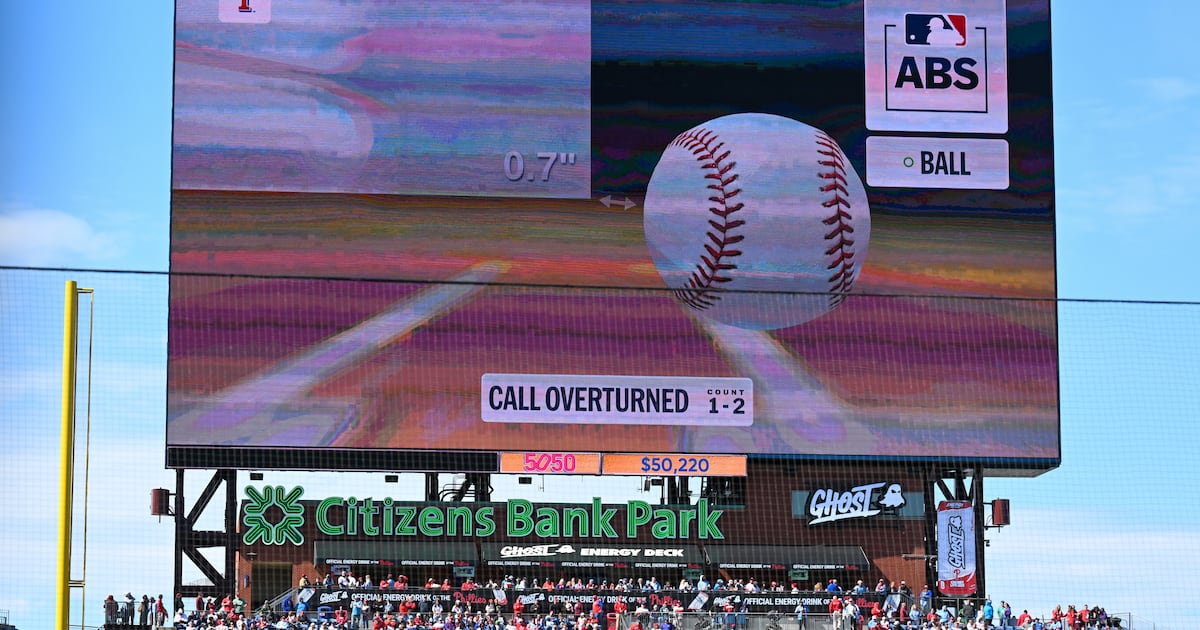
Major League Baseball has implemented the automated ball-strike (ABS) challenge system this season and it has been a huge hit. No pun intended. The players and fans love it.
Here is how it works:
Each team is given two challenges per game. If a player initiates a challenge and the call is overturned, the team keeps its challenge. If the call is confirmed, then the team loses that challenge.
Teams will be given another challenge for each extra inning played if they’re at zero after nine innings. If they have existing challenges remaining, they will not be given another, unless they lose a challenge in extras and exhausted both initial challenges.
Each ballpark has a number of cameras that triangulate the strike zone for each individual hitter based upon their height.
The challenges can only be initiated by the pitcher, catcher or hitter, and must be signalled immediately with a hat or helmet tap. Players are not allowed to get assistance from the dugout.
Once a challenge has been initiated, the umpire announces it and an animated graphic appears on the scoreboard for everyone to see. The umpire then announces the result.
The system has been implemented seamlessly as many players have experienced ABS in the minor leagues over the past several years where it was being tested. The fans get really excited by the anticipation of the unveiling of an animated graphic of the result.
The only ones who don’t love the new system are the umpires. They are getting exposed publicly when they make mistakes. It is embarrassing for the umps and leads to even more heckling.
Umpires are asked to do the impossible, which is to be perfect on calling balls and strikes, on pitches that range from 70 mph to 104 mph. Oh yeah, and the pitches usually move in a significant manner as they come to the plate. To top it off, the umpires don’t know what pitch is coming.
I am a huge fan of the ABS challenge system, because all I have ever wanted is to have what happens on the field to be the actual result. I am completely okay to have a call reversed against my team, if it is the right call. I just never wanted to live with the result of a play or game that went against us because of a mistake.
The optimal time to challenge
Teams have spent the first week of the season trying to figure out their strategy as to when to use the challenges; when during the game is it appropriate to use them; what situations take precedent; and who can initiate the challenge?
The results so far have been interesting. The catchers and pitchers have been more successful at challenging (58 per cent through Tuesday) than hitters (50 per cent). Pitchers have only initiated a total of five challenges, as most teams have recognized that catchers have a better perspective than the pitchers do.
A significant majority of the pitches that have been overturned are those at the bottom of the strike zone or below it. It makes sense as those pitches are the furthest away from the umpires’ line of sight. Those are also the pitches where catchers best at framing can pull a ball up into the strike zone and fool an umpire. Jays’ catcher Alejandro Kirk is one of the best at framing low pitches.
Some teams have been aggressive with challenges while others have not. One of the tougher decisions is what to do when a call is not overturned on a challenge early in the game. When a team only has one remaining challenge and there are several innings left in the game, it becomes unclear when to use the remaining challenge. If it is used too early in the game and is lost, then there could be a situation where it is game critical and there are no challenges left.
There is no one right answer as to how and when to use challenges. I would have my players be aggressive with them early in the game, but only if they are 100 per cent sure the call was egregiously wrong.
If a challenge is lost early in the game, I would save the remaining challenge until the seventh inning or later in a close game. However, if the game is close and we are on the verge of a big inning, then I would become more aggressive with the usage before the seventh. If we are trailing by four or more runs, then I would welcome a more aggressive use of the challenges to try and get back in the game.
I would never let pitchers make challenges. The catchers always have a better perspective and can more reasonably understand the strategy plan of the team than a pitcher who may only be in the game for three batters.
ABS is here to stay
The ABS Challenge System was a compromise between having no automated system and a full robotic system. I don’t anticipate that baseball will transition to a fully automated system. I think there will be a call for more challenges than just the two in the future.
With as many calls that we see are being overturned, it only makes sense to try and correct as many of the wrong calls as possible. Don’t be surprised if teams get three or four challenges per game in the future.
A residual benefit of the ABS system is that it will hold umpires accountable for the quality of their work. The evaluations of the umpires have never been made public, but now their work is front and centre. There is no spinning the number of calls that get overturned by each umpire.
I do think that we should still do all we can to support umpires and help them improve.
One of the changes I would like to see implemented is to have the umpires wear the earpieces that the catcher and pitchers wear for the PitchCom system. That is the system of communication where the catcher signals the pitcher, or vice versa, as to what pitch should be thrown.
I don’t understand why we don’t also let the umpire know what pitch is going to be thrown. It would allow them to anticipate the movement of a pitch rather than reacting in a split second as to whether it’s a ball or strike, while never knowing what pitch is going to be thrown. Ideally, we want the umpires to get as many calls correct as possible. I think this would make a huge difference.
This is another rule change in the game that has dramatically improved the product on the field, as well as the fan experience. And that call can’t be overturned.
Related Stories