
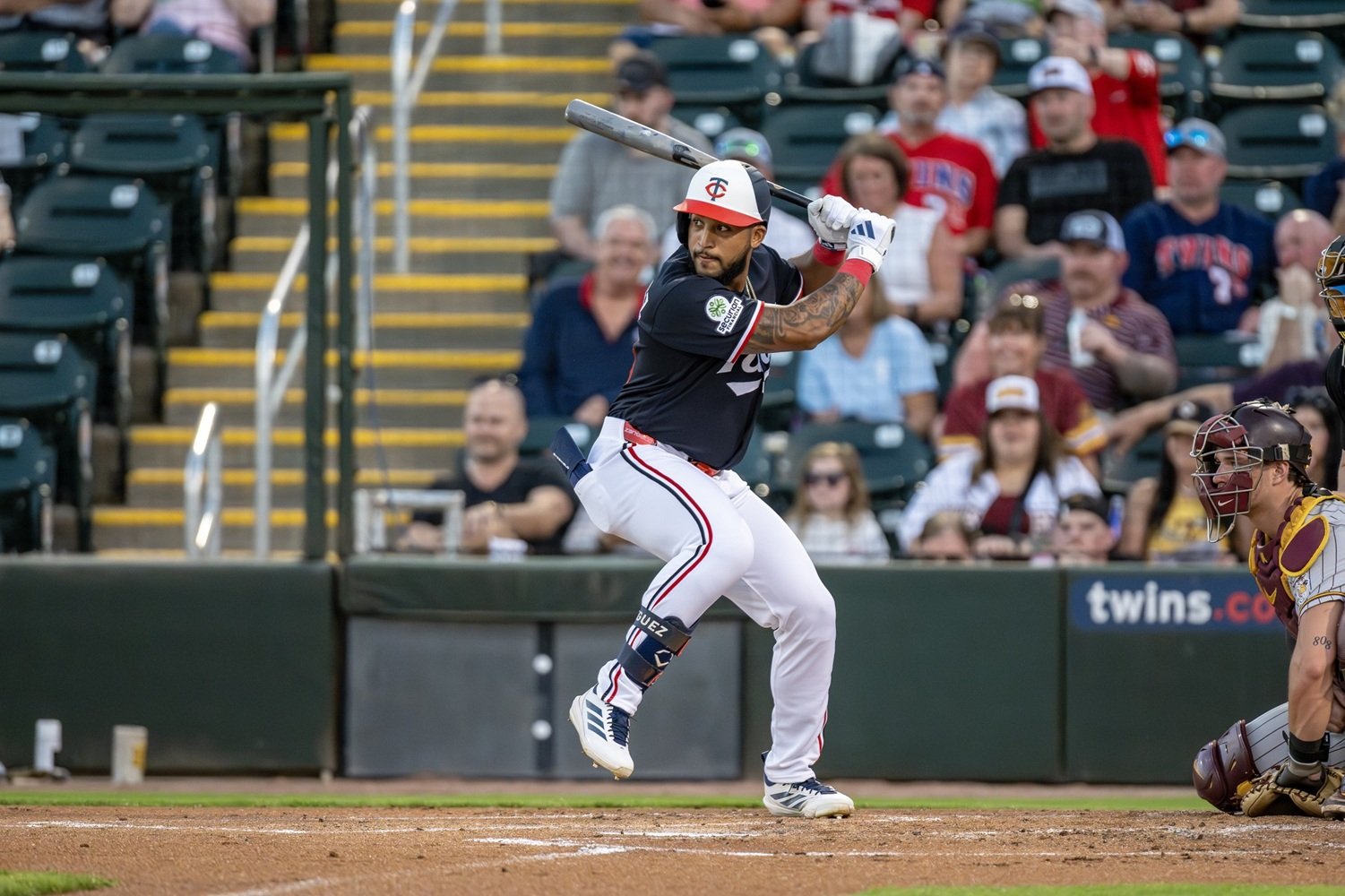
Evaluating power in a prospect is about more than just counting home runs. It’s about projection, bat speed, physicality, and the ability to translate raw strength into game action. It also requires separating raw power from game power. Plenty of hitters can light up batting practice, but the real value comes from how often that strength shows up against live pitching in competitive situations. Approach, swing decisions, and contact quality all play a role in determining whether a player can consistently access that power.
Context matters, as well. Age, level, and environment can all influence how power production looks on the surface. A younger player holding his own against advanced pitching or driving the ball in a pitcher-friendly league can be just as encouraging as eye-popping home run totals in a more favorable setting. For the Twins, that context is especially important, given how many of their top power bats are still developing in the lower minors.
The tools below are graded on the traditional 20-to-80 scouting scale, where 50 represents the big-league average. To qualify for this list, each player appears on MLB Pipeline’s Top 30 Twins prospects.
Honorable Mentions
Kala’i Rosario narrowly misses the cut with a 55-grade power tool and remains one of the more intriguing bats in the system. Kaelen Culpepper and Billy Amick also fall just shy of average game power at this stage, though both have room to grow as they gain experience.
5. IF/OF Brandon Winokur: 60-grade power tool
Winokur’s first taste of full-season baseball over the last two years has been a mix of flashes and growing pains, but the underlying tools remain loud. His combination of strength and athleticism showed up in a big way at High-A Cedar Rapids, where he paired 17 home runs with 26 stolen bases and proved he can impact the game in multiple ways.
The power itself is not in question. It shows up easily in batting practice and in spurts during games. The next step is refining his swing so that the impact becomes more consistent. At times, his bat path has led to weak contact, especially on balls pulled on the ground or softly hit the other way. If he can make the necessary adjustments to find the barrel more often, there is legitimate middle-of-the-order upside here.
4. OF Walker Jenkins: 60-grade power tool
Jenkins entered pro ball with questions about how much power he would ultimately produce, and that debate still exists, depending on the outlet. What has become clear is that his overall offensive profile continues to trend in the right direction.
Despite missing time, he was one of the most productive hitters in the organization last season, posting a 135 wRC+ over a significant sample. His left-handed swing is polished and repeatable, allowing him to consistently square the ball up while maintaining strong plate discipline.
As he has gotten more comfortable, the power has started to show up more frequently, particularly to his pull side. He’s also shown the ability to drive the ball the other way, giving him a well-rounded approach that should translate against advanced pitching. If the power continues to tick up, he has a chance to develop into a true impact bat.
3. C Eduardo Tait: 60-grade power tool
Tait brings an interesting blend of contact ability and raw strength to the plate. He can produce impressive exit velocities and has shown the ability to drive the ball to all fields, though most of his home run damage comes when he turns on pitches.
His aggressive approach is both a strength and a limitation. Tait puts the ball in play at a high rate, but that comes with a tendency to expand the zone and limit his walk totals (7.4 BB%). When he gets a pitch to hit, he can do serious damage, but refining his approach will be key to unlocking more consistent game power.
There is no doubt about the bat speed or the strength. The focus now is on finding a balance between contact and selectivity so that the power can play more regularly in games.
2. IF Quentin Young: 60-grade power tool
Few hitters in the system can match Young’s raw power potential. Some evaluators believed it could reach the top of the scale when he was an amateur, and the Twins are now focused on helping him translate that into game production.
His 6-foot-6 frame creates natural leverage, but it also introduces challenges with swing length and contact. To his credit, Young has already taken steps to simplify things, dedicating significant time to reworking his mechanics. By quieting unnecessary movement and improving his bat path, he’s giving himself a better chance to consistently reach his power potential.
There will probably always be some swing-and-miss in his game, but if the adjustments stick, he has a chance to be one of the more dangerous power hitters in the system.
1. OF Emmanuel Rodriguez: 60-grade power tool
Rodriguez continues to stand out as one of the most electric hitters in the organization. Even with injuries limiting his development time, he reached Triple-A at just 21 years old and continued to produce when he was on the field, including a strong showing in winter ball.
The power comes from elite bat speed and natural strength, allowing him to drive the ball with authority when he connects. He pairs that with an advanced understanding of the strike zone, drawing walks at a high rate (20.6 BB%) and forcing pitchers to challenge him.
The biggest hurdle remains contact consistency. Strikeouts have been a part of his profile (31.8 K%), and missed time has not helped his overall development. Still, the combination of patience and power gives him a chance to profile as a middle-of-the-order hitter if he can make enough contact to maximize his tools.
It’s remarkable how much power exists throughout this system. Three of the five players on this list are still in the lower levels and have significant development ahead of them. Rodriguez and Jenkins, meanwhile, are knocking on the door and could bring that power to Minnesota in the near future.
Power is one of the hardest tools to develop, which makes the Twins’ current pipeline especially encouraging. This is not just a group with raw strength, but one with multiple paths to impact at the big-league level. Some will need mechanical adjustments, others will need to refine their approach, but the foundation is already in place.
If even a couple of these bats reach their ceiling, Minnesota could be looking at a lineup capable of changing games quickly and often.
Other rankings in the series:
Do you agree with the above rankings? Who is too high? Too low? Leave a comment and start the discussion.
Interested in learning more about the Minnesota Twins’ top prospects? Check out our comprehensive top prospects list that includes up-to-date stats, articles and videos about every prospect, scouting reports, and more!