
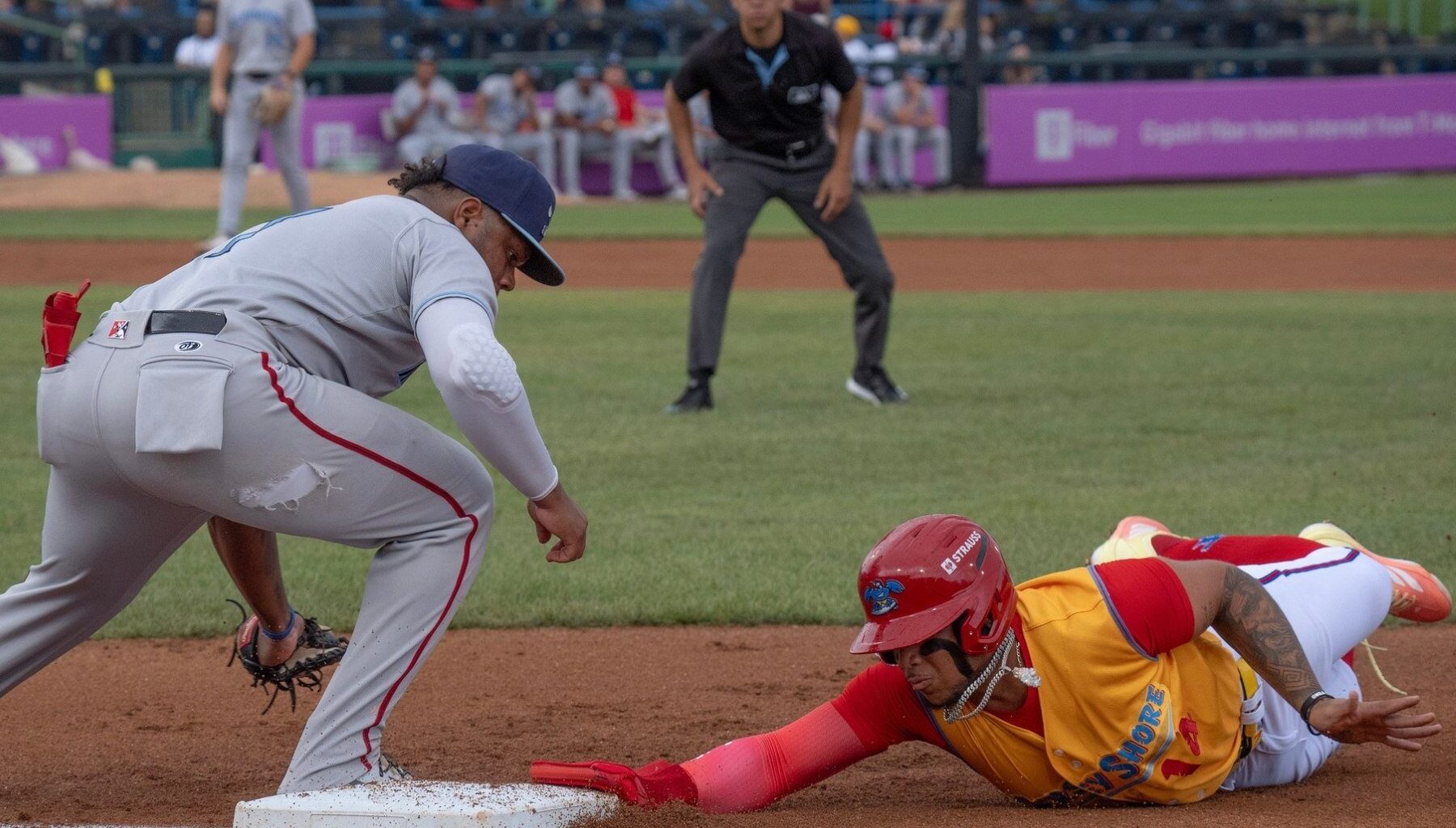
The Minnesota Twins may have found something pretty special behind the plate—not this year, and maybe not even in the next year or two. But when you start looking at the long-term picture, it’s hard not to keep coming back to one name: Eduardo Tait.
Ranked as the Twins’ No. 4 prospect according to Twins Daily, Tait has quickly become one of the most exciting pieces in the organization. Alongside Mick Abel, he was acquired from the Philadelphia Phillies at last summer’s trade deadline in the deal that sent Jhoan Duran the other way. It was a move that raised some eyebrows at the time, but the early returns are giving the Twins plenty of reasons to feel good about it. While he might not be the flashiest catching prospect in baseball, Tait has quietly put together a skillset that checks a lot of boxes.
Let’s start with his bat. Tait isn’t ranked this highly because he projects to hit 35 to 40 home runs at the major-league level; he’s not Cal Raleigh. But that doesn’t mean there isn’t power here. In fact, we saw him rip a ball 112 MPH off the bat in the Twins’ Spring Breakout game against his former team, so his ability to impact the ball is very real.
The interesting part is how his power shows up. Up to this point, it hasn’t come from consistently lifting the ball in the air. Instead, it’s been more about hard contact, line drives, and a hit tool that’s advanced well beyond his years.
That brings us to, arguably, the most impressive part of his profile: his age relative to his performance. Most 18-year-olds are finishing their senior year of high school. Tait, at 18, was hitting .250 at High-A. At first glance, that might not jump off the page. But to put it into context, Marek Houston—the Twins’ first round pick from last summer—hit just .152 at High-A as a 21-year-old after being drafted. That’s a massive difference in both age and production.
Overall, across Low-A and High-A in 2025, Tait slashed .253/.311/.427, with 32 doubles, a triple, and 14 home runs. It’s a well-rounded stat line that reflects exactly what he is right now: a balanced offensive player with room to grow.
If there’s one area to keep an eye on, though, it’s his plate discipline. Tait has extremely strong bat-to-ball skills, and sometimes that can be a double-edged sword. Because he’s so good at making contact, there were some stretches (especially after his promotion to High-A) wherein he expanded the zone more than you’d like to see. In 37 games at that level between the Phillies and Twins organizations, he drew just six walks. That’s a noticeable drop from the 30 walks he posted in 75 games at Low-A.
It’s not uncommon for young hitters to go through that adjustment phase, especially when they know they can put the bat on the ball. But as he continues to develop, becoming more selective and more willing to take pitches will be key. It should also help boost his on-base percentage, which dipped to .286 at High-A.
Defensively, there’s also a lot to like. Tait has a strong arm and a solid presence behind the plate, with MLB Pipeline grading his arm as a 60 on the 20-80 scale. The tools are there for him to develop into a solid defensive catcher, and the foundation is already in place.
That said, there’s still some refinement needed. After posting a respectable 32% caught stealing rate at Low-A, that number dropped to below 10% once he reached High-A. That’s a pretty significant shift, but again, it speaks more to where he is in his development than to any long-term concern.
The arm strength is there, and the frame is there. Now it’s about consistency, mechanics, and continuing to grow into the position. That’s really the theme with Tait, as a whole: there’s a lot to like, and a lot to be optimistic about. But it’s also important to keep everything in perspective; he’s only 19 years old.
Realistically, he’s probably not going to be major league-ready until 2027 or 2028, and even that might be an aggressive timeline. More likely, you’re looking at 2029 before he’s fully established at the big-league level, assuming everything continues trending in the right direction. A lot can change in that time. Prospects develop, some stall out, and others take unexpected leaps. But if Tait keeps progressing the way he has so far, his ceiling is pretty clear.
This is someone who could realistically develop into the Twins’ starting catcher for the next decade or longer once he arrives, and that’s what makes him so interesting. He might not have the headline-grabbing power, but he does a little bit of everything. And at his age, that’s exactly what you want to see. As the season gets underway, he’s absolutely a name worth keeping an eye on. Because the Twins’ catcher of the future may very well be in the system already.
Interested in learning more about the Minnesota Twins’ top prospects? Check out our comprehensive top prospects list that includes up-to-date stats, articles and videos about every prospect, scouting reports, and more!