
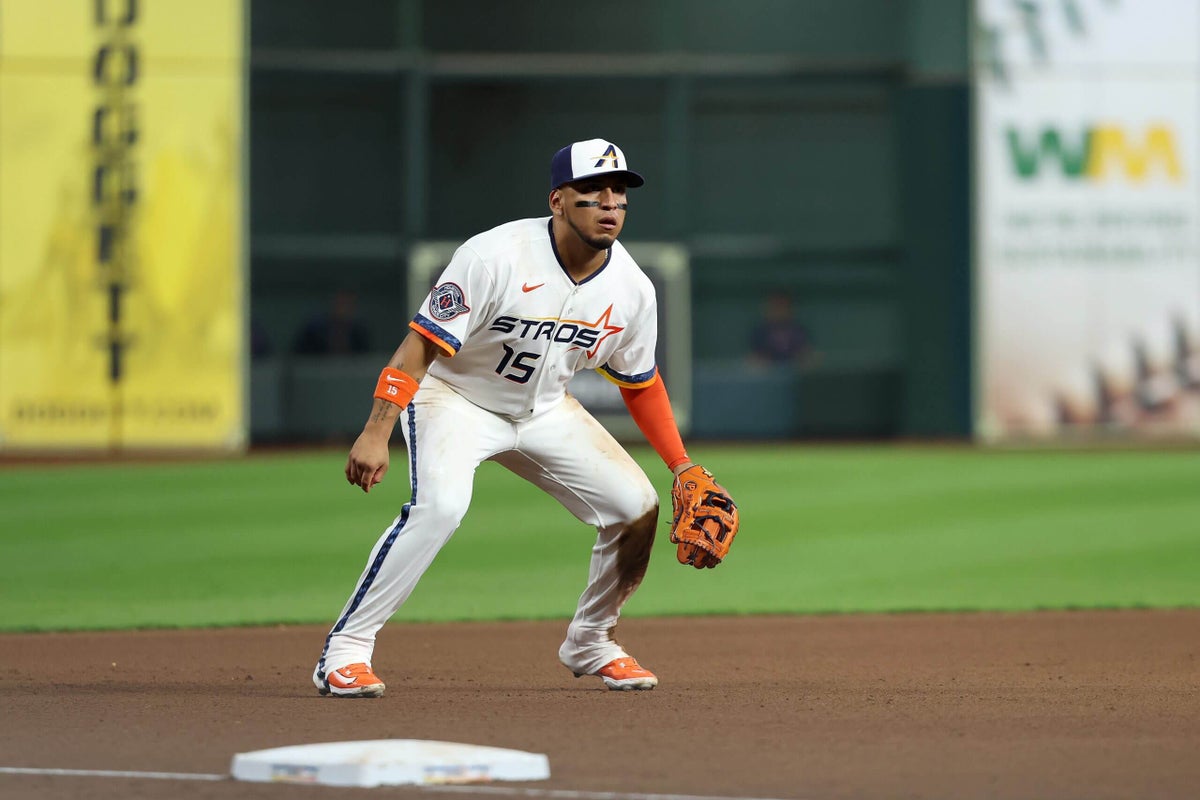
HOUSTON — Carrying Jeremy Peña on the Opening Day roster came under a condition that he continue his spring training-style buildup during the regular season. Peña took just 11 Grapefruit League at-bats before fracturing his right ring finger March 4.
Peña’s finger healed without incident, but the unorthodox nature of his spring training prompted discretion from Houston Astros officials. Peña ramped up quicker than other teammates in preparation for the World Baseball Classic, only to decelerate after the fracture. Scars also linger from last season’s ill-fated attempts to return players from injury.
As a result, Peña started three games and did not play on consecutive days during the Astros’ season-opening, seven-game homestand. That Houston still finished 5-2 is a testament to its infield surplus, which Peña’s sporadic appearances helped to hide.
This weekend, it should return to the forefront. According to manager Joe Espada, Peña will resume playing back-to-back games in Sacramento, Calif., where the Astros will open a 10-game trip Friday night.
Doing so will test Espada’s ability to find enough at-bats for the five infielders on his roster, restarting the debate that dominated discourse this winter and forced the Astros to dangle displaced third baseman Isaac Paredes in trade discussions with other teams.
Though Peña might still receive an occasional off day, he is reprising his role as the Astros’ everyday shortstop, which will squeeze Paredes out of the playing time he enjoyed during the first seven games of the season.
Peña’s buildup allowed Paredes to start six of the Astros’ first seven games at three positions. Four of those appearances came with Peña out of the lineup — Paredes played third base while Carlos Correa shifted to shortstop in Peña’s stead.
During the three games Peña played, Paredes started once at second base, once as Houston’s designated hitter, and he did not play during Tuesday’s 9-2 win against the Boston Red Sox.
Those two positions — second base and designated hitter — are Paredes’ most straightforward path to somewhat regular playing time. Paredes has experience at first base, too, but Christian Walker has started the season too well for Houston to consider a timeshare. Walker doubled five times in the Astros’ first seven games and is averaging a 95.7 mph exit velocity. Only nine hitters entered Thursday with a higher one.
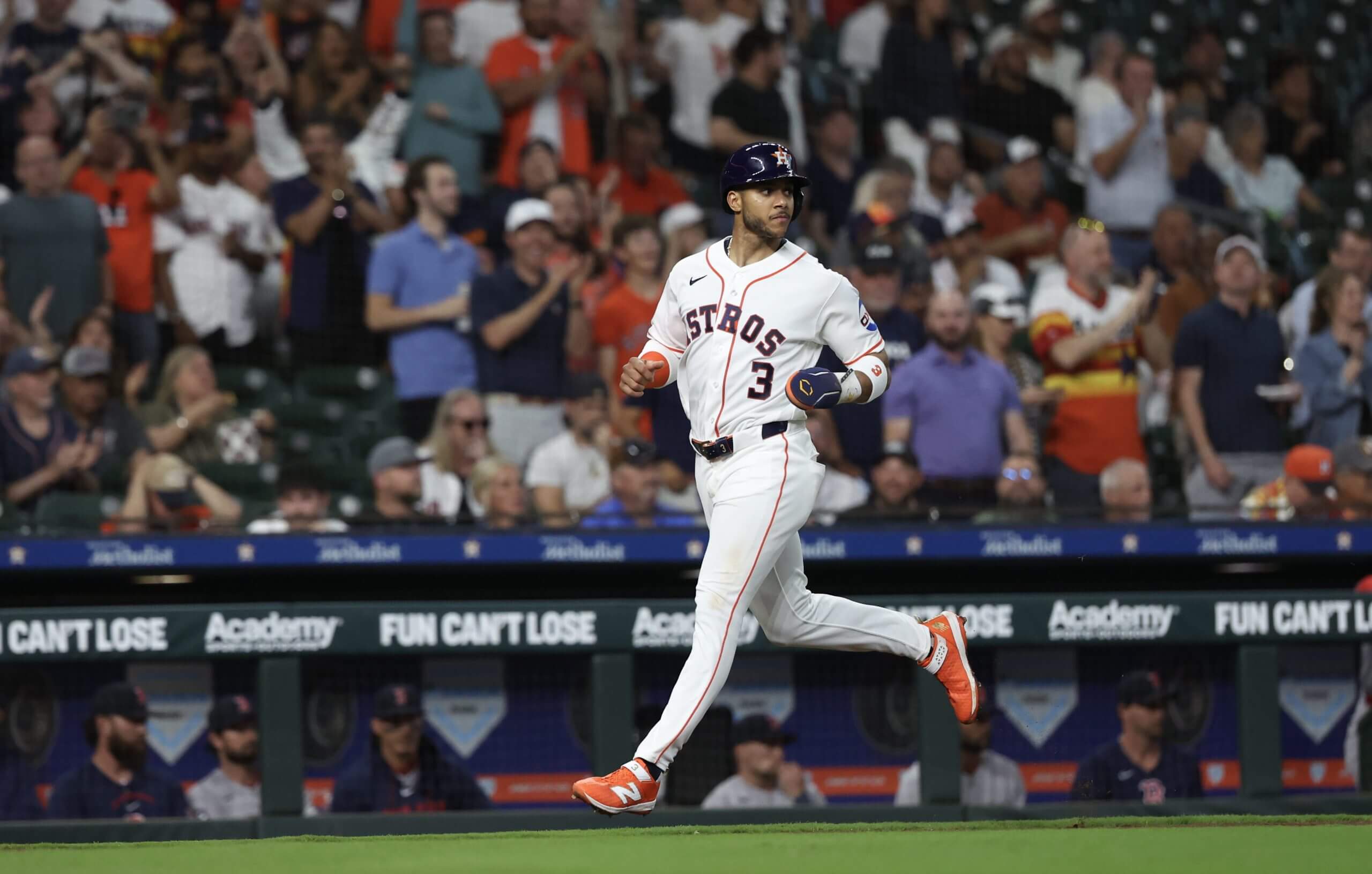
Jeremy Peña will resume playing back-to-back games in Sacramento, Calif., where the Astros will open a 10-game trip Friday night. (Thomas Shea / Imagn Images)
Putting Paredes at either second base or designated hitter would arrive at the expense of Jose Altuve or Yordan Alvarez, the two men who buoyed Houston’s offense during the first homestand. Alvarez has six extra-base hits and six walks in his first 32 plate appearances. Altuve is demonstrating plate discipline seen at few other points of his storied career.
After seven games, Alvarez and Altuve each have an OPS higher than 1.160. Sample size must be taken into account, but regardless of it, these are two franchise cornerstones playing on the two biggest contracts handed out in Jim Crane’s ownership tenure. Barring injury or a dramatic decline in production, neither of them is coming out of the lineup, save for an occasional off day during the course of a long season.
Bear in mind that Altuve — who is pursuing 3,000 hits — said in spring training he hopes to play 150 games.
Constructing a lineup that includes Altuve, Peña, Paredes and Alvarez is possible. Espada did it during the second game of the season, playing Peña at shortstop, Altuve at second base, Paredes at designated hitter and Alvarez in left field.
Using Altuve more at designated hitter would help preserve a player who turns 36 next month while opening a potential path for Paredes to contribute. That it would force Alvarez to play left field would run counter to one of Espada’s most hardline stances.
Whether the skipper is willing to soften it is perhaps the most pertinent question in this predicament. In December, Espada anointed Alvarez as the team’s primary DH and promised to limit his exposure in left field. That he started there just twice during these seven games at Daikin Park, one of the few outfields best suited for Alvarez’s skills, would seem to reinforce Espada’s preference.
Leaving home will only further it. Gone are Daikin Park’s cozy, Crawford Box-aided left-field confines in favor of a 10-game journey through Sacramento, Denver and Seattle. Paredes isn’t picking up an outfield glove, and Altuve is entrenched at second base, delivering a conundrum that Peña’s injury delayed.
The emergence of Brice Matthews and Joey Loperfido as part of a well-functioning left-field platoon has an impact, too. Their production is important, but in a broader sense, both are the type of players Espada has always longed for more of on his roster — athletic, fast and versatile enough to affect the game in myriad ways.
For a club with an aging core and an abundance of entrenched players with limited defensive flexibility, finding ways to inject more athleticism and energy at the few unsettled positions is important. Loperfido and Matthews fulfill that edict. Both could see time in center field, too, as part of a timeshare with incumbent starter Jake Meyers.
Matthews, the right-handed, strong side of Houston’s outfield platoon, should see increased action this weekend against the Athletics, who are scheduled to start two left-handed pitchers in the three-game series. Sutter Health Park has 330-foot dimensions in left field — identical to the Oakland Coliseum.
Alvarez played four career games in left field at the Coliseum. Playing him behind fly-ball specialist Cristian Javier on Friday wouldn’t seem logical, but perhaps Sunday when Lance McCullers Jr. pitches would be a more favorable matchup. Paredes, then, could serve as Houston’s designated hitter.
It’s difficult to envision Espada deploying Alvarez in the outfield during any of the three games at Coors Field, where more athletic options such as Loperfido and Matthews are better options to patrol one of the sport’s most cavernous ballparks.
Alvarez has started nine career games in left field at T-Mobile Park, where the trip will conclude with a crucial four-game series against the defending American League West champion Mariners.
Deploying the most dangerous offensive lineup for every game seems paramount, but it’s worth wondering whether Espada will be able to do so. Playing Alvarez in the outfield for all four games isn’t realistic — and runs counter to Espada’s wishes to protect him from overexposure.
Starting Alvarez in left field twice feels more feasible but forecasts a sobering reality: Paredes as a bench player for half of a meaningful series.
Such is the quandary this surplus presents.