

Good morning from Boston,
So now he’s taking guys out too early?
Craig Stammen can’t win.
His team isn’t winning because it is not hitting.
We will get to that later.
Now, let’s talk about how the Padres’ rookie manager can’t seem to go a game without making a pitching decision that invites scrutiny.
In yesterday’s 5-2 loss to the Red Sox, he went against his previous tendency and pulled Michael King earlier than some thought was prudent given that King had allowed three runs in 5⅔ innings and just got his fifth strikeout with what was just his 81st pitch.
Given that three of the Red Sox’ previous five balls in play had an exit velocity of 107 mph or greater and a left-handed batter was coming to the plate, it could also be argued pretty convincingly that inserting lefty Wandy Peralta was appropriate.
It did not work out. Peralta’s first pitch was hit over the right field wall by Marcelo Mayer to turn a one-run game into a three-run game.
Stammen is quoted in my game story (here) saying the Padres liked the matchup and that the hard contact against King is what precipitated his decision to pull the right-hander.
In the six-game homestand that began the season and his tenure, Stammen arguably stayed with a pitcher too long twice, leaving Jeremiah Estrada in a couple batters beyond his expiration and doing the same with Kyle Hart a few nights later. Some asserted there was a third time — when he had King go out to start the sixth inning in his first start.
As yesterday illustrated, there is no guarantee regardless of what move a manager makes. He has to do what his available information tell him gives his team the best chance to succeed. The rest is up to other humans on the field.
I spoke with Stammen before yesterday’s game about this particular part of his learning on the job.
He knew coming in that his in-game assessment of pitchers was going to be his biggest challenge, given that he was one of them for 12 seasons in the major leagues.
“How I personally feel is ‘Leave me out there. Let me figure this out on my own. I got this. I can do it,’” he said yesterday morning. “And as a manager, you’ve just got to be, you know, the other side of the coin of ‘No. I want you to have success. I think you’ll have better success if I take you out of the game and have somebody else go in.’
“I think that’s my biggest learning curve is just wanting to root for the pitcher so hard that sometimes just leaving him in the game a little bit longer than maybe you should.”
It should be pointed out that Stammen stuck with Randy Randy Vásquez on Saturday against the San Francisco Giants after he surrendered a single and walked a batter with two outs in the sixth inning.
“He proved me right,” Stammen said of Vásquez, who retired the next batter to finish his scoreless outing. “It’s a give and take. It’s learning each pitcher too.”
Stammen had spoken earlier this week about the learning process over his first half-dozen games. He said his bench coach, Randy Knorr, has repeatedly told him to not second-guess himself.
“I found some things that helped me move on from certain decisions that maybe could have went a different way,” he said. “You can always play the second-guessing game. You know, I’m second-guessing myself probably more than anybody. But I think that’s healthy, and it helps me learn and then helps make us better as we go.”
He explained yesterday that in addition to talking with Knorr about decisions, he is spending time essentially journaling.
“The thing that I haven’t ever done in the past that I’m doing now is I’m writing down my thoughts a little bit more,” he said. “I’m just like recapping games, recapping what I think we need to work on a little bit, what we need to be better at — certain plays, and then also my own internal thoughts of like, decision making, how I made those decisions, and what did I learn from them.”
He writes these observations, recollections and self critiques in bullet-point form in a notebook.
“That has helped me,” he said. “When I was a player, I could watch the video, and that flushed me. But it’s hard to watch the entire game. I would just drive myself nuts. And I would spend four more hours. As a pitcher, I could watch an inning pretty quickly, and that flushed it for me. As soon as I watched the game, I was like, ‘All right, I got it. I know what I need to do.’ I’d go do my workout, and then it was over with, go to sleep and be ready to go the next day. I just don’t have that ability to do that now. So writing down has been that kind of like video watching for me.”
Figuring out his comfort level in decision making, how to handle certain situations and even mistakes were to be expected for a guy who had not managed or even coached at any level.
Stammen certainly expected it.
“I did, but I didn’t know how it was going to manifest itself,” he said. “It’s kinda cool. … The biggest thing for me is realizing I don’t have all the answers, and I will continue to not have all the answers, but I will to try to continue to figure them out. It’s the same way it was when I was on the mound — ‘I think I’ve got a plan. Let’s see if the plan works, and if it doesn’t, figure out a new way to make that plan work.’ … I hope I’m saying that 15 years from now, where I can say I’m still learning.”
So about the offense …
My game story focused largely on the lack of offensive production.
The Padres had four hits, the fourth time in seven games they have managed five or fewer. They let a starter complete six innings while allowing three or fewer runs for the fifth time.
Here is where they stand statistically on offense:
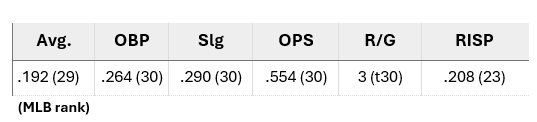
The Padres maintain they have the right approach and are executing well far more often than not.
It is true there have been an abundance of good at-bats with lousy results. That is baseball.
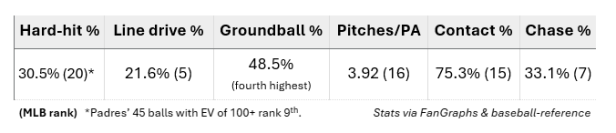
My game story touched on some of the “unlucky” numbers like a batting average on balls in play that is second lowest in MLB and a batting average on hard-hit balls that is 200 points below the MLB average.
“Guys are hitting the ball hard,” Jake Cronenworth said. “It just seems like it’s going right at guys right now, whether it’s those one hop line drives on the infield or line drives right at the outfielders. Making really good swing decisions. Got a good plan. It’s just not going for us right now.”
Here is a look at some of the other underlying numbers, some of which support what the Padres contend:
For whatever reason this is happening, Ramón Laureano is the only player on the Padres with more than five hits. He is the only player with more than one home run, and Jackson Merrill is the only player with one. Lack of slug was a problem (the problem) last season, and it is so far in this one.
The Padres went down in order in six innings yesterday and have sent just three batters to the plate in 24 of the 41 innings in which they have batted. (That total includes three innings in which a double play erased a baserunner.)
Yesterday was the fourth time they have scored two runs. They have scored three twice.
The four hits yesterday were their second fewest in a game this season. They have had more than five hits four times.
This newsletter is a place where you’re going to get perspective and context whether you want it or not. The Padres hit .192 or worse in two separate seven-game spans last season. They scored 21 runs or fewer in four separate spans. They won 90 games.
Almost six
It was apparent by looking at him when Stammen walked out to get him that King was not pleased his day was finished.
But he knew what he needed to have done to stay in the game.
“I threw a couple bad pitches that I wish I executed a little better, and I … could have gone deeper in the game and (allowed) less runs.”
King’s changeup was darting better and he located it better than in his first start. He threw some filthy sweepers.
The Red Sox had two hard hits in the first four innings before four of the final seven batters King faced put the ball in play at 99 mph or harder, including the 109 mph home run that Willson Contreras hit over the Green Monster and onto Lansdowne Street.
King finished the day having allowed seven hits, walking one, striking out five and having been charged with four runs.
“I just threw a middle-middle pitch to Contreras,” he said. “But (the outing) felt better than the line that it ended up being.”
AL King
Yesterday was King’s 21st start against an American League team since he joined the Padres in 2024. That is second most among National League pitchers in that span, behind Logan Webb’s 22, despite King missing half of last season due to injuries.
It was the most earned runs (four) and most hits (seven) he has allowed in any of those starts.
Among the 23 NL starters who have made at least 15 starts vs. the AL since the start of ’24, King’s 2.47 ERA trails only Paul Skenes (1.64) and Andrew Abbott (2.47), and his .200 opponents’ AVG trails only Skenes (.190) and Freddy Peralta (.193).
Altered Crone Zone
Cronenworth topped himself.
We talked in Tuesday’s newsletter about his fantastic sliding play on a grounder, which might have been the finest of his career.
The double play he started yesterday might have been better, as he dove to his right and reached back to snare a one-hopper behind second base, raced to beat a runner to the bag and threw to first in time to end the fifth inning.
Don’t they know they can’t hit it to the Crone Zone? pic.twitter.com/ft2BNtrWXK
— San Diego Padres (@Padres) April 3, 2026
“I mean, it was just incredible,” King said. “… I thought it was for sure just a single up the middle. And then Jake came out of nowhere and made it a double play.”
Cronenworth doesn’t attribute his gems to coincidence. He instead credits an alteration in his ready position made by new infield coach Ryan Goins.
“I feel like a lot of it is changes in my prep step on the infield and kind of my setup and just allowing me to have a little better of a first step,” Cronenworth said. “I feel like I’ve noticed it here in the first seven games.”
A look at last season shows Cronenworth’s ready position being a more traditional hunched over and on his toes. This year, he is standing up with his arms down before a quick crouch as the pitcher begins his delivery and a small hop into motion as the ball gets to the plate.
“It probably looks like I’m in a much less athletic position, but I’m in a much more athletic position,” Cronenworth said. “… This has been comfortable, and I guess it keeps me more relaxed and not so, just like, tense.”
It isn’t just Cronenworth who has made a noticeable change.
“It’s something I saw with all of the guys,” Goins said. “They were just very stuck, I guess you would say. They were all, like, just super wide and just kind of bent down. I’ve tried to get them more engaged, where they’re walking around more. The biggest thing we talked about was we have to have downward momentum as the ball is being hit. You don’t want it too early. Right when the ball is being hit, you should be in the air, so that once the ball is actually put into play and it’s heading in your direction, you’re springing off the ground. All the guys were kind of the same. They’ve all added, like, the hop, just to be, you know, more ready, more explosive.
“Maybe (Cronenworth) is getting better jumps because of it. You’re more engaged. If you just sit there and, it’s just like, get ready, stand up, get ready, stand up, you just don’t move. … That hop does get you more engagement. They’re like, “I know I hit the ground and I should be moving.’ Once you hit the ground, you should be moving somewhere.”
Goins introduced the new ready position to Cronenworth when visiting him for a few days of infield work inside a gym in Chicago this winter. But that was not the first time they met.
They played against each other in the International League, and here is a photo from the 2019 Triple-A All-Star game in El Paso with second baseman Ryan Goins of the Charlotte Knights catching a pop-up as shortstop Jake Cronenworth of the Durham Bulls watches:
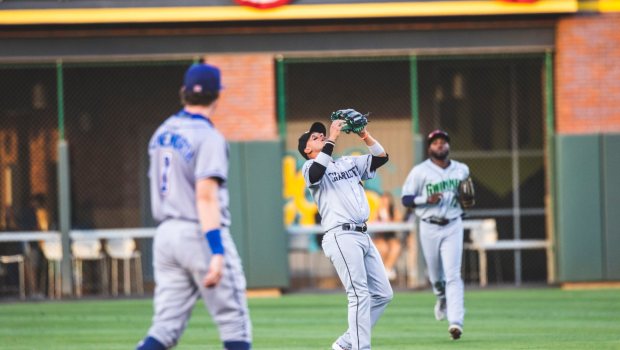 (Courtesy El Paso Chihuahuas)
Willson pimping
Contreras hit one home run but had two bat flips yesterday.
The first came after he walked in the second inning.
Willson Contreras was so confident in his ABS challenge that he flipped his bat and started walking down to first base 😭 pic.twitter.com/dW5khqeWrB
— js9innings (@js9inningsmedia) April 3, 2026
And that wasn’t even close to his biggest flex after the walk.
What turned out to be ball four was initially called strike three. Contreras had already taken a few steps toward first base and barely broke stride as he looked back at home plate umpire Chris Segal and tapped his helmet.
By the time he reached first, the ABS review had shown the pitch was 0.6 inches outside the strike zone. At that, Contreras flipped his elbow guard and forearm guard about 40 feet toward the Red Sox dugout.
Contreras had been riled up by the second-to-last pitch of the plate appearance, a 94 mph sinker up and in that buzzed in front of his face as he spun backward out of the box.
“On the challenge I was 100 percent sure it was a ball, for sure,” Contreras said. “That was my reaction. I didn’t try to show up the umpire or anything like that. But I took the homer personally because in the first at-bat, he threw one — I know it got away from him, because it was close to my face. I was like ‘Hmmm, if I hit a homer on this one, it’s going to be big vibes.”
Back in Boston
Our notebook (here) from yesterday’s game was about Fernando Tatis Jr. almost catching Mayer’s home run, Luis Campusano’s first hit of the season and the reception Xander Bogaerts got in his return to Boston.
I wrote on the off day (here) about Bogaerts playing at Fenway Park for the first time since leaving the Red Sox after the 2022 season. (Yes, it was his second time back but his first time playing.) In my off-day story, Bogaerts had some interesting things to say about expectations in San Diego, comparing them with those of Red Sox fans.
Tidbits
The Padres are three games below .500 for the first time since being 37-40 on June 18, 2024. They went 56-29 the rest of the way to finish that season with 93 wins.
Jeff Sanders, who was kind enough to come on the road for this series, not only helped with the notebook but also wrote (here) about the big game by Mayer, who graduated from Eastlake High.
Gavin Sheets went 2-for-3 for the second straight game and is 5-for-7 since beginning the season 0-for-13. He also stole a base, which puts him halfway to matching his career high.
Laureano (0-for-4) did not reach base for the first time in his six games this season. He still leads the Padres with a .318 average (7-for-22).
Miguel Andujar’s fly ball that center fielder Cedanne Rafaela lost in the sun was the Padres’ first triple of the season.
Infielder Sung-Mun Song is eligible to return for the start of the series in Pittsburgh on Monday, but indications are that he will remain in Triple-A for a while to get more at-bats. Song missed the majority of spring training with an oblique strain.
Reliever Jason Adam, in the final stages of his comeback from September’s quad tendon surgery, might join the team on Wednesday in Pittsburgh. If not, the plan is for him to be activated Thursday at the start of the team’s six-game homestand.
At two hours, 19 minutes, yesterday’s game was tied for shortest of the season.
All right, that’s it for me.
Early-ish game today (1:10 p.m. PT). Talk to you tomorrow.