

SAN FRANCISCO — When it comes to base running, Matt Chapman is an exemplar of effort and efficiency.
It might not stand out to watch him play for a game or a series. But follow him for a season and you’ll lose count of how many times he stretches a single into an opportunistic double, how many flawless reads off the bat result in a run scored from second base and how many times he turns a pitcher’s briefest blip of distraction into a steal. Even better, Chapman is near perfect at calibrating those aggressive, green-light decisions within the context of the game.
So the ninth inning Sunday qualified as a flat-out brain breaker. The Giants were down three runs to the New York Mets. Chapman hit a leadoff single. Then, with the heart of the order coming up, and Rafael Devers at the plate, Chapman inexplicably tried to steal second base. He was thrown out.
It was the kind of bad base-running decision that gets a player benched in a Pony League game. For Chapman to make the mistake? It was like watching Ada Lovelace struggle with long division.
Chapman’s poor gamble wasn’t the most pivotal play in the Giants’ 5-2 loss on the shores of McCovey Cove, which included Tony Vitello’s first ejection as a major-league manager. Given the scoreboard, though, it was the least justifiable act of the afternoon. And it might have been the most emblematic moment for a group that continues to make fundamental flubs, give away outs and struggle to sustain scoring rallies.
The Giants became the first National League team to seven losses, and although 10 games is not a representative sample, there’s never a good time in a season for a team’s most reliable veterans to play sloppily or make decisions on tilt.
The Giants’ principal issue, of course, is a lineup that has averaged a major-league-worst 2.6 runs per game. If only the offense were the lone concern …
“I don’t think there’s any magic solution, but the one thing about getting good results, it covers up mistakes,” Vitello said. “And when you’re not playing well, everybody notices everything — fans, media, players, families, coaches — you start to notice every little thing. So at least now it becomes a talking point. And the wise thing, in my opinion, is to pick out the things you know you can eliminate, because you can control them, and eliminate them, because they’re clearly not working.”
What has disappointed Vitello most about the Giants’ play through 10 games?
“You can pull them out case by case … but where there’s smoke, there’s fire,” Vitello said. “And there’s too much of it.”
The first fiery eruption of Mount Vitello hardly calmed the waters in the seventh inning when he argued an umpire’s interpretation of an esoteric base-running rule. If you’re assuming Vitello was using the umpiring crew as a proxy for his frustration, since 10 games is probably too soon for a rookie skipper to air out a room full of major-league veterans, then you’d be missing one important bit of context. When third-base umpire David Rackley gave Vitello the heave, the Giants weren’t careening toward a series loss. They were leading 2-1 behind Logan Webb at the time.
That’s hardly the ideal time for a manager to draw an ejection, isn’t it?
After the game, Vitello didn’t even contend that plate umpire Edwin Jiménez made the wrong call when he ruled that Jerar Encarnacion, by running on the grass up the first-base line, impeded a throw from Mets pitcher Huascar Brazobán. Vitello said the play merely triggered him because he lost two games in college — one at the University of Tennessee, and the Big 12 championship as an assistant coach at the University of Missouri — because of similar rulings.
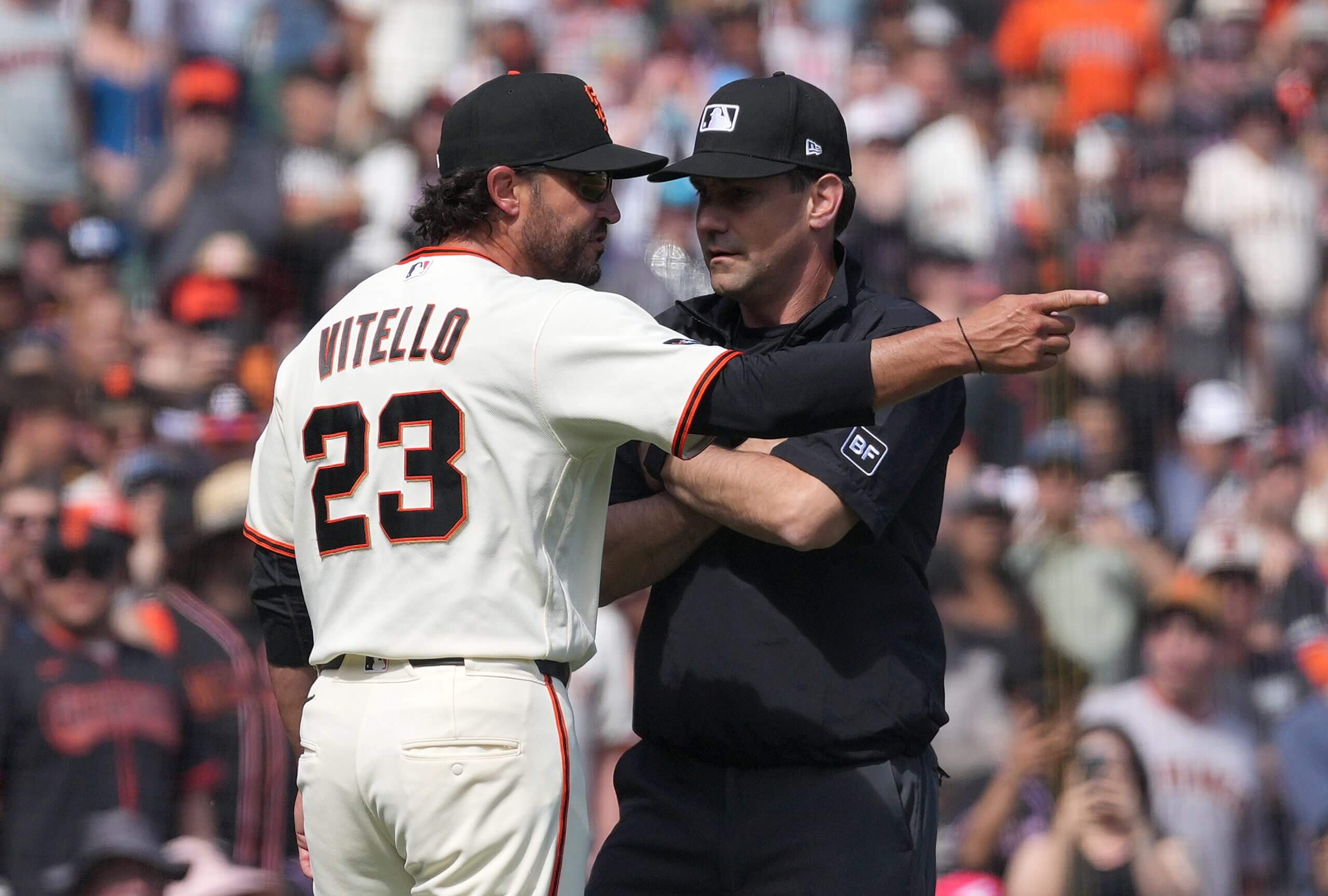
Tony Vitello drew the first ejection of his major-league career, and he said the source of his frustration dates to two games he was involved in when he coached college baseball. (Thearon W. Henderson / Getty Images)
“I’m sure he got it exactly technically right,” said Vitello, who might have taken issue with the fact the throw, which didn’t hit Encarnacion, glanced off the glove of Mets first baseman Mark Vientos. “It’s just a play I’ve got a lot of history for. … Lost a game to Lipscomb on that play, lost the game to (Oklahoma State coach) Frank Anderson and a Big 12 championship on that play. The difference between the two that I’m talking about, and I can talk about others, is the runner. In Frank’s instance — and I’ve called his team cheaters — (the runner) completely interfered with the throwing lane for the pitcher. So again, umpires are held accountable by what the rules are, and they enforce those rules.
“And again, I don’t want to replay. I’m sure they did it 100 percent to the tee, but you know, from my perspective, for plays between the mound and the third-base line, you know, the runner’s not going to have much to do with it.
“I said one last thing, just out of frustration or being all fired up. It was complete nonsense. I think it was misinterpreted a little bit, but (if) you’re on the field that long and you’re not a player, you’re probably out of place a little bit.”
Vitello said when Encarnacion was called out, he was already upset about something he did not disclose that happened earlier in the game. (It could have been the extended argument from Mets manager Carlos Mendoza on a checked-swing call in the top of the seventh, which forced Webb to cool his heels on the mound. It also might have been Encarnacion’s base-running mistake in the fifth inning, when he hit a drive off the base of the left-field wall but wasn’t watching first-base coach Shane Robinson, then slowed around the bag before he was thrown out at second base.)
Vitello also said the batter interference call bothered him because it deprived him of an opportunity to deploy his lightly used bench and send in pinch runner Jared Oliva.
“In my mind, we lost a double there,” Vitello said.
While Vitello was banished to his office, the Giants lost a lot more than that.
Vitello was changing into workout clothes in his office in the eighth inning and acknowledged he wasn’t paying attention to every pitch when the Mets combined enough flared contact with at least two critical mistakes.
Shortstop Willy Adames wasn’t in good position to receive a throw from right fielder Jung Hoo Lee that beat Jorge Polanco to second base. Adames missed his lunging attempt to tag Polanco, giving the Mets a one-out double instead of a momentum-turning second out with the bases empty. Luis Robert Jr. singled, and after Giants bench coach Jayce Tingler replaced Keaton Winn with left-hander Erik Miller, the Mets countered with right-handed-hitting backup catcher Luis Torrens, who flared a two-run double down the right-field line.
The Mets led 3-2, but another mistake helped them add two more runs. Vientos hit a hard grounder down the third-base line and Chapman made a diving stop, but yet another first baseman struggled to complete the connection. This time it was Devers, making his first start of the season at first base, who failed to pick Chapman’s short-hopped throw as a run scored. Vientos took second base and scored when Marcus Semien followed with a double.
Perhaps the most troubling part of the Giants’ poor fundamental play is that the mistakes aren’t coming from rookies or fringe players. Chapman, Adames and Devers form the core of this team and the heart of the lineup. And it’s not as if they’re coming close to outhitting their mistakes, either. Patrick Bailey got dinged for a catcher’s interference call, too.
“We’re definitely not playing our best baseball right now. We know that,” said Webb, who rebounded from his first two laboring efforts while recording 14 groundball outs in seven innings. “It’s something we’ve got to be better at. … We’re 10 games in. Obviously I’m not making any excuses or saying that it’s OK that we’re playing this way. But it starts with me. I have not pitched well at all, and there’s 152 games left in the season.
“So I think before anyone hits the panic button, you’ve just got to take a deep breath. We’ve played some good teams. Just go out there tomorrow and try to compete. That’s it.”
Webb said his focus leading up to Sunday’s start was to “find a rhythm, get back to what I do well. Not trying to overcomplicate things and let the infielders do the work.”
With the assumption, of course, that the work will get done.
As for Chapman’s thought process in the ninth? Both he and Adames had left the clubhouse within 25 minutes of the final out, when reporters were allowed to enter. That’s a hasty exit even when you consider it was Easter Sunday. Vitello said he didn’t know what Chapman was thinking, either.
“I didn’t even ask,” Vitello said. “When you’re in the moment of competing, maybe things are seen differently than if you’re in the dugout. But yeah, it’d be nice to get a second base runner on in that situation.”