
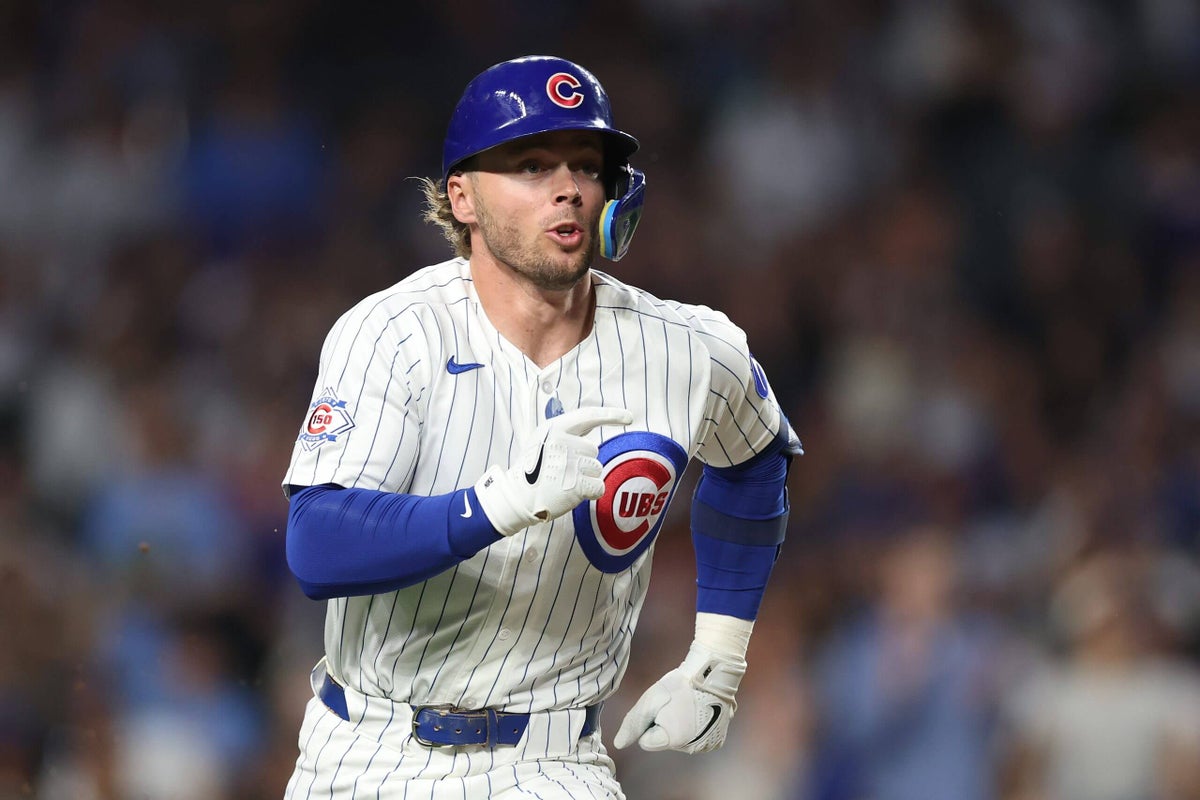
CLEVELAND — The contract would have been unthinkable 10 years ago. Even now, just over a week after becoming official, it remains surprising, bordering on staggering.
Second baseman Nico Hoerner’s six-year, $141 million extension with the Chicago Cubs reflects something of a perfect storm. But in the context of today’s game, with its advanced metrics and adjusted rules that boosted the value of all-around players, it also makes perfect sense.
“It’s hard to put into words how deserving he is,” said Hoerner’s double-play partner, Cubs shortstop Dansby Swanson.
Strong words, considering that Hoerner has hit only 36 career home runs, no more than 10 in a season and just seven in each of the last two years. But Hoerner, who turns 29 next month, is a top defender and base runner, and some with the Cubs believe he still might evolve into more than a slightly above-average hitter.
Still, $141 million, or even a reported $137.5 million in net present value when accounting for deferrals? The fourth-largest guarantee for a second baseman, behind only Robinson Canó ($240 million), Marcus Semien ($175 million) and Jose Altuve ($163.5 million)?
Here’s why it made sense:
Defense
“This is where you have to say data has helped us,” Cubs manager Craig Counsell said. “We’re better at agreeing on who the best defenders are. And I think the whole industry agrees how valuable defense is.”
Defensive metrics still are not perfect, and probably never will be. But the public numbers generally are revealing, and teams use their own proprietary measures that presumably are even more granular — and necessary. The banning of shifts before the 2023 season only enhanced the value of accomplished defenders at up-the-middle positions.
The Cubs, dating back to their signing of outfielder Jason Heyward to a $184 million free-agent deal in Dec. 2015, have placed considerable emphasis on defense. Their four biggest current contracts — Swanson at $177 million, third baseman Alex Bregman at $175 million, Hoerner and center fielder Pete Crow-Armstrong at $115 million — all belong to defenders who are either above-average or elite.
Crow-Armstrong led all players last season in Statcast’s Outs Above Average. Hoerner ranked 12th, and from 2021 to 2025 was fourth overall behind Cincinnati Reds third baseman Ke’Bryan Hayes, Toronto Blue Jays shortstop Andrés Giménez and Swanson.
He is not defined by his slugging percentage.
“I still want to improve. I want to add to my game. I want to be the best version of myself,” Hoerner said at the news conference announcing his extension.
“But I’m also proud that my game in a lot of ways hasn’t changed that much since I was in high school and in college. You’re always improving around the edges, but I feel like I’ve stayed pretty true to myself. And I’m really grateful that’s valued in this game.”
The Cubs’ ledger sheet
Cubs ownership rightly deserves credit for signing Bregman, Crow-Armstrong and Hoerner to nine-figure contracts within a three-month span. Yet, with so many other Cubs eligible for free agency after this season, it’s not like management had much choice.
The Cubs had to spend on someone.
Before agreeing with Bregman in mid-January, the team’s future commitments — $39 million in 2027, $30 million in 2028 and $26 million in 2029 — were in the same range as the notoriously thrifty Cleveland Guardians.
The Cubs’ potential free agents still include left fielder Ian Happ, right fielder Seiya Suzuki and catcher Carson Kelly, plus right-hander Jameson Taillon and left-handers Matthew Boyd and Shota Imanaga.
Hoerner is the youngest of that group and projects the best.
The 2026-27 free-agent class
For all the talk of what Detroit Tigers left-hander Tarik Skubal might command on the next open market, the group overall is weak. Hoerner would have been among the best position players available, if not the best.
Now that Hoerner is off the market, third baseman Bo Bichette likely will be the top hitter if he opts out of his deal with the New York Mets. Jazz Chisholm Jr., the New York Yankees’ second baseman, also should do well if he matches or exceeds his 30-homer, 30 stolen-base season from a year ago.
Hoerner provides value in different ways than Bichette and Chisholm. But judging from Wins Above Replacement, which incorporates a player’s offense, defense and base running, he is at least comparable to them, and arguably superior. In fact, Hoerner leads the 2018 draft class, a group that included Skubal and Seattle Mariners catcher Cal Raleigh, in both fWAR and bWAR. This, after going 24th to the Cubs.
WAR is an estimate, not an end-all, be-all. But it often is a strong indicator of how players will be paid. From 2021 to ‘25, Hoerner was healthier than Bichette, more consistent than Chisholm. And, unlike those two, he is capable of playing above-average shortstop, which likely would have caused his value to soar on the open market.
The collective bargaining agreement
Remember what happened in the final days before the last CBA expired on Dec. 1, 2021? The free-agent market erupted, and a number of position players, including Corey Seager ($325 million), Semien ($175 million) and Javier Báez ($140 million), agreed to massive deals.
If anything, the environment this time might be even more frenzied. Big-market teams such as the Los Angeles Dodgers and New York Mets are carrying markedly higher payrolls than they were then. And the final days of the CBA might represent the last chance for those teams and others to make major investments. Greater restrictions on spending are almost certain to be part of the next agreement, either through a salary cap or stiffer luxury-tax penalties.
The Mets, with Semien under contract through 2028 and shortstop Francisco Lindor through 2031, probably would not have been in play for Hoerner. The Dodgers, on the other hand, have long coveted him. And with Miguel Rojas retiring at the end of the season, their future at second base is unclear.
Considering the short-term, high-AAV plunge the Dodgers took last offseason with free-agent outfielder Kyle Tucker, who’s to say they might not have tried the same with Hoerner, paying him for four years close to what the Cubs ended up giving him for six?
Makeup
To Swanson and the Cubs, Hoerner’s value stems not just from his performance, but also his personality. It’s rare, Swanson said, for players who work so diligently on their individual skills to also show complete devotion to the team.
Hoerner does both.
“The guy’s the best,” said Swanson, who joined the Cubs on a seven-year contract before the 2023 season. “My appreciation for him has grown. Not that it was ever not high. But every day, it just grows more.”
At the news conference announcing Hoerner’s extension, Cubs president of baseball operations Jed Hoyer spoke of how his lieutenants kept saying before the 2018 draft that Hoerner was, ‘Our kind of player,’ ‘Needs to be a Cub,’ ‘Plays like a Cub.’”
Hoerner fulfilled those expectations. The market conditions worked in his favor. Players today are valued differently than in the past. The Cubs couldn’t let him get away.