
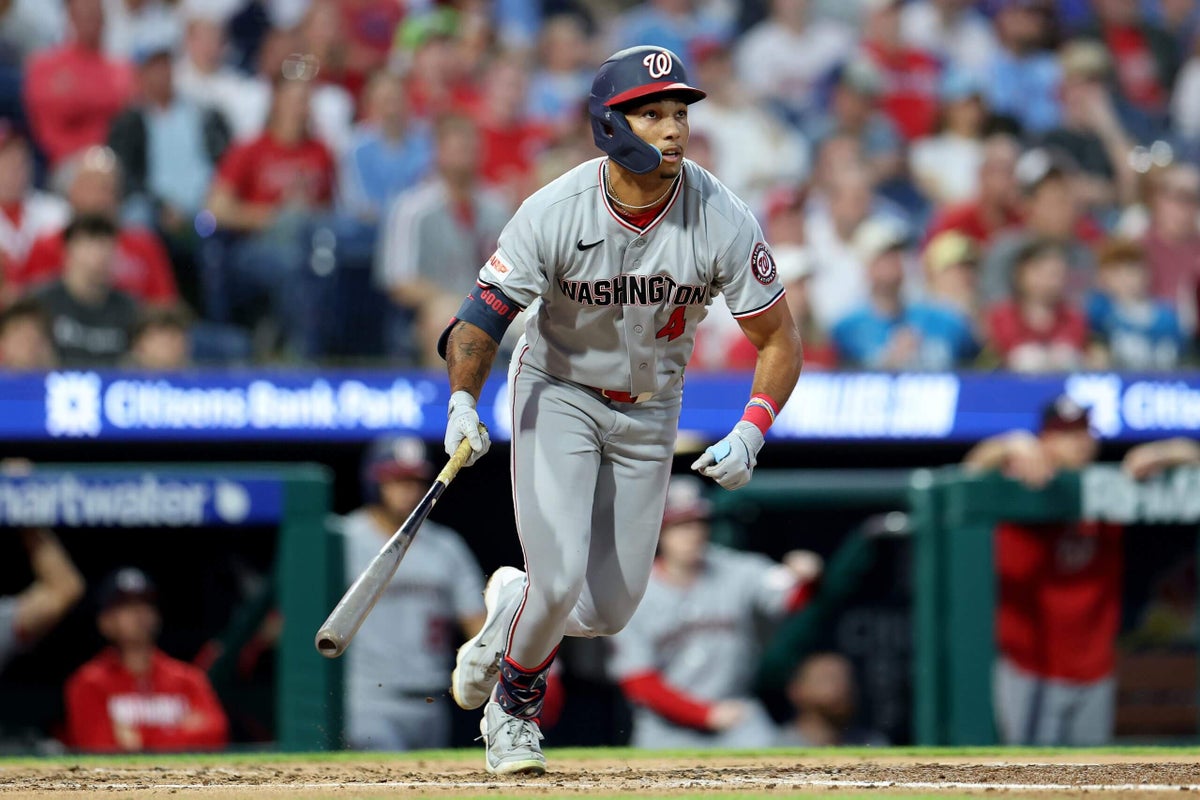
As he will be during the first game of every Nationals series this season, Nationals beat writer Spencer Nusbaum will watch the game alongside fans starting around first pitch at 6:45 p.m. ET on Monday.
The Washington Nationals are as clear-eyed about their philosophy as they are about their budget. To build a scouting and player development monster, they invested in new tech and more coaches. To save money elsewhere, they trimmed payroll to $97 million. To create a sustainable winner and give ownership the best bang for their buck, they are thinking long term.
Which, of course, brings us to the one budgetary item that neither fits into that philosophy nor explicitly falls outside it. We’re talking about contract extensions.
These multiyear extensions — popular as of late, with 14 signed in the past eight months — are small enough on the front end to attract teams like the Athletics and significant enough on the back end to involve teams like the Chicago Cubs and Boston Red Sox.
In Washington’s case, an extension would require a young player who has produced reliably, believes in the young core around him and is represented by an agency with a track record of signing these extensions.
Daylen Lile checks those boxes. The outfielder debuted last May and finished fifth in National League rookie of the year voting. Even with poor defensive metrics, he is athletic and intelligent enough to suggest he will improve. Evaluators inside and outside the organization believe in the bat. He has rewarded their faith thus far, hitting .303 with an .839 OPS in 99 career games entering Sunday.
And yet, a source familiar with the situation told The Athletic that the Nationals have yet to broach Lile with an extension offer.
“Right now, all I can do is just keep doing what I’m doing,” Lile said when asked about extensions. “Just keep staying consistent as possible, and whatever happens, happens.”
Should the Nationals’ early inaction come as some massive surprise? Probably not. Extension conversations usually begin when an executive group and a player are intimately familiar with one another. President of baseball operations Paul Toboni has been in Washington for six months. This spring, Toboni told The Athletic that he and ownership had not engaged in serious conversations with regards to extensions or long-term deals.
“It just very much has to align with where you’re at from a competitive standpoint; and also what you envision your payroll to be in future years; then also, there has to be a desire on the players’ end to want to be here; then there has to be a desire on the players’ representatives ends to want to be here,” Toboni said. “What I have found is that when it’s worked, there is this sentiment from the team’s end, like, ‘Hey, if you’re willing to do this, wanting to do this, then awesome. If you’re not? Also awesome. We’re more than happy with you being part of the organization for whatever the rest of your term and control is.’”
There is plenty of precedent, however, to suggest that Washington could engage in these conversations.
Since 2024, no team has signed more players to a multiyear extension than Toboni’s old club, the Boston Red Sox. Those extensions included a prospect who had not yet debuted (Kristian Campbell), an emerging star in his rookie season (Roman Anthony) and a player who was one year away from free agency (Garrett Crochet).
On the other side, you’ll find Lile’s agency, Beverly Hills Sports Council, which has been a major player in the extension world as of late. Over the past couple of years, they’ve inked a handful of young players to extensions before they even debuted in the majors, including the aforementioned Campbell and Milwaukee Brewers outfielder Jackson Chourio.
A representative for the agency said they are always open to engaging with teams in extension conversations. Additionally, he said, they spend a lot of time educating their players — Lile included — on what their value could be and how various types of extensions line up with that.
While Washington has mostly steered clear of long-term investments since the start of the rebuild, most young players who sign an extension remain relatively inexpensive in the first few years of the deal.
In Lile’s case, this could be a deal that buys out his arbitration years — the years where his contract would start to creep up in cost without becoming unwieldy — and his first couple of years of free agency.
These deals have been particularly popular as of late, due in part to a potential work stoppage looming this offseason. Players sign extensions to secure life-changing money at the expense of some upside. Teams extend players they believe will outperform their contracts. And ownership groups crave cost certainty, with the collective bargaining agreement up on Dec. 1.
The Nationals last handed out an extension in 2023, when they signed catcher Keibert Ruiz to an eight-year, $50 million deal with two club options. The ownership group has also given significant extensions to Stephen Strasburg, Ryan Zimmerman (twice) and Gio Gonzalez.
To ownership, an extension could prove cost-effective. To their fan base and the Nationals clubhouse, it could show a willingness to invest in the big-league club, and a player who they believe is as committed to winning as anyone in the organization. That is, of course, if they believe in the talent and the evaluation. A lot has to line up.
But if it did — what would a comparative deal look like?
One potential framework for the deal, The Athletic’s Tim Britton believed, could be a slightly tamer version of the extension the Athletics gave outfielder Lawrence Butler last year. Butler signed a seven-year, $65.5 million deal that covered his arbitration years and bought his first two years of free agency. Butler had produced a three-win season by that time; Lile has been worth 1.6 wins above replacement in 99 big-league games.
For the Nationals and Lile, a seven-year, $55 million deal could potentially work. That deal would cover the first two years of Lile’s free agency at about $35 million total (or $17.5 million per year) with a $20 million club option at the end. These figures could change in Lile’s favor if Lile qualifies for SuperTwo status.
This, of course, is just one estimate. If the Nationals want more control, they could alter the number of option years. If Lile’s side would get spooked by something of the sort — it would potentially make him wait longer to reach free agency — that could alter the calculation.
Butler, again, is simply one example. He signed his deal at one year of service time; Lile’s extension could start whenever the sides agree upon it. Perhaps Tyler Soderstrom (seven years, $86 million, though Lile hasn’t had a full season like Soderstrom’s 2025) or a handful of recent pre-debut extensions have moved the market.
But that feels like a reasonable place to start, if they decide to engage.