
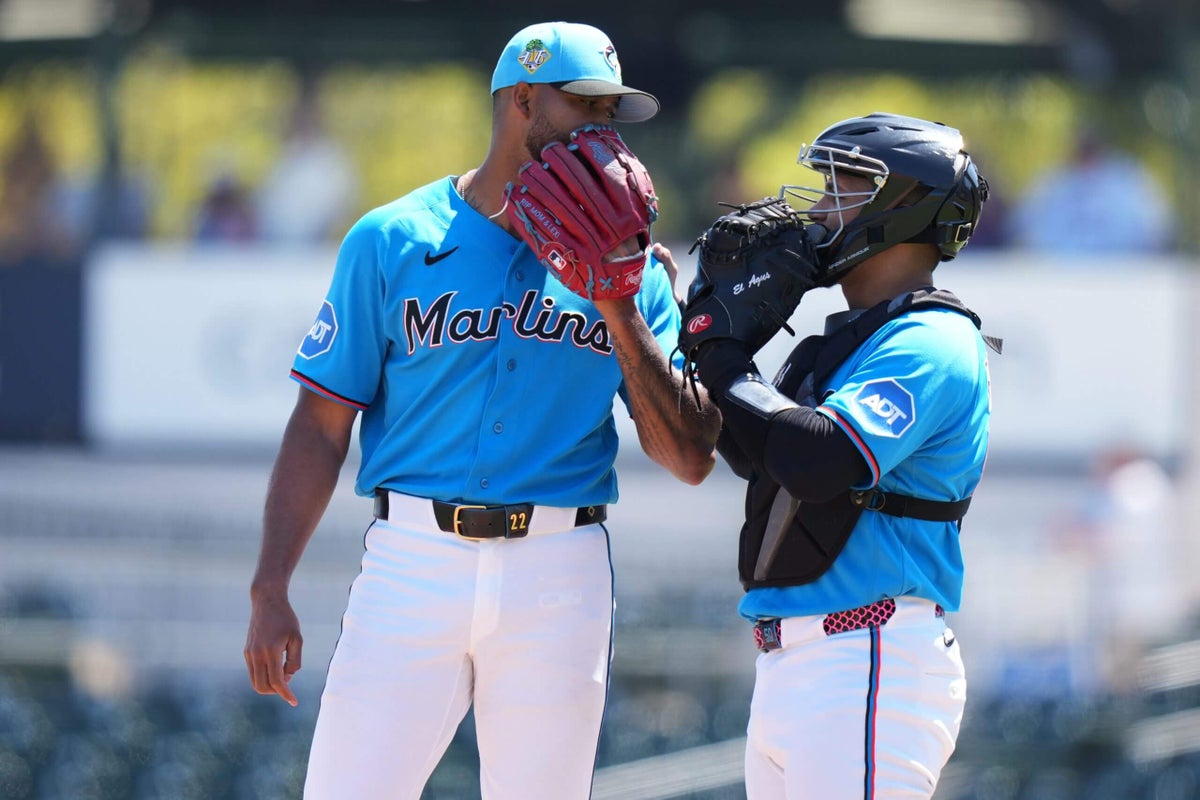
NEW YORK — Carlos Rodón wonders if the Miami Marlins are tanking catcher Agustín Ramírez’s value.
They began implementing a dugout-driven pitch-calling system in the final nine games of 2025 and have carried it into this season. It uses a numerical sequence from coaches relayed to the catcher, who references the number on a corresponding wristband and transmits the pitch selection to the pitcher via PitchCom.
One of a catcher’s most important jobs is to control the pitching staff each game. But two MLB teams, the Marlins and Colorado Rockies, are taking that responsibility away from catchers. They believe their coaches will do a better job of understanding what pitches should be thrown because they have information readily available that includes strengths and weaknesses of their pitchers and the opposing hitters.
Suffice to say, not everyone agrees. Rodón, one of the highest-paid starting pitchers in the sport, is staunchly against this practice.
“Do I think it’s good?” he rhetorically asked during this weekend’s series at Yankee Stadium. “No, I think it’s terrible.
“When Agustín Ramírez wants to be a free agent, and he’s had every pitch called for him, who the hell is going to look at him and be like, yeah, he’s a catcher? It’s just taking away opportunities to learn.”
Rodón thinks the Marlins are devaluing their catchers, but it might be for a good reason. Ramírez graded out as the worst defensive catcher in the majors last season, finishing with minus-28 blocks above average, according to Statcast. Kansas City Royals catcher Salvador Perez was the second-worst with minus-15, and Ramírez had nearly 1,000 fewer block opportunities than Perez.
Ramírez was also the worst catcher in controlling the running game, finishing last in the league with an 8.8 caught stealing percentage. In Saturday’s 9-7 loss to the New York Yankees, not only did Ramírez have two passed balls, but also — in perhaps the biggest indictment of his ability behind the plate — Giancarlo Stanton swiped a base on him. It was Stanton’s first steal in the regular season in six years.
Taking away game-calling from Ramírez could be a way for the Marlins to help the 24-year-old’s receiving and throwing improve by removing the biggest responsibility, while shifting more of his focus to offense. There’s also evidence it could boost their pitching outcomes.
The Marlins used this strategy for their entire minor-league season last year to great success. They went from 15th in whiff rate in 2024 to first in 2025. Their strikeout-to-walk ratio improved from 15th to sixth. It’s too early to know if it’ll make a noticeable difference in the majors, but for a young, inexperienced team that doesn’t have World Series aspirations, now is the time to improvise.
Miami’s ace, 2022 National League Cy Young Award winner Sandy Alcantara, is all in favor of the Marlins’ new approach. Even with his pedigree, Alcantara doesn’t get special treatment. The dugout is calling his pitches. So far, he’s perfect on the season, allowing zero runs in 16 innings.
“That was an idea that came from our (assistant) pitching coach last year,” Alcantara said of Alon Leichman, who is now the Rockies’ pitching coach. “We did it a couple times last year and we had great success. They call the pitches and the catcher gives the sign to the pitcher. And we do the same this year — for everyone. I think it’s a good idea because they call a pitch that they think is good for you to get a groundball or a strikeout. We feel great because they call the pitches.”
Don’t expect the Yankees to adopt this process.
Austin Wells said he would be upset if the club took away his game-calling responsibility, which he’s had as a catcher at various stops since high school. When he was a freshman at the University of Arizona in 2019, Wells said the coaching staff wanted to call pitches from the dugout. They ultimately decided against it. He believes calling pitches is a big reason he’s developed into one of MLB’s best defenders behind the plate.
“Calling pitches (from the dugout) is completely different than from behind the plate and reading swings and being in the box,” Wells said. “If you’re just relying on whatever the dugout is trying to call, you’re going to lose out on a lot of valuable time and feedback on whether you call the right or wrong pitch. If you call the wrong pitch and you thought one thing and it ended up being bad, you’re gonna learn from that. With whatever the coaches are calling, you’re not learning and growing with the game, especially when you face guys in your division over and over again. You have an idea of what each guy does well or doesn’t do well — and you’re able to grow from being in there. Watching film and looking at the numbers only gets you so far.”
That feedback loop is constant in the Yankees’ dugout. Between innings, pitching coach Matt Blake and director of catching Tanner Swanson will usually sit down with whoever is pitching and catching to discuss what just transpired. Blake called the process “sensitive,” especially if an outing has gone sideways, because the coaches don’t want the players to feel like they’re being second-guessed every time there’s a bad outcome. But the feedback is critical for growth. If the data shows an opposing hitter struggles against a certain pitch in a given count, but Wells or backup catcher J.C. Escarra calls for one the hitter handles well — and it leads to damage — the coaching staff will want to understand the reasoning behind the decision.
Those are the conversations Miami’s and now Colorado’s catchers might be missing out on this season.
“There has to be some level of question-and-answer feedback about what our decision-making process was,” Blake said of those discussions. “How do we get to that pitch call in that situation? Say we value the curveball, slider and the changeup ahead of the two-seamer in this environment, and we threw the two-seamer in that count, why did we think that was the right pitch to go to? What were you seeing that led you down that path? Was it something the hitter had shown us with his swings? Was it something the pitcher had shown us by not being able to execute something? We just need to get a better understanding of how we’re making decisions. … Maybe it wasn’t the best path to go down.”
The Yankees do extensive prep work before games, so it’s rare when there is disagreement among players and coaches about what should be done in those moments. The team will begin a three-game series against the Athletics on Tuesday. Escarra said that his off day on Monday will be spent learning every detail about the Athletics’ lineup. By the time he arrives at Yankee Stadium on Tuesday, he’ll know the hitters’ strengths and weaknesses, their heat zones and how they fare against certain pitches, along with preparation focused on the Automated Ball-Strike system.
Escarra said the Yankees have three different meetings with the starting pitchers every day for going over the scouting reports they’ve created. If, for some reason, the catchers forget something from those meetings, Wells and Escarra have notes on their wristbands that are, essentially, cheat sheets for every batter.
“I’m not even playing, and I prepare and do my homework, and I game plan for that team,” Escarra said. “If I’m a Marlin, I don’t really need to do any of those things. So what am I learning?”
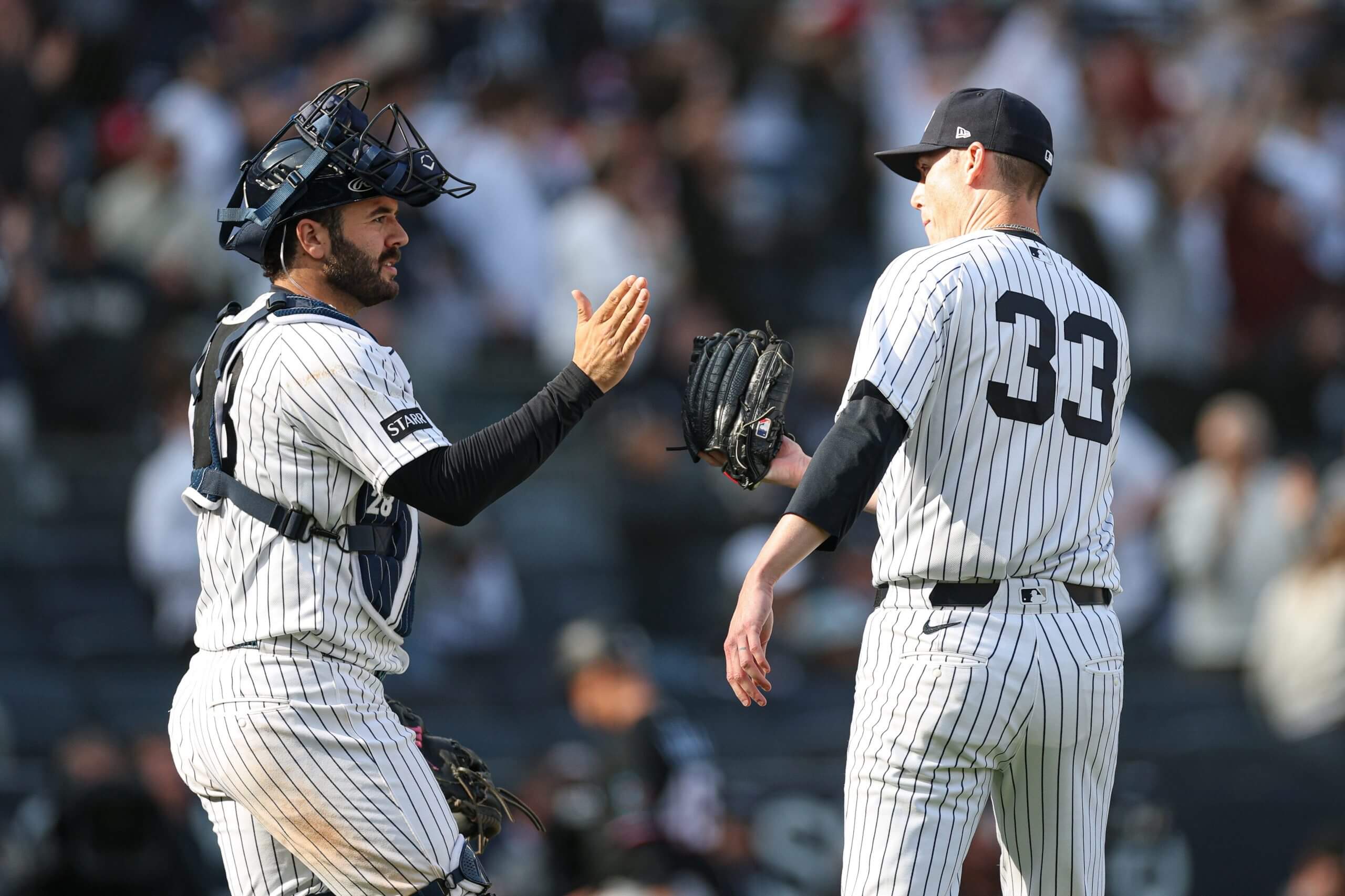
Yankees catchers Austin Wells, right, and J.C. Escarra (not pictured) criticized the Marlins’ use of dugout-called pitches, saying it hurts catchers’ development. (Vincent Carchietta / Imagn Images)
Rodón’s biggest gripe with the dugout calling pitches is that not everything in a game can be scripted. He understands the optimization aspect, but game plans are routinely altered over the course of nine innings. Wells said that when he’s catching, he’s making adjustments pitch-to-pitch, mid-at-bat and mid-inning every game. He believes the best pitching staffs continuously adjust to what the opposing team is doing.
“You can’t script when you’re in Game 3 of the ALCS or Game 2 of the World Series,” Rodón said. “You’re going to get the best from everybody. The computer is not going to be able to tell you everything in those moments. Over the regular season, sure. But it separates itself when you get to the games that really matter.
“When you’re facing Freddie Freeman, he’s gonna have a different approach than what he’s gonna have in a regular season. Tommy Edman is a great player, but Tommy Edman the postseason player is a better player than he is in the regular season. Tommy Edman is going to refuse to strike out. So, the heat zones you have on Tommy Edman won’t correlate in the postseason.”
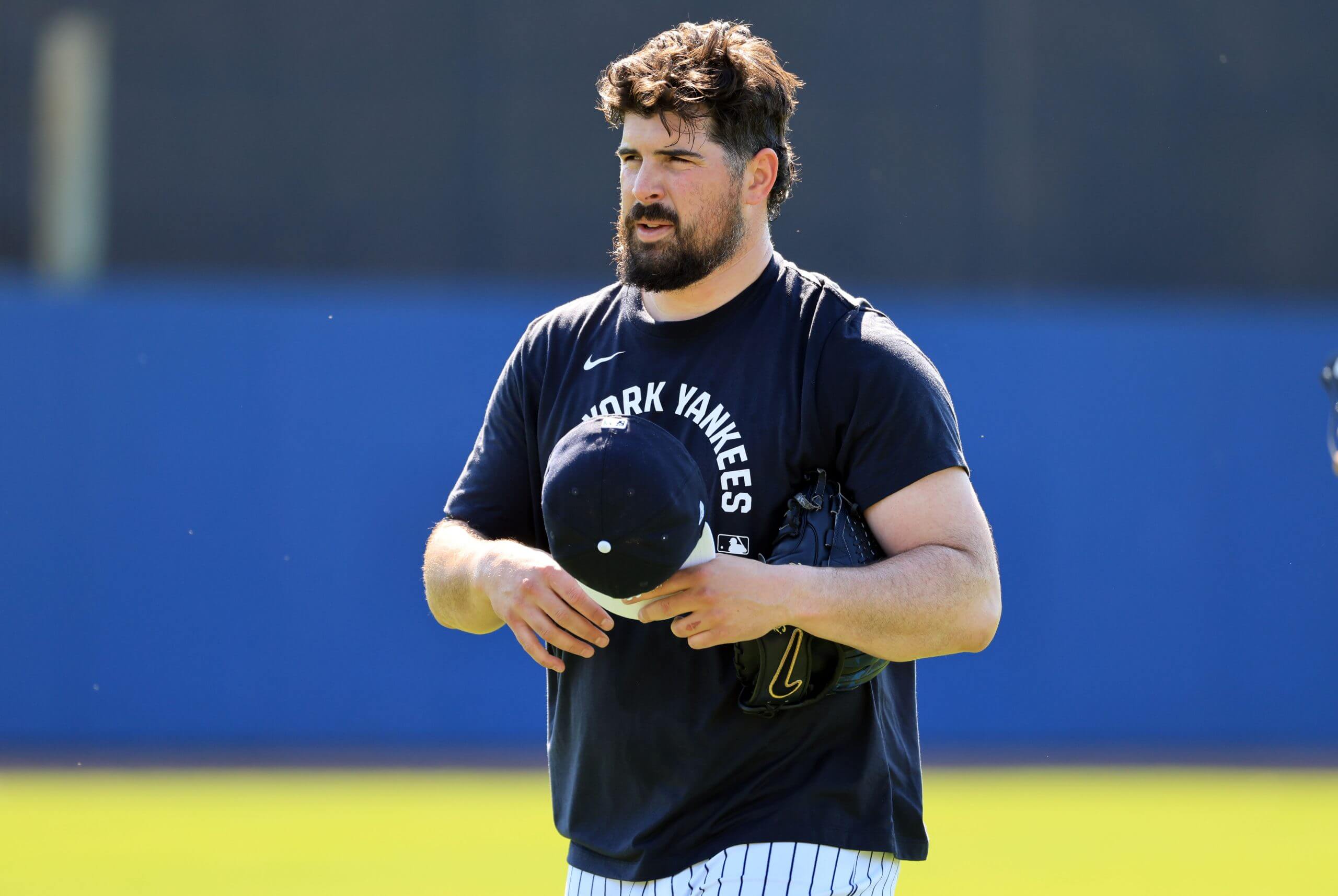
Carlos Rodón’s reaction to dugout-called pitches? “I think it’s terrible,” he said. (Kim Klement Neitzel / Imagn Images)
It’s too soon to know whether this will hurt the bank accounts of Ramírez or Liam Hicks, the Marlins’ backup catcher. Ramírez, whom the Yankees traded to Miami as part of the Jazz Chisholm Jr. trade two years ago, won’t be a free agent until 2032, and Hicks won’t be till 2031.
Baseball trends frequently change. This idea may gain popularity and become more widespread — the New York Mets experimented with dugout-called pitches during spring training. But Blake, who has previous experience in the Cleveland Guardians’ front office, said that it would give him some pause to add a catcher who hadn’t called games for their previous team.
“If we bring a catcher into this environment, especially in New York, that has never called a game, it’s a lot to throw on them to call games in the American League East, where every game is a nail-biter,” he said. “I’d have to know more about whether there’s any level of advanced work. Is there any level of detail they’re going into to look at hitters that they understand pitch-calling at all? Because it would be a lot to put on them.”
— Tyler Kepner contributed to this report.