
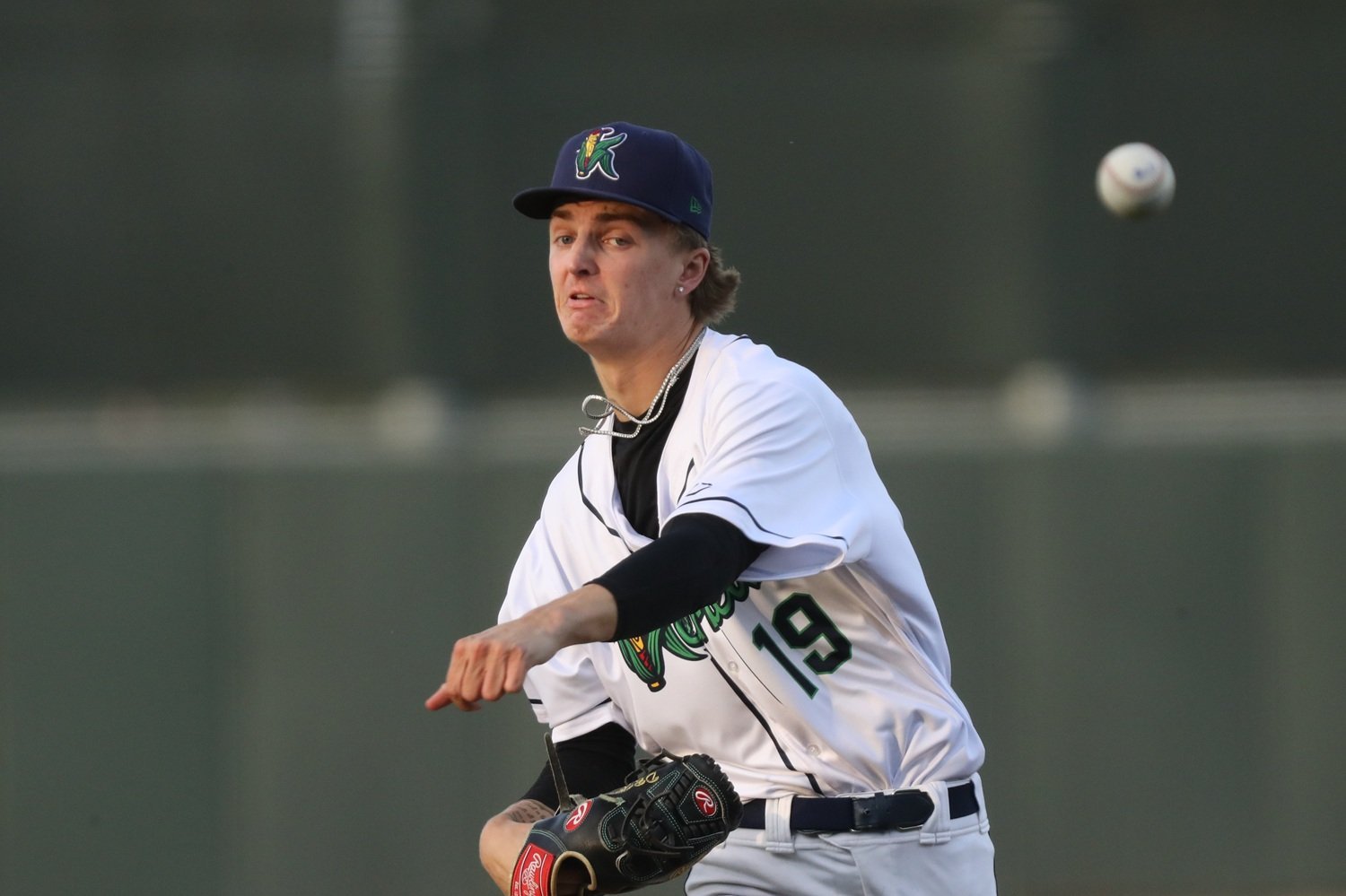
Prospect rankings are never as simple as lining players up from best to worst. A traditional list tries to balance everything at once. Upside, present tools, age, injury history, proximity to the big leagues, and even organizational need all get thrown into the mix. It’s part projection, part preference, and part educated guess.
This exercise throws most of that out the window. Instead of weighing floors and timelines, this ranking leans fully into ceiling. It’s about identifying which arms in the Twins system could become something special, if everything clicks. That might mean ignoring risk. It might mean betting on pitchers who have barely thrown, or struggled to stay on the mound. In some cases, the floor might be never reaching Target Field. But the reward, if it hits, could be enormous.
Here are five Twins pitching prospects ranked purely by upside.
5. Riley Quick, RHP
Twins Daily Current Prospect Rank: 11
Quick looks the part before he even throws a pitch. At 6-foot-6 and 250 pounds, the former four-star football recruit brings rare physicality to the mound. That alone creates intrigue, but the upside comes from how quickly his stuff returned after surgery.
Just a year removed from Tommy John, he was already touching the upper 90s, flirting with 99 mph. That kind of velocity rebound suggests there may still be another gear as he gets further removed from the procedure. Pair that with a legitimate four-pitch mix, and you start to see the outline of a durable, innings-eating starter with power stuff.
The Twins slow-played his debut, which only adds to the mystery. Minnesota will start him in the low minors in 2026, where he should dominate the competition. There is risk in a pitcher with a limited recent workload, but the combination of size, arm strength, and pitch mix gives Quick a ceiling that extends well beyond a typical mid-rotation profile.
4. Connor Prielipp, LHP
Twins Daily Current Prospect Rank: 5
At his best, Prielipp might have the most complete arsenal on this list. He’s already shown what it looks like when everything is working. A mid-90s fastball, a true plus slider, and a quality changeup give him the weapons of a front-line starter. The strikeout numbers back that up (27.0%), and when he was finally healthy in 2025, the results followed.
Health is the obvious caveat. Years of elbow issues have limited his workload to the point where projecting a full starter’s role becomes difficult. Even after a relatively stable season, he has still thrown a fraction of the innings typical for someone his age.
But that’s where upside comes into play. If Prielipp can hold his health long enough to build innings, the pitch mix is good enough to slot near the top of a rotation. And if durability pushes him to the bullpen, the stuff could play up into something even more dominant in shorter bursts. There are multiple paths to impact, which raises the overall ceiling.
3. Charlee Soto, RHP
Twins Daily Current Prospect Rank: 10
Soto is the definition of volatile upside. The raw ingredients are loud. He can reach triple digits and flashes three pitches that project as above-average or better. His changeup already stands out as a legitimate weapon, and his slider took a step forward when his velocity ticked up early in 2025.
That brief three-appearance stretch, before his season was cut short, is part of what makes him so intriguing. The added velocity hinted at another level, even if it came in a tiny sample. There was no ligament damage, which keeps the long-term outlook intact, but missed time and inconsistent command leave plenty unanswered.
Soto does not need perfect command to succeed, but he will need more consistency in the strike zone. If that comes, the arsenal is good enough to dream on a high-impact starter. If it does not, the fallback could still be a power reliever with dominant stretches. Either way, the upside is tied to just how electric the arm can be.
2. Kendry Rojas, LHP
Twins Daily Current Prospect Rank: 8
Rojas is a reminder that upside is not always a guarantee of linear development, especially after being traded to the Twins as part of the Louis Varland deal. His introduction to the organization did not go smoothly, as he struggled to find the strike zone in Triple-A. Walks piled up, and the stat line turned ugly in a hurry. For many rankings, that would be enough to push him down.
For this exercise, it’s almost irrelevant. Even during those struggles, the traits that matter showed through. He sat in the mid-90s with his fastball and generated swings and misses with both his changeup and slider. When he was around the zone, hitters had a hard time squaring him up.
That’s the key. If the Twins can help him harness the command, there is playoff-caliber starter potential, with the raw stuff to miss bats consistently. Injuries and inconsistency have limited his track record, but the flashes are loud enough to keep the ceiling intact. In a more optimistic outcome, he becomes a reliable starter. In a less stable one, he still has the weapons to thrive in high-leverage relief.
1. Dasan Hill, LHP
Twins Daily Current Prospect Rank: 7
Hill is the purest upside play in the system. When the Twins drafted him, the appeal was projection. A tall, lean high school lefty with room to grow and a fastball that hinted at more. It did not take long for that projection to start turning into reality.
His velocity jumped into the mid-90s almost immediately, and he began overpowering hitters in his first taste of pro ball. The strikeout numbers followed (31.1%), and both his slider and changeup showed the ability to miss bats against lower-level competition.
The command, as expected, is still a work in progress. Walks piled up (15.0%), and efficiency was not always there. That’s typical for a young pitcher learning to control newfound velocity and sharper secondary pitches.
What separates Hill is how high the ceiling climbs if it all comes together. A left-hander with near triple-digit velocity and two swing-and-miss secondaries does not come around often. If he finds even average control, he has the ingredients of a true front-line starter. If he does not, the fallback could still be a dominant, high-leverage arm.
Upside rankings are not meant to be comfortable. They require buying into uncertainty and accepting that some of these arms may never fully click. Injuries, command issues, and stalled development are all part of the equation. That is what makes pitching prospects so volatile in the first place.
But it is also what makes them so compelling. The Twins system does not lack for intriguing arms, and this group highlights just how wide the range of outcomes can be. From near-ready options with frontline stuff to teenage projections still taking shape, the ceiling on this group is undeniable.
If even one or two of these pitchers reach that ceiling, it could reshape the future of the organization’s rotation in a hurry.
How would you rank the Twins’ top pitching prospects by upside? Leave a comment and start the discussion.
Interested in learning more about the Minnesota Twins’ top prospects? Check out our comprehensive top prospects list that includes up-to-date stats, articles and videos about every prospect, scouting reports, and more!