
Hello, Padres fans. After a 2-5 start, your favorite team has won three consecutive games, even as bigger-picture questions hang over everything. Let’s get right to it. A more baseball-specific portion of the mailbag will follow later this week.
Note: Questions have been lightly edited for clarity.
The San Diego Padres need a moneyed new owner who wants to win soon and will allow A.J. Preller to plug the gaps in the starting rotation by following the Dodgers’ obvious strategy of filling the player tank before the new collective bargaining agreement (which will probably include a salary cap and floor). Who do you think is the best potential owner to move the Padres forward before it is too late? — D. P.
Having never covered any of the sports teams already owned by the final four bidders, this is difficult to project without talking out of my rear end. But we can at least discuss some of what is publicly known.
Each of the Padres’ prospective owners appears significantly wealthier than any individual member of the Seidler family. Here are their estimated net worths, courtesy of Forbes: $11.1 billion (Dan Friedkin), $10.1 billion (Tom Gores), $3.9 billion (José E. Feliciano), $2.3 billion (Joe Lacob). This doesn’t account for any financial partners the winning bidder would bring aboard. The second and final round of bids remains scheduled for mid-April, with an agreement possible before the end of the month.
Friedkin owns one of the world’s largest independent Toyota distributors and three European soccer clubs. He attempted to buy the Boston Celtics in 2025, and he seems to be emulating the Fenway Sports Group model. Last summer, Friedkin hired former FSG and Red Sox executive David Beeston to help manage the three soccer clubs and pursue ownership in a major North American sports league.
Gores founded Platinum Equity in 1995, became the sole owner of the Detroit Pistons in 2015 and purchased a 27 percent stake in Dean Spanos’ Los Angeles Chargers in 2024. Since Gores bought the Pistons in 2011, the NBA team has routinely finished at or near the bottom of the Central Division. But the Pistons are on an upswing; last week, they clinched their first division title in 18 years.
Feliciano is the co-founder and managing partner of Clearlake Capital, which teamed with Los Angeles Dodgers part-owner Todd Boehly in 2022 to buy Chelsea Football Club. Speaking at a recent business conference, Feliciano said the consortium that owns Chelsea had implemented a “more sustainable system” that is “yielding results” despite a heavy pre-tax deficit for the 2024-25 season.
Lacob was a longtime partner at a venture capital firm and has owned the Golden State Warriors since 2011, with current Dodgers part-owner Peter Guber as his primary partner. In terms of net worth, Lacob might lag behind the other bidders vying for the Padres, but he is well connected in Silicon Valley and Hollywood (thanks in part to his history with Guber, a film producer who hosted Roki Sasaki at his house two offseasons ago).
If you’re keeping track, the final four bidders consist of two private equity investors, a venture capitalist and, in Friedkin, the head of a family business conglomerate. How badly do these suitors want to win, as opposed to merely collecting another asset that keeps appreciating?
We may never know, but for whatever it’s worth, some members of the organization have been rooting for Lacob, 70, who oversaw the Warriors’ dynasty and looked into buying an MLB franchise several times. And although a salary cap in the next CBA is far from guaranteed, I’ve also heard Lacob and the other bidders are intrigued by a potential spending limit that would curb the excess of the Dodgers, the Padres’ chief rivals.
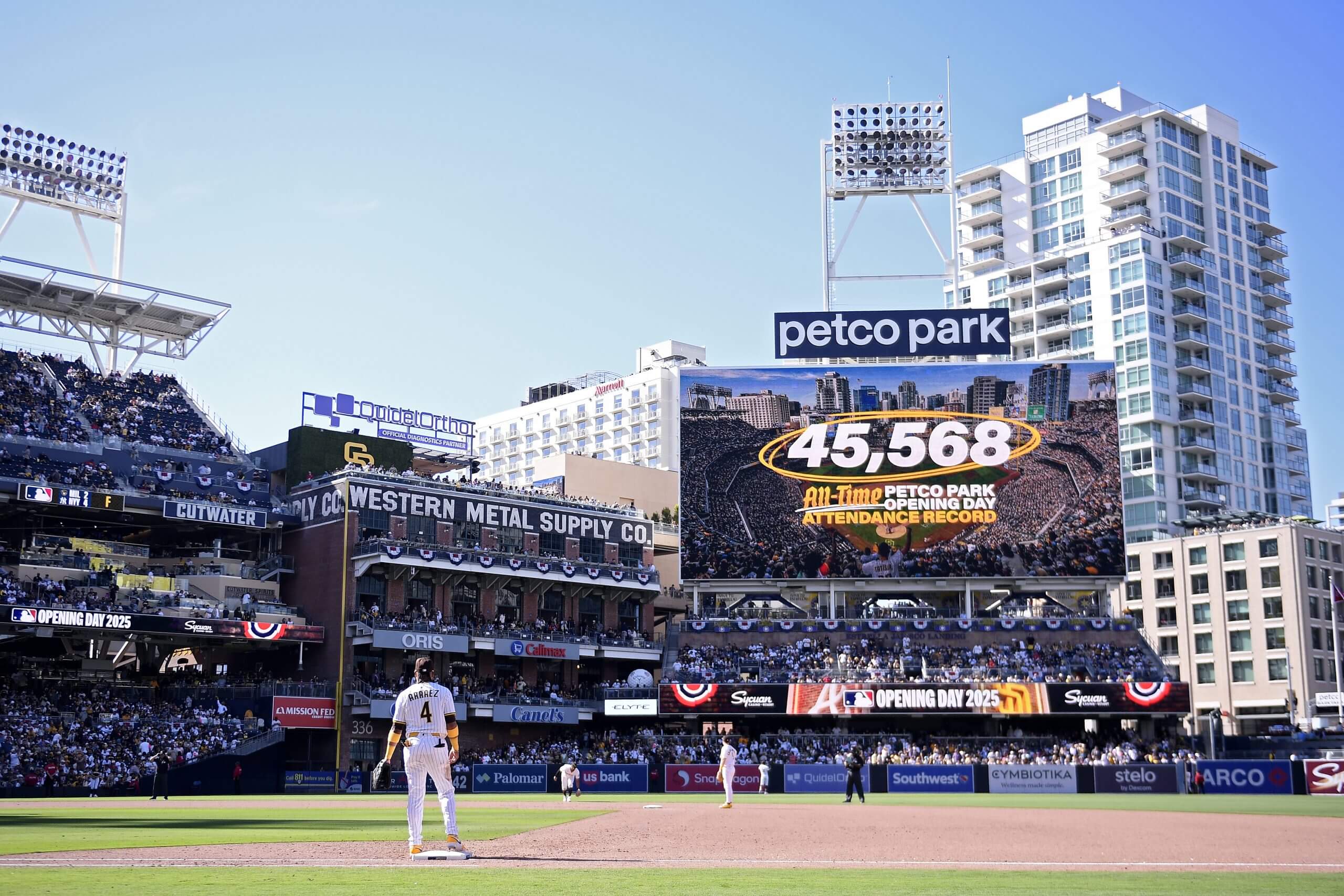
Petco Park is the only major-league ballpark to average a sellout per game since Opening Day 2023. (Orlando Ramirez / Getty Images)
What are the chances the new owner orders Preller to dismantle his roster and rebuild from the ground up next season? Or do you think the new owner (2027 labor issues notwithstanding) will have A.J. do more A.J. things and try to scrap together another winner next season? It almost feels like it is time to hit eject on this crop of players and just build around Jackson Merrill. — Justin R.
A rebuild is always possible, especially under new ownership. And the people bidding for the Padres ostensibly would have the wherewithal to shed at least one or two of the team’s more burdensome contracts. Gores, for example, gave Monty Williams a six-year, $78.5 million contract to coach the Pistons. A year later, after a 14-68 season, Gores fired Williams.
That said, much of the Padres’ appeal comes from observing the revenue machine the late Peter Seidler built while allowing Preller to chase star talent. Petco Park is the only major-league ballpark to average a sellout per game since Opening Day 2023. Possible labor reform and national media rights renegotiations could eventually reduce San Diego’s reliance on attendance, but for now, the team’s brand is as strong as ever.
What does all this mean for the current roster, which contains several burdensome contracts that could limit the competitive ceiling in 2027 and beyond? Hard to say, but a lot is riding on the results of the 2026 season and the terms of the next CBA.
Do you believe Preller will still be with the team once new ownership takes over? If you were the new owner, would you sign him to a long-term deal? — Anonymous
I’d be surprised if Preller doesn’t get at least the rest of this season. In most cases, a new owner will want to take time to evaluate inherited operations before potentially making sweeping changes.
That said, Preller’s future past 2026 remains uncertain. No one directly involved will confirm the terms of his recent extension, but most indications are that he is now under contract through 2028. If a billionaire owner wants to handpick their own general manager, moving on from Preller would represent a relatively small expense.
So, it’s a big year for the Padres. And few in the organization have more at stake than Preller, who at least possesses some financial security.
I saw an article stating that Sen. Bernie Sanders was introducing a bill to “keep the Padres in San Diego.” Is/was there a chance that the new owners plan on moving them out? — Brian D.
I don’t believe there’s much of a chance — Petco Park remains a gem, and potential labor reform could solve the Padres’ challenges with local media revenue — but the topic probably will continue to surface as the city of San Diego moves closer to repaying its stadium construction debt.
“This is a perennial issue with any professional sports teams that want to play in state-of-the-art facilities, and if they don’t get a good deal or the deal they want or a new stadium, there’s always the potential threat of relocation,” Irwin Kishner, co-chair of the Sports Law Group with New York law firm Herrick Feinstein, said in a recent interview. “It’s less likely when it’s a bigger market like San Diego. It’s very unusual when it’s a really big market.
“Nevertheless, you’ve seen even in Chicago what’s going on there; there’s a fight as to where the Bears are going to play. And I’m only using that as an analogy. Soldier Field (being) an older facility, the Bears want to get a great new stadium, and they’re talking about going to Indiana, and they’ve talked about going to different other places, all based upon how much of a more favorable deal that they can achieve.”
For fans hoping the Padres stay in San Diego for the foreseeable future, it’s a good thing Petco Park looks quite a bit younger than 22 years old, a far cry from the sad situation involving the Athletics and the Oakland Coliseum. And the contract governing the use of Petco is significantly more favorable to the Padres than to the city. Although a new ownership group and the 2031 initial expiration date of the aforementioned contract could lead to some uncertainty, I have a hard time envisioning at least 75 percent of MLB owners approving a move out of San Diego.
Is Ruben Niebla content being a pitching coach, or is he a risk to leave after being passed over for the manager job? — Steve W.
Here’s what Niebla said last month when I asked if he remains interested in managing one day.
“I think that everybody gets to a point in their career where you’re motivated for challenges, and I still feel there is a challenge there that is intriguing,” Niebla said. “But I also feel that I can still get better as a pitching coach, and there’s still more to learn there, so I don’t want to make that jump just to make the jump.”
So, he sounds mostly content. And by all accounts, he has a strong relationship with rookie manager Craig Stammen, whom Niebla coached in 2022.
Still, the risk of Niebla leaving — whether next winter or in a future offseason — is probably as high as ever. He turns 55 in December, and as he said himself, the idea of managing continues to intrigue him.