
With their offseason trade for Freddy Peralta, the Mets acquired the kind of bona-fide ace they lacked during last season’s collapse.
And there was no shortage of optimism that rookie phenom Nolan McLean would continue his top-of-the-rotation ascent after he dazzled during last year’s second-half call-up.
But torrid starts by Kodai Senga and Clay Holmes have turned this year’s rotation into a full-blown early-season strength — and it’s giving the Mets reason to dream.
“As long as we stay healthy, stay out on the mound, we can be a stabilizing force for the team,” Senga said through an interpreter after Sunday’s 5-2 win in San Francisco. “That goes for everybody and myself. I don’t want to be the one lagging behind. I want to be up there with them.”
Entering Tuesday, the Mets’ rotation boasted a cumulative 3.13 ERA, which ranked eighth among MLB starting staffs.
Their five starters had totaled 54.2 innings, the third most among MLB rotations.
That’s even with relatively slow starts by the right-handed Peralta, who began Tuesday with a 4.35 ERA through 10.1 innings, and the left-handed David Peterson, who has a 4.66 ERA over 9.2 innings.
While the Mets’ new-look offense got going during three consecutive wins in San Francisco over the weekend, the rotation has been the driving force in the team’s 6-4 start.
“It starts on the mound, setting the tone, getting the offense back in the dugout,” manager Carlos Mendoza said. “Shut-down innings after we score. The pitching staff attacking [opposing hitters].”
McLean, 24, began Friday’s start with five perfect frames before he allowed two walks and a hit in the sixth inning of a 10-3 win over the Giants.
The right-hander is 1-0 with a 2.61 ERA through two starts this season and 6-1 with a 2.16 ERA over 10 career MLB starts.
“You feel good about your chances every time he takes the baseball,” Mendoza said.
“Every time he’s pitching, you feel good about winning that game, and that’s what he’s done. Even when he’s not at his best, you know that he’s going to keep you in games. You know he’s going to at least go five [innings]. That’s what makes him special.”
Holmes then hurled seven shutout innings in Saturday’s 9-0 victory. Now in his second year since converting to the rotation, Holmes — a former Yankees closer — improved to 2-0 with a 1.42 ERA over 12.2 innings.
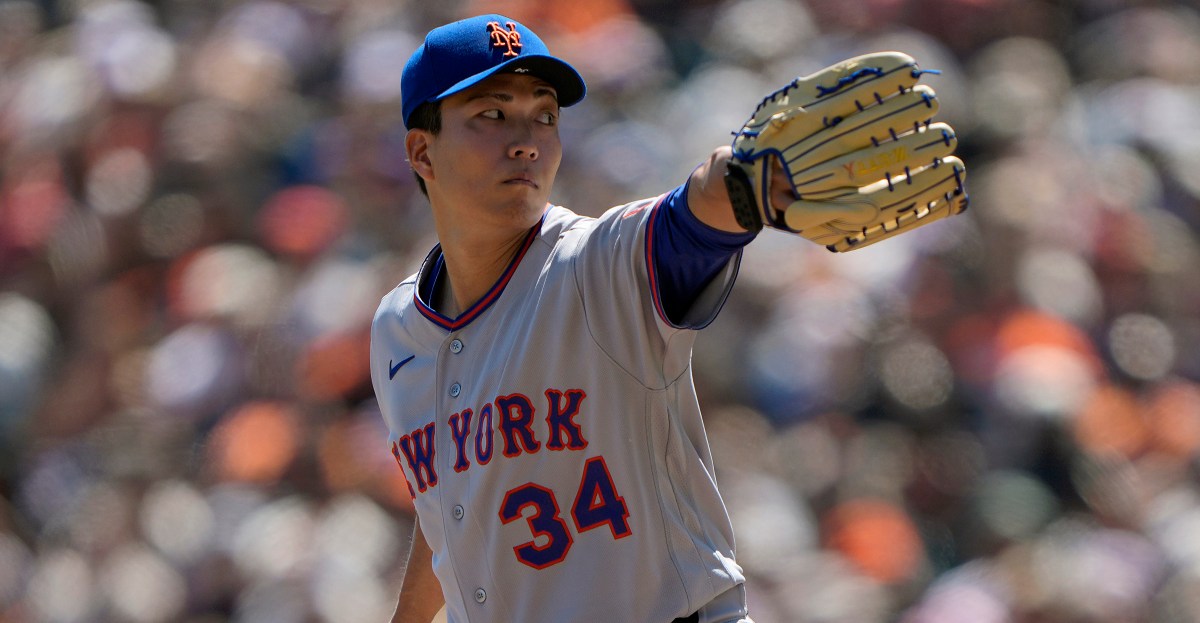
And then Senga wrapped the weekend with 5.2 innings of two-run ball, striking out seven, and took a no-decision in the Mets’ series-clinching victory over the Giants.
Senga is 0-1 with a 3.09 ERA through two starts, and his four-seam fastball is averaging 96.7 mph — two full mph faster than last year’s.
Notably, Sunday’s outing marked only the fifth time in four MLB seasons that Senga pitched on regular rest. The Mets have typically found ways to give Senga an extra day between starts to better replicate the schedule he followed in Japan.
“Whatever the pitching schedule is, whether it’s regular rest or an extra day, as long as I know ahead of time and I’m able to live on that schedule, then it’s no problem,” Senga, 33, said.
Of course, this is a small sample size.
Through 69 games last year, the Mets were 45-24, and their starters owned an MLB-best 2.79 ERA.
But on June 12, Senga (who was 7-3 with a 1.47 ERA at that point) injured his hamstring, and he was never close to the same pitcher upon returning.
From June 13 on, the Mets’ starters pitched to a 5.27 ERA — the fourth-worst mark in the majors — and averaged only 4.6 innings per outing.
But the addition of Peralta, who finished fifth in 2025 National League Cy Young Award voting with Milwaukee, and a full season of McLean figures to help the Mets avoid a similar fate this year, while taking some pressure off of Senga, Holmes and others.
“I think it’s a really strong group,” Senga said.