
Major League bullpens can be volatile entities, and the Kansas City Royals’ bullpen is no exception.
In 2024, the Royals’ bullpen ranked 20th in ERA and 17th in fWAR. Last year, they ranked 7th in ERA and 14th in fWAR. Two years ago, many Royals fans felt that the Royals’ bullpen was an area of weakness, especially before Lucas Erceg arrived at the Trade Deadline. Last year, it was seen as a strength, especially with Carlos Estevez being the second Royals reliever in franchise history to lead the league in saves (Dan Quisenberry being the other).
This year, it’s not been the greatest start, much to the chagrin of Royals fans and management.
Through 11 games, the Royals rank 26th in bullpen ERA (6.17) and are tied for 25th in reliever fWAR (-0.5). In terms of the former, the Nationals, Diamondbacks, Astros, and Rays have been worse in reliever ERA. Regarding the latter, they are tied with the Rays and Cardinals.
The biggest regression from 2025 with this group has been BB/9. After ranking 4th in BB/9 as a bullpen last year with a 3.15 mark, they rank 27th with a 5.91 BB/9. That has contributed not only to their high reliever ERA but also to their WHIP (1.63, which ranks 20th).
While the Royals’ bullpen hasn’t been the sole reason for the Royals’ 5-6 record this season, it certainly hasn’t helped. Kansas City’s bullpen has allowed two walk-off victories, including today in Cleveland.
The numbers haven’t been good, which begs Royals fans to ask the question: Is this bullpen something to panic about? Or are the Royals just going through a tough stretch and are due for positive regression soon?
Let’s break down the positives and negatives of the Royals’ bullpen and what to look for with this group going forward in 2026, using TJ Stats data and charts.
Strahm, Schreiber, and Erceg Off to Rough Starts
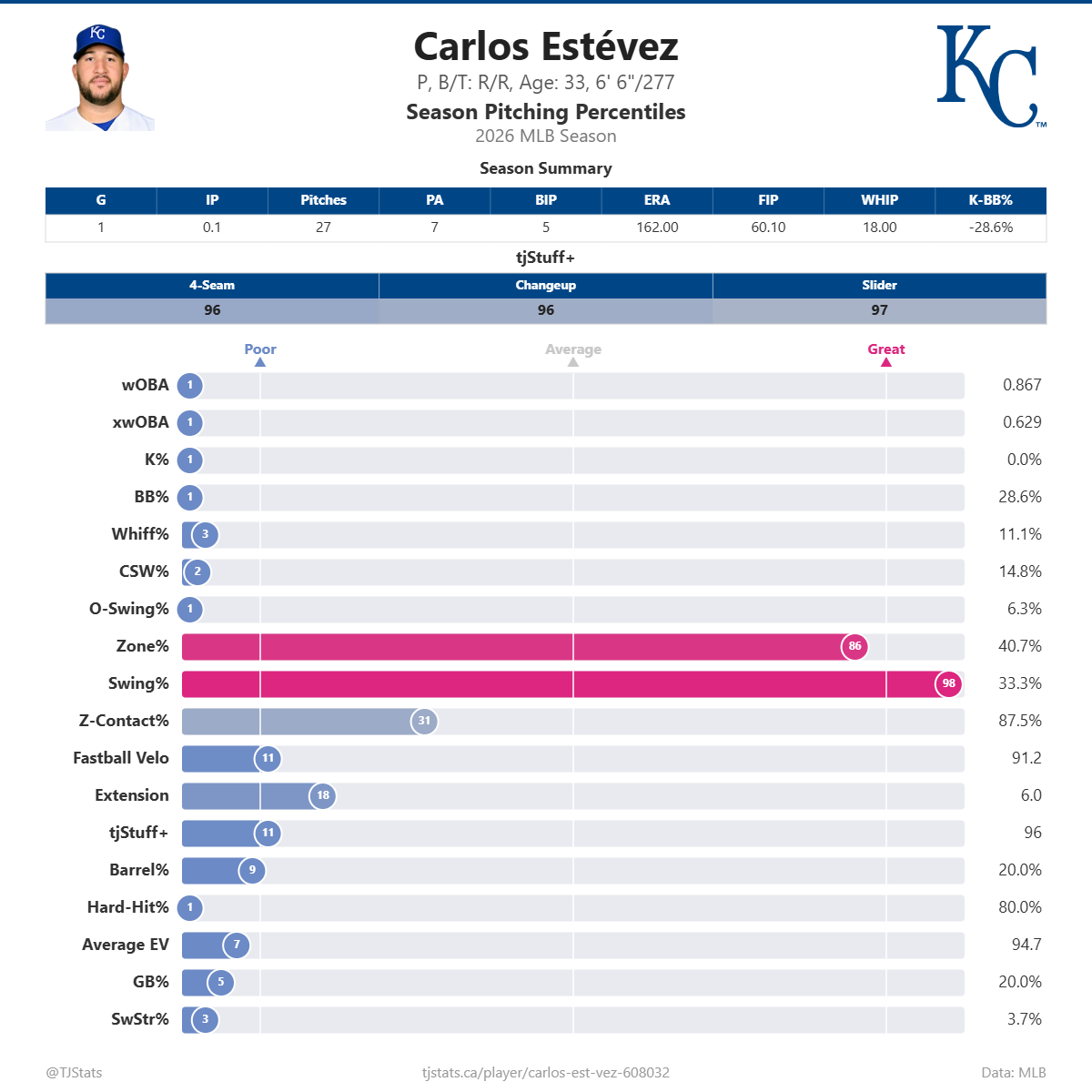
The Royals lost Estevez to the IL early in the season. The Dominican-born closer only made one appearance before being hit by a line drive in the foot and going on the IL due to a foot contusion.
That said, there were concerns about his velocity this offseason, so going on the IL and a possible rehab assignment could help him get back to where he was a season ago in terms of velocity and stuff (his Statcast percentiles after one outing were NOT impressive, to put it kindly).
That said, while Estevez’s early IL stint was concerning, it seemed like the back of the Royals’ bullpen was in good hands. Not only did Erceg and John Schreiber return (they both pitched in high-leverage situations in 2024 and 2025), but they also welcomed Matt Strahm from the Phillies. Strahm thrived in Philadelphia as a setup man and fireman, and it seemed like he would serve in a similar role in Kansas City in 2026.
Unfortunately, the results haven’t been great so far for the bullpen trio.
Here’s how the three relievers have fared thus far in 2026 with the Royals.
Erceg: 3.86 ERA, 1.50 WHIP, 16.7% K%, 11.1% BB%, 5.6% K-BB% in 4.2 IP.
Strahm: 5.79 ERA, 1.29 WHIP, 23.8% K%, 9.5% BB%, 14.3% K-BB% in 4.2 IP.
Schreiber: 6.23 ERA, 2.31 WHIP, 11.1% K%, 22.2% BB%, -11.1 K-BB% in 4.1 IP.
Erceg has performed the best of the three relievers, as his ERA is under four. However, he’s struggled to strike out batters, and he isn’t generating much chase or whiffs either, as seen below via his TJ Stats Statcast percentiles.
.png.89793007b0a5dd68147290f3b946aa12.png)
Erceg ranks in the fourth percentile in whiff rate, first percentile in CSW%, and 32nd percentile in O-Swing%. That’s not what one wants to see from someone pitching in high-leverage situations. On a positive note, his fastball velocity ranks in the 92nd percentile, as does his hard-hit allowed. He is also generating a 53.8% GB%, which ranks in the 75th percentile, and his average exit velocity also ranks in that percentile as well
Thus, the former Athletics reliever is doing a lot of things right. His TJ Stuff+ has also been above average, with an overall mark of 103, which ranks in the 66th percentile. That said, Erceg needs to find a way to generate more strikeouts, as he posted a 19.3% K rate last season. In 2024, with the Athletics and Royals, he had a 28.5% K%.
As for Strahm, he started strong, but he’s struggled in recent outings, which is why his ERA is inflated at 5.79. However, some of his Statcast percentiles suggest he may be due for a bounce-back soon, as illustrated below by TJ Stats.
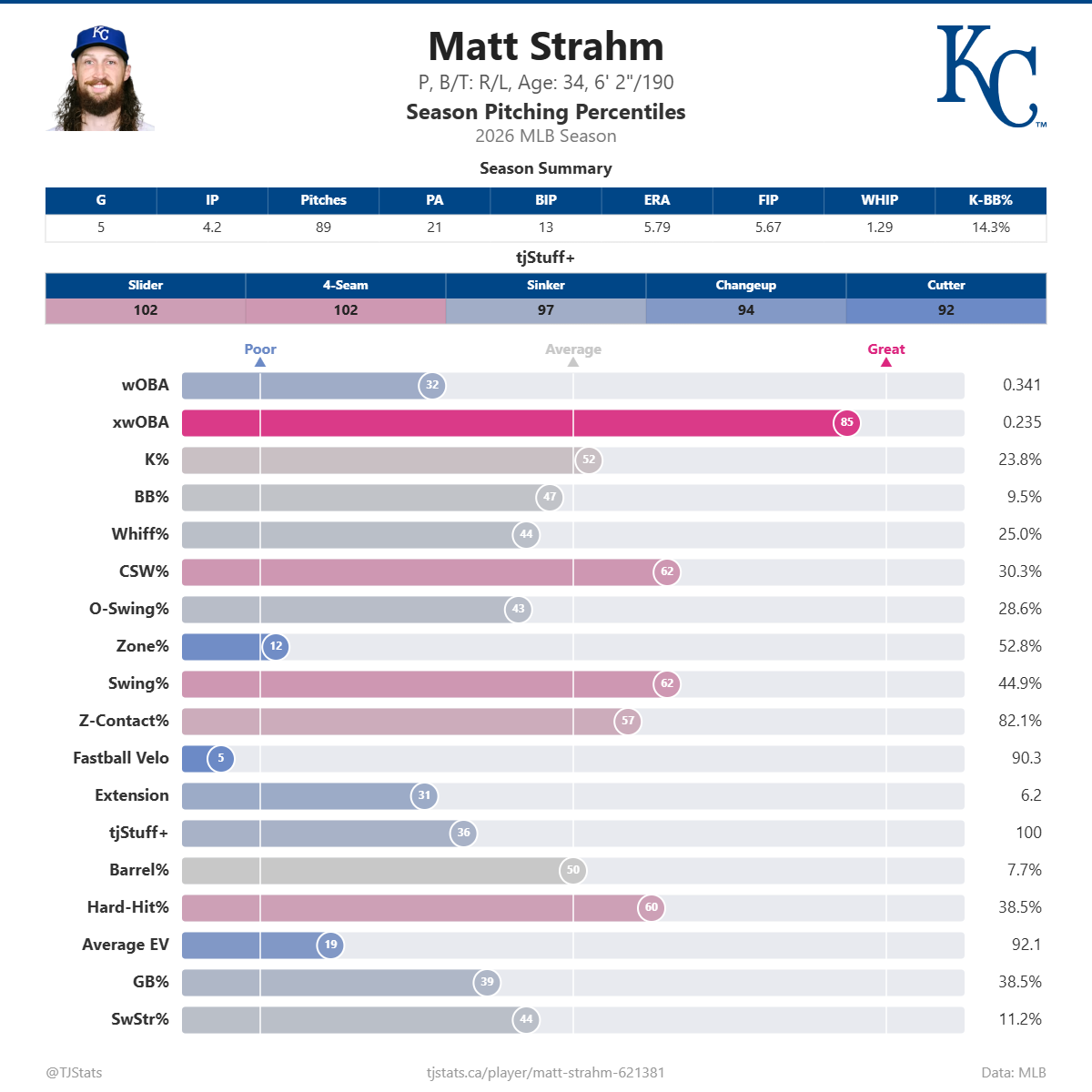
Strahm’s 30.3% CSW% ranks in the 63rd percentile, and his .235 xwOBA not only ranks in the 85th percentile but is 106 points lower than his actual wOBA. He also has a hard-hit rate allowed 38.5%, which ranks in the 60th percentile. Thus, he hasn’t been a total disaster, though the ERA may suggest that.
There are concerns with Strahm that still have to be taken into consideration.
His 100 overall TJ Stuff+ ranks in the 36th percentile, his fastball velocity is poor (5th percentile), and his extension is lackluster (31st percentile). He still generates a decent amount of whiff (25%, 44th percentile) despite his lack of elite stuff or velocity. However, his pull% allowed is 53.8%. It’s never been above 40% since 2021, so one has to wonder if he’s tipping hitters off to begin the year, since they are pulling the ball on him so much.
The most concerning reliever has been Schreiber, who has looked like a shell of his 2024 and 2025 self. He’s been a favorite of Matt Quatraro, especially in crucial spots. Since 2024, he has been tied for fourth in gmLI, which measures the leverage index at the start of an appearance. His 1.51 mark is tied with James McArthur, and he trailed only Estevez (1.81), Erceg (1.70), and Hunter Harvey (1.53).
Despite confidence in Schreiber, he has been poor at the beginning of 2026. That is demonstrated not only in his lackluster ERA and K-BB%, but also in his Statcast percentiles below.
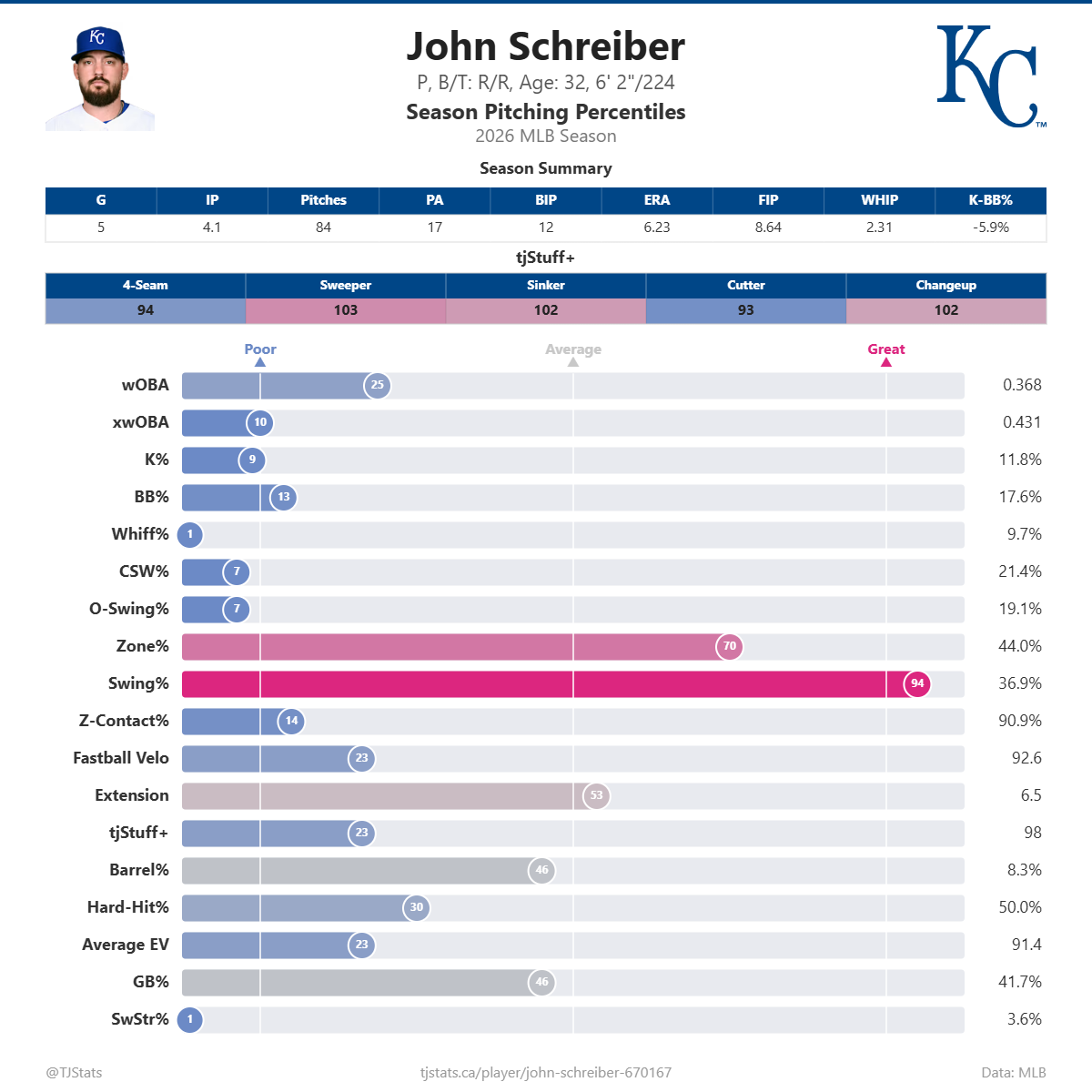
As Royals fans can see, not a lot has gone right for Schreiber in terms of Statcast data.
His hard-hit rate allowed ranks in the 30th percentile, his average EV allowed ranks in the 23rd percentile (as does his TJ Stuff+), his O-Swing% and CSW% rank in the 7th percentile, and his wiff rate ranks in the 1st percentile. Thus, it’s not a surprise that the results have been so poor for Schreiber at this point in the season.
It’s still early, but while Strahm and Erceg have shown promise in some categories in their Statcast summary profiles, the same can’t be said for Schreiber. His stuff and batted-ball profile are not trending in the right direction. Schreiber’s sweeper, sinker, and changeup all have TJ Stuff+ marks of 102 or higher. However, his four-seamer and cutter have TJ Stuff+ marks of 94 and 93, respectively.
It will be tough for Schreiber to be successful as a high-leverage reliever with two of his main pitches being such poor offerings, stuff-wise.
Mears and Lynch IV Showing Promise
While the Royals haven’t gotten great results from those expected to command high-leverage innings this year, they have seen some interesting growth from two relievers who could be ready for more innings in pressure situations.
Those two relievers are newcomer Nick Mears and lefty Daniel Lynch IV.
Mears came over in the Angel Zerpa deal and has succeeded as a middle-innings reliever capable of pitching in medium-leverage situations. His 1.04 gmLI ranks fourth behind Estevez (1.81), Erceg (1.23), and Strahm (1.21), according to Fangraphs. Despite not being a high-leverage guy, he has produced stellar results. He has a 0.00 ERA, a 0.80 WHIP, and 21.4% K% in 5 IP.
His Statcast percentiles have been a little bit mixed, though he has particularly excelled in limiting hard contact, as illustrated in his TJ Stats summary below.
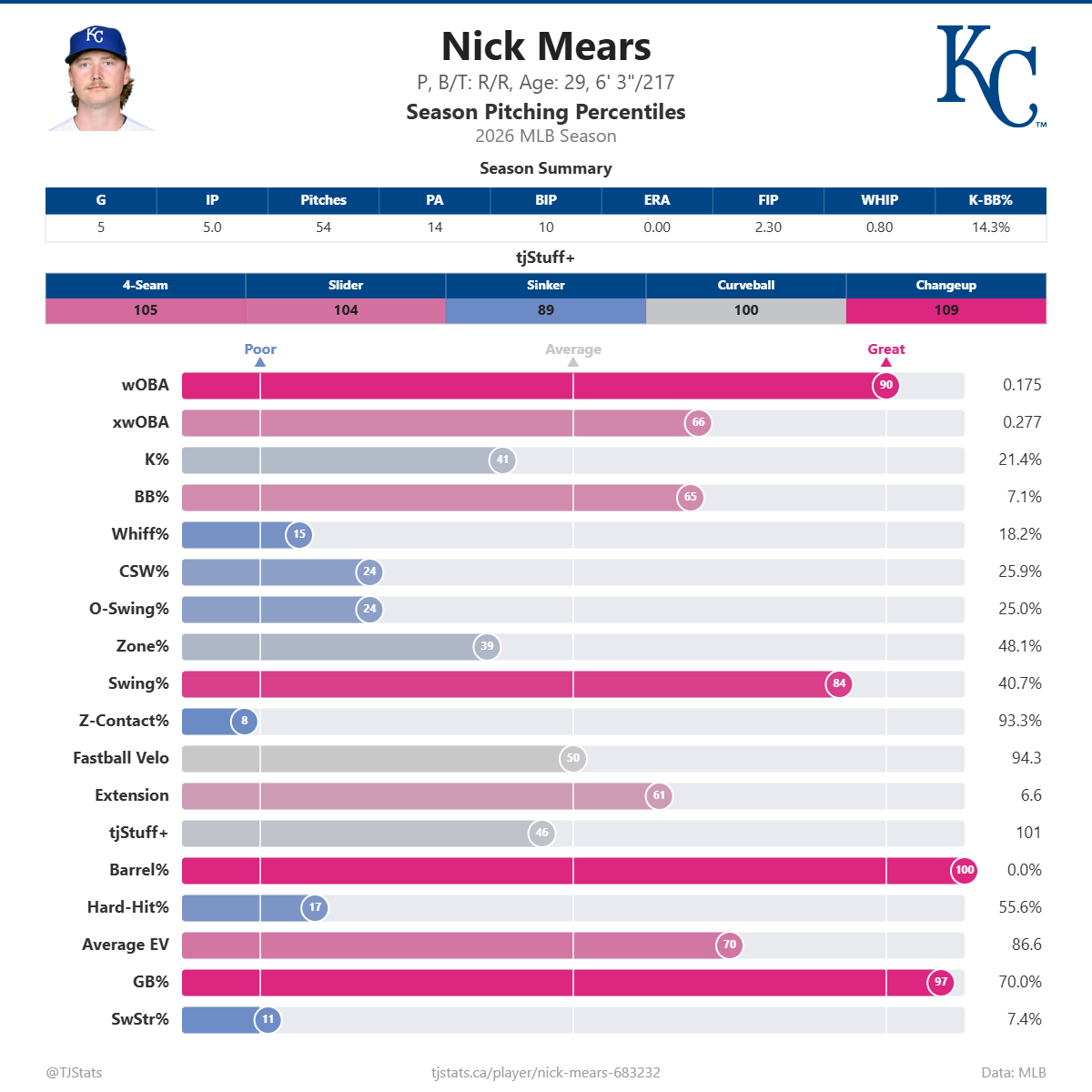
Mears hasn’t allowed a barrel, and his average exit velocity allowed on batted balls ranks in the 70th percentile (86.6 MPH). He also has a 70% GB%, which is encouraging to see from a middle-innings reliever who can come in with men on base. Mears can take advantage of the stellar infield defense behind him (the Royals rank 5th in infielder Fielding Run Value).
The main concern with Mears is that his profile is similar to Erceg: the stuff is decent (101 overall TJ Stuff+), but he doesn’t generate a whole lot of whiff (15th percentile), CSW% (24th percentile), or chase (24th percentile O-Swing%). Thus, while Mears has been good, Quatraro may be hesitant to bring him in until he can show more effectiveness when it comes to generating chases, whiffs, and ultimately, strikeouts.
On the lefty end, Lynch IV has stepped up and been the most valuable lefty reliever so far, which says something with Strahm in this bullpen.
In four innings of work, Lynch has a 2.25 ERA, a 2.43 FIP, a 1.25 WHIP, and 16.7% K-BB% (fueled by a 33.3% K%). When it comes to his TJ Stats Statcast summary, the former Virginia lefty has thrived by generating strikes, minimizing barrels, and average exit velocity on batted balls so far this season.
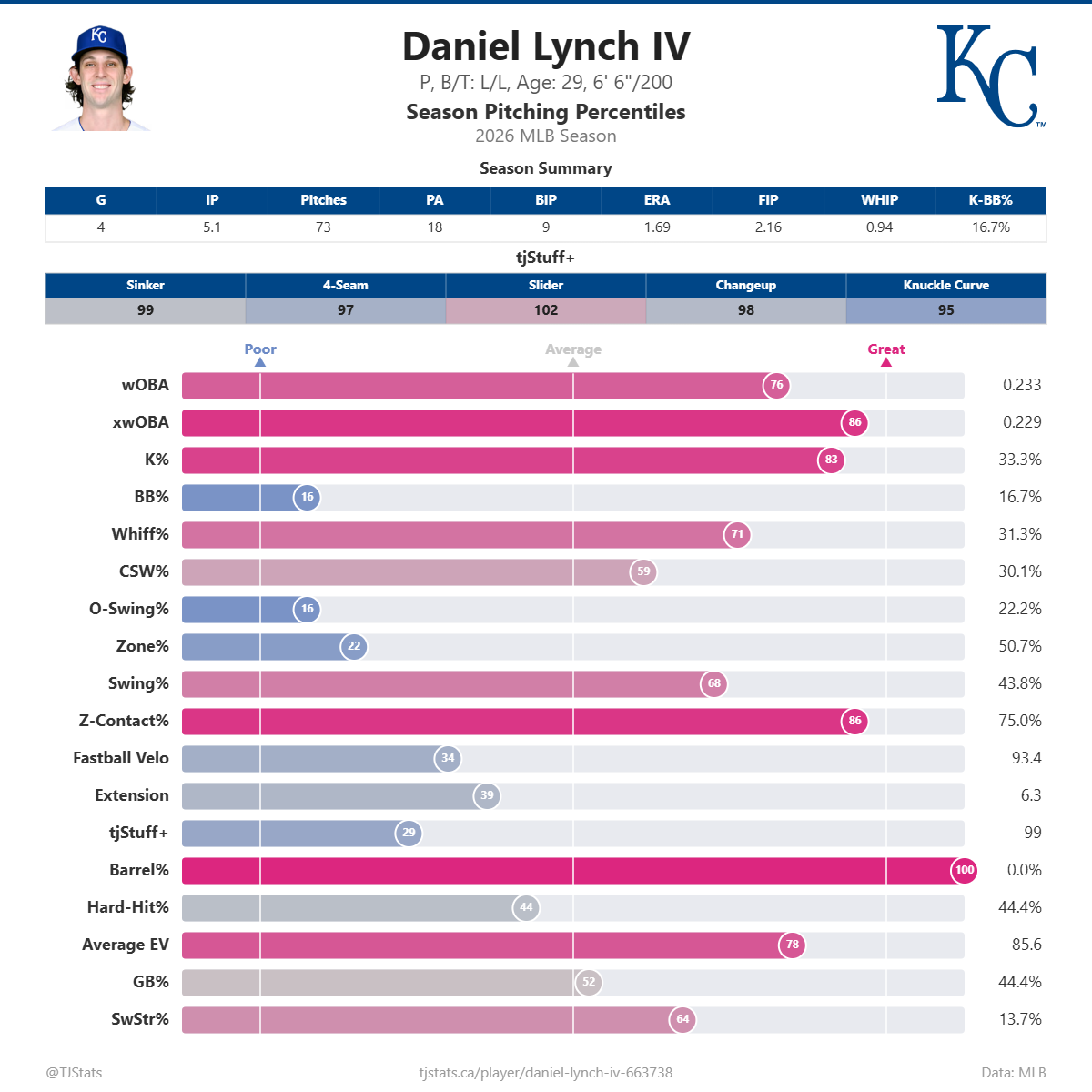
Not only does Lynch rank in the 86th percentile in xwOBA, 83rd percentile in K%, and 71st percentile in whiff%, but he also ranks in the 100th percentile in barrel rate allowed and 78th percentile in average EV allowed. That shows Lynch doesn’t rely solely on whiffs to be successful. He can allow contact and keep the ball in the yard, which is needed from a reliever in certain situations.
The main concern with Lynch is that control has been somewhat sporadic. His zone rate ranks in the 22nd percentile, and his 16.7% BB% ranks in the 16th percentile. As a result of that erratic control, hitters haven’t chased too much, as illustrated by 22.2% O-Swing%, which ranks in the 16th percentile.
The better Lynch can find the strike zone as he pitches more innings, the more effective he will be as a pitcher overall. His whiff ability and ability to minimize hard contact are already encouraging and will only be amplified if his control settles down.
Final Thoughts on the Royals Bullpen
The early results haven’t been good, but I don’t think Royals fans should hit the panic button with the bullpen just yet.
Yes, Estevez wasn’t good, but so much of his struggles were tied to velocity. If he comes back healthy and with velocity, I think he will show the closer form that made him so effective in 2025. Estevez wasn’t a big-strikeout or whiff-generating guy. That said, he flooded the zone, induced weak and ineffective contact, and seemed willing to take the ball in the biggest moments and biggest spots.
Notice how different Estevez’s 2025 Season Pitching Percentiles chart below is from his 2026 one that I showcased earlier in this post.
.png.c2925ba6f87c5459f51952e9f8dc3693.png)
Estevez wasn’t a savant when it came to generating chase (19th percentile), minimizing barrels (31st percentile), or hard hits (27th percentile). However, he attacked hitters and generated strikes (70th-percentile CSW%) with premium velocity (89th percentile) and stuff (80th-percentile TJ Stuff+). The Royals are missing that, and haven’t gotten that so far from Erceg and Strahm, though it’s a small sample.
Even if Estevez doesn’t come back 100 percent, the Royals have big “stuff” guys available who could fill that role, though they are less proven.
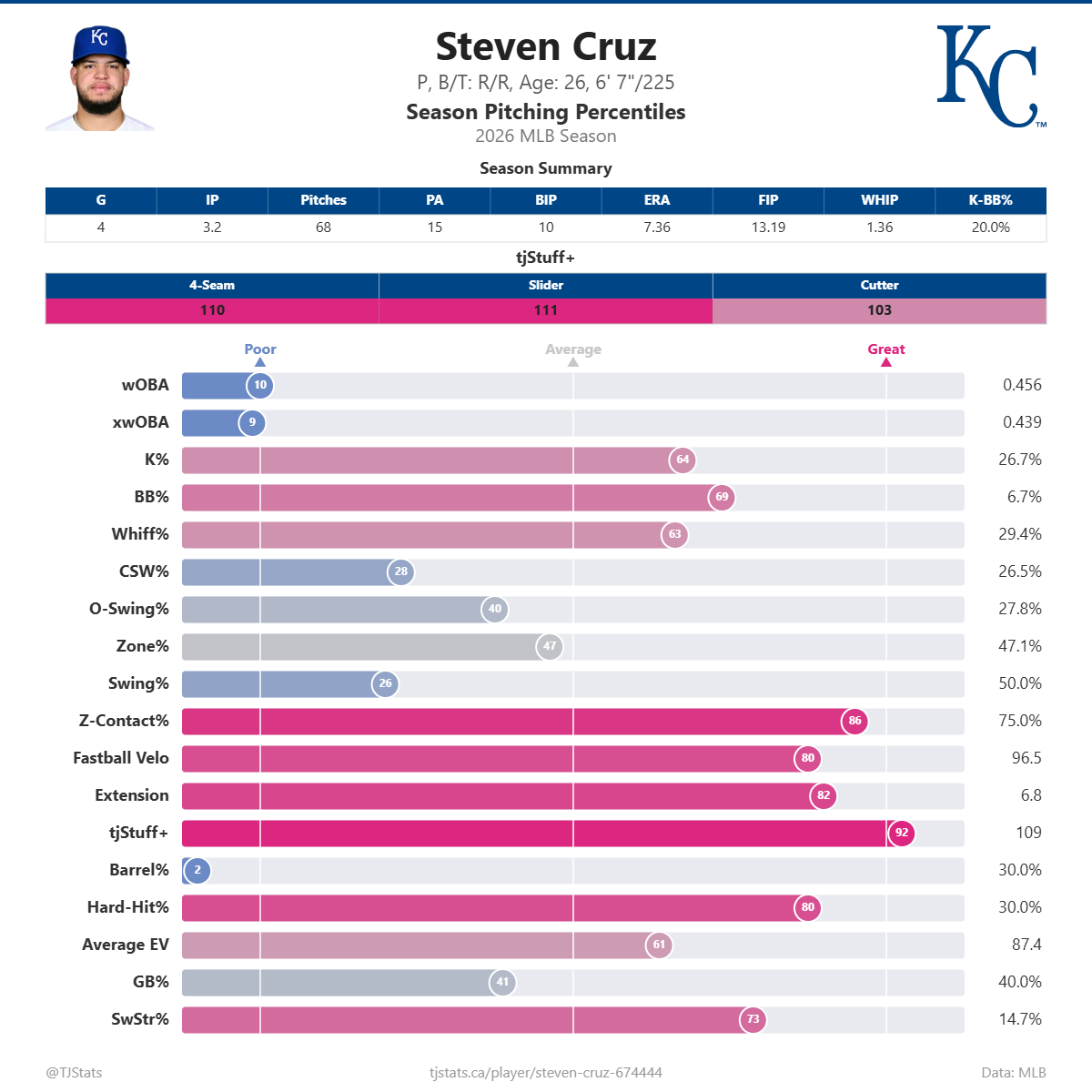
Steven Cruz has given up some barrels and home runs, which explains his high 7.36 ERA. That said, his velocity and TJ Stuff+ have been some of the best marks in the Royals bullpen thus far.
The same was true for Luinder Avila in his lone start, a rough one on Saturday against the Brewers. While he was tagged for five earned runs in three innings of work, the velocity, TJ Stuff+, and extension were all impressive, as illustrated in his Statcast summary below.
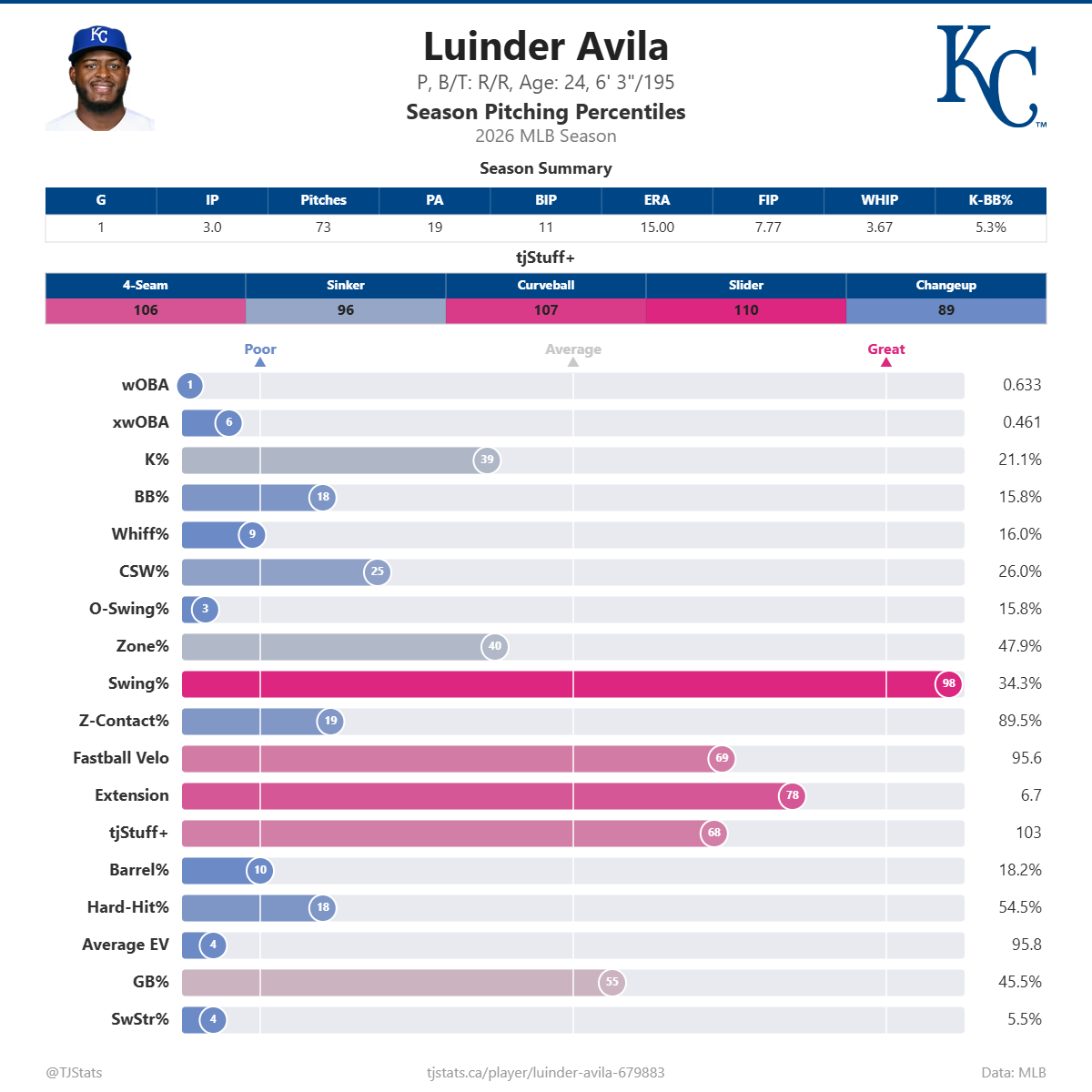
Avila wasn’t immediately sent down to Omaha after his Saturday start. Thus, the Royals may be keeping the promising Venezuelan arm up in Kansas City, with the hope that he can succeed in the bullpen, much like he did a year ago (1.29 ERA and 0.93 WHIP in 14 IP last season).
Therefore, the Royals’ bullpen certainly hasn’t been stellar or pretty so far this year. However, fans shouldn’t throw the towel on this group just yet. Schreiber is a concern, and his role may be lessened, especially if Mears, Lynch, Avila, and Cruz trend upward and Estevez returns healthy. However, there’s enough depth to absorb Schreiber’s regression, which is something the Royals couldn’t say with their bullpen in 2025 or even 2024.
That’s a sign that better days are ahead for this group of Royals relievers.