
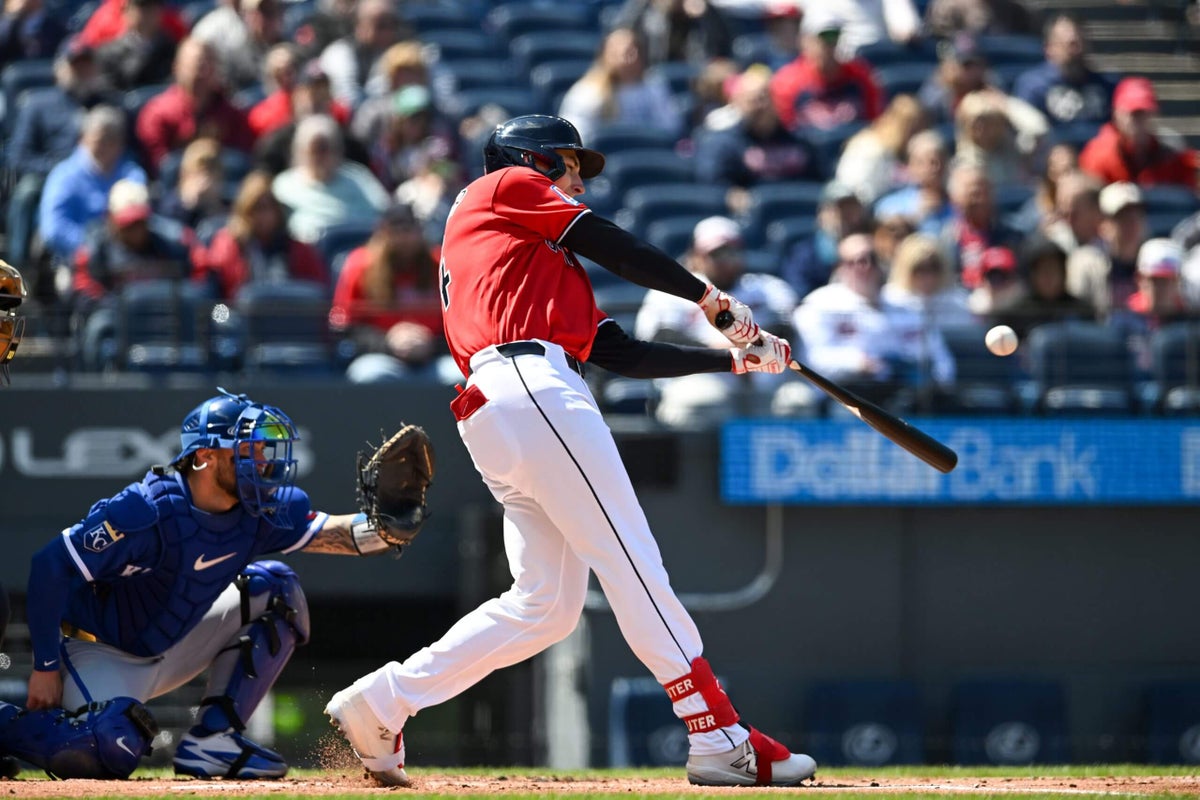
CLEVELAND — Every day, there’s a new Chase DeLauter highlight. A fastball yanked over the right-field fence at Progressive Field. A pitch launched the other way off the 19-foot wall in left. A crowd full of fans, bundled in parkas and winter beanies, shouting the lyrics to his walk-up song, John Denver’s “Take Me Home, Country Roads.”
And every day, questions surface about the mechanics behind it all. How can such a distinct swing inflict so much damage?
Is he scooping the baseball? Is he flicking it? What’s the proper terminology to describe his motion? Is he even completing a full swing? Is he comfortable while doing it? That can’t possibly feel natural, right?
Since the Cleveland Guardians drafted DeLauter in the first round in 2022, DeLauter has heard the questions, the gripes and every critique that his swing won’t work. He hopes his production will silence the critics, if it hasn’t already.
“Forget them,” he nonchalantly said about his detractors. And, no, he didn’t use the word “forget.”
Yes, he might wield one of the more aesthetically unusual swings in baseball. It is also one of the mightiest swings in the league so far this season.
“My swing has been the same my whole life,” DeLauter told The Athletic. “Even if I wanted to change it, I couldn’t do it. All the people who say it’s not a good swing don’t play or probably haven’t played at the professional level.”
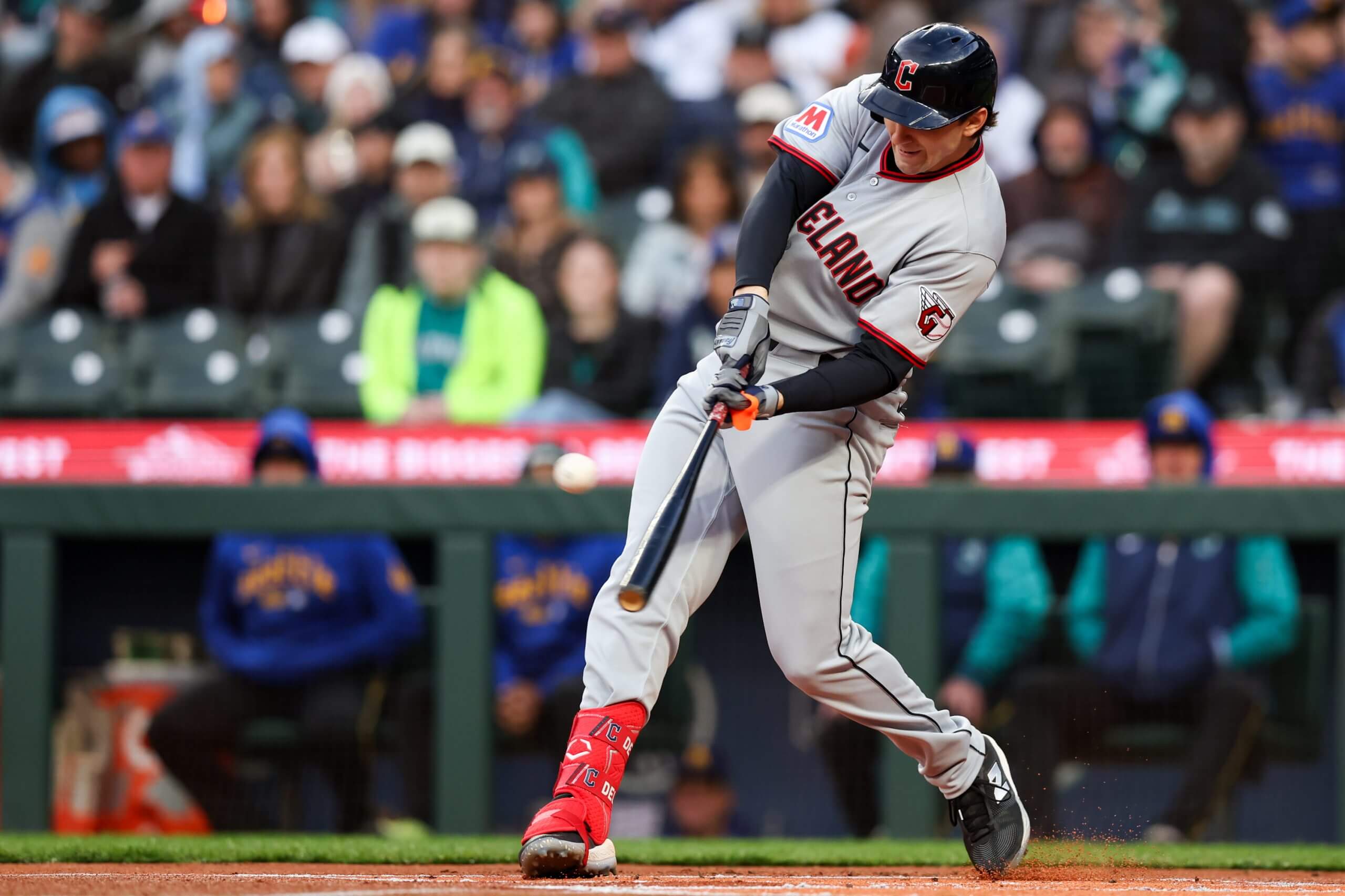
Chase DeLauter rode his unorthodox swing to AL Player of the Week honors for the season’s opening week. (Maddy Grassy / Getty Images)
OK, so what makes the swing so productive?
“The biggest thing with hitting, a lot of people don’t realize, is everything you do is to make the bat move fast and accurately,” Guardians hitting coach Grant Fink said. “If the bat is moving fast and accurately, who cares what you’re doing? You’re doing something. Nobody’s swing looks the same.”
No one knows the nuts and bolts of DeLauter’s setup better than Fink, who’s studied the swing since the Guardians were surveying their draft options four years ago. At the time, he was the organization’s hitting coordinator. Now, he has a front-row seat to DeLauter’s daily fireworks.
There are two elements to DeLauter’s swing, Fink said, that make something that looks so unorthodox work so proficiently. The first is his acceleration. Bat speed is pivotal, and DeLauter’s ranks in the 54th percentile, but it’s how quickly DeLauter accesses his peak bat speed that makes him such a threat.
“It’s like a 0-to-60 versus a top-end speed,” Fink explained. “His bat speed is above-average, but it’s not outrageous. But his ability to get to his top-end speeds faster and earlier is what leads to a lot of the hard-hit balls. On something inside, where a lot of guys might be beat or have to manipulate, he’s able to continue through the swing.”
DeLauter’s metrics include healthy rankings in hard-hit rate, barrel rate and average exit velocity, as well as a slew of expected stats that match the eye test.
The elite acceleration grants DeLauter more time to make a decision. In the split-second after a pitcher releases the ball, DeLauter attempts to recognize the type of pitch spinning his way, its location and movement profile. Then, he must determine if he can inflict damage on it.
Every nanosecond counts, and since he can generate his best bat speed in such a short period, he has more time to cycle through that process.
“The quicker you can get up to (top bat) speed, the more you can let the ball travel,” Fink said. “The more you can let the ball travel, the better your decision-making typically is.”
For as much as DeLauter has flaunted his power early on, with a league-high five home runs, his plate discipline has always been at the root of his production. He has even joked with Fink in recent days that he “isn’t even a home run hitter,” despite his stat line.
“He’s not, naturally,” Fink said. “He doesn’t hit the ball super high. He’s more of a gap-to-gap hitter, but pitchers throw homers, and when you get pitches on the inner third that you have to turn on, he’s going to run into those.”
Chase DeLauter keeps crushing 😤
He LAUNCHES his 5th homer of the season! pic.twitter.com/wsi0WCJRu9
— MLB (@MLB) April 3, 2026
That’s what happened during the Guardians’ home opener last Friday against the Chicago Cubs. Hunter Harvey fired a waist-high 3-1 fastball on the inside part of the plate. DeLauter pulled in his hands, twisted his torso and shot it into the right-field seats. The swing looked effortless.
As soon as he made contact, DeLauter dropped the bat at his feet and admired the ball’s flight path.
DeLauter explained that the pitch was too far inside for him to extend his arms for what would look like a more traditional, full swing. But he flexed enough muscle and created enough bat speed in time to power the 97 mph heater into the stands.
“Getting my hands crazy extended through the ball has never really been one of my biggest focus points,” DeLauter said. “It’s been more whatever I need to do to get the barrel to the ball. So when I swing like this (hands in), it’s usually because I’m late and I have to somehow get the barrel there. If I try to fully extend, there’s no way I’m gonna get to the ball on time. So those ones are more typically fastballs in, and I’m like, ‘Oh crap, I’m a little beat,’ and I try to turn and get the bat there as fast as I can.”
The second element of the swing that stands out is how it almost appears as if DeLauter stops halfway through.
“It’s all a balancing mechanism for being able to produce elite levels of force and speed in a really quick, tight window,” Fink said.
Fink compared DeLauter to a car that plunges into a brick wall. Others hit the brakes more gradually and slow to a halt.
“If you’re going to produce that much speed early, you have to have the ability to stop,” Fink said. “Otherwise, you’d just spin. So his ability to stop the bat, with his strength, it makes it look like he’s just kind of flicking the ball. But really, if you slow it down and look through it, he’s taking a full swing.”
CHASE DELAUTER DID IT AGAIN! pic.twitter.com/JSdl4iixV9
— MLB (@MLB) March 29, 2026
There’s no better example of how DeLauter has mystified teammates, coaches and Cleveland fans than his opposite-field homer in Seattle on March 28.
If you pause the video of Andrés Muñoz uncorking a 97 mph fastball high and outside just as the ball is arriving at the plate, DeLauter is finally starting his swing. Yet, he still had time to trigger enough acceleration and strength to drive the pitch over the left-field wall.
“He can hit the ball the other way,” Fink said. “He can hit the ball high to the pull side. He can let a ball travel really far and shoot a ground ball through that way. He’ll walk. He will be patient at times. It’ll be exciting to see what he ends up turning into, but he has the ingredients to have the whole package.”
The Guardians — and DeLauter — don’t care what it looks like, either. They’re just thrilled it’s working.
“There are going to be swings that look more normal on certain pitches,” DeLauter said, “maybe hanging breaking balls that are out over the plate and I can get a little more extended on, stuff like that. But typically, it’s just whatever my body does. As long as these guys (hitting coaches) are saying whatever I’m doing is right, then we’ll just roll with it.”