
DETROIT — It is very early in the season, and the Tigers are not off to their best start. Welcome to the world of high expectations, where the tendency to overreact and draw ire only rises from its baseline.
The Tigers remain a playoff team with what should be the most talented roster in the American League Central. With those designations, though, come criticism when you lose games to the Minnesota Twins and questions when the team doesn’t play its best baseball from the jump.
Thursday and Friday, we’ll turn to the mailbag to see what fans have on their minds.
Questions have been lightly edited for length and clarity
What are your thoughts on pinch-hitting Jahmai Jones for Colt Keith against left-handed pitchers fairly early in games (when it’s likely he’d get another at-bat)? Will they let Keith get some ABs against LHP this year? — Jeremy S.
The Tigers last season used pinch-hitters 41 times more than any other team. Those pinch-hitters had a 106 wRC+, which means they posted better than league-average results. I’m surprised by how strongly people seem to be pushing back against manager A.J. Hinch’s use of pinch hitters so far this season. It is odd that the Tigers entered Wednesday night’s game 0-for-9 with a sacrifice fly in pinch-hit at-bats. But it’s an incredibly small sample.
The reason Hinch has gone to Jahmai Jones in big spots — even if it means Jones might get a later at-bat against a righty — is pretty simple. Hinch is taking his shots with runners on base, at the highest-leverage moments of the game.
If there’s a lefty on the mound and runners on base, who gives you the best chance to cash in? Is it Jones, who had a .970 OPS against lefties last season? Or is it Keith, who had a .403 OPS against left-handers in 46 plate appearances last season? The answer should be pretty clear!
Now, it’s entirely possible Jones doesn’t replicate last year’s success. It’s entirely possible that Keith improves somewhat against left-handers. But I don’t at all fault Hinch for trying to capitalize on the opportunities right in front of him and worrying about later at-bats when the game gets there.
I was a little surprised he didn’t hit Zach McKinstry for either Jones or Matt Vierling late in the series finale against the Cardinals, but it’s worth noting McKinstry actually only has a career .680 OPS against right-handers.
Albeit in only 25 at-bats last season, Jones hit a surprising .280 against righties, though all seven of his home runs came against lefties.
I don’t think the Tigers are going to change their ways. And in this case, I don’t think they should.
Who makes the Tiger lineups? Is it Hinch or Harris or a combined effort or just do what the analytics say? So many odd lineups that don’t make sense. I know Hinch liked Carpenter being in the 19th spot in the lineup, but I don’t see it.— Philip C.
I’m under the impression Hinch makes his own lineups and always has, presumably with varying degrees of collaboration with the front office and analytics department. Hinch, at least in my mind, tends to get creative in predicting how games will unfold and capturing things predictive models might lack the context to account for.
Carpenter hitting leadoff is a prime example. For anyone who doesn’t understand why Hinch often prioritizes the 19th at-bat of the game, I would recommend revisiting last year’s ALDS, when Mariners manager Dan Wilson was tied in knots debating mid-game pitching decisions, and a few key Carpenter at-bats nearly propelled the Tigers to the ALCS.
But I also see your point. Even against right-handers only, Carpenter has a good-but-not-great career .329 on-base percentage. Part of all the mixing and matching and outside-the-box lineup construction has been about trying to maximize the Tigers’ strengths and perhaps help the team be greater than the sum of its parts. But do the Tigers sometimes get a little too cute? I know there are people in the league who think that.
Another point: In 2019, Hinch led off George Springer in all 119 games Springer played. Jose Altuve hit second 106 times.
One harsh truth is that while the Tigers have developed some very good players, they don’t have hitters of quite that caliber, and that’s at least part of why the lineup varies so often.
If anything, I think the biggest challenge Hinch faces right now is dividing playing time for the likes of Matt Vierling, Javier Báez and McKinstry now that Kevin McGonigle is on the roster.
You can ONLY pick one position player. Who will be represented in the All-Star Game this year? — Matt H.
This is a fun question. First of all, I’d say don’t be surprised if the Tigers again send several players to the All-Star Game. Despite his slow start, Riley Greene has been an All-Star each of the past two seasons. Gleyber Torres remains a quality hitter at a second-base position that doesn’t boast many true stars in the American League. Kevin McGonigle will likely hit a rough patch as all players do, but man, it would be fun to see him make it if he keeps this up.
For this question, though, I’m going to pick Dillon Dingler. Dingler won a Gold Glove last season. He didn’t make the All-Star Game in 2025 but finished third to Cal Raleigh and Alejandro Kirk among all MLB catchers with 4.1 fWAR. Dingler already has two home runs, and I wouldn’t be shocked if he easily exceeds the 13 homers he hit last season.
So long as his defense remains elite, he’s going to be on a short list of catchers worthy of making the Midsummer Classic.
What, if anything, do they do with Wenceel Pérez? — Lazarus J.
Everyone is always clamoring for the next guy up. It’s a weird cycle. Pérez is down in Triple A, where he entered Wednesday hitting .263 with two home runs. When there’s an injury or if someone is struggling badly in two or three more weeks, I expect Pérez to be the next guy promoted. And then people will go on demanding a call-up for Max Clark or someone else in place of whoever the next slumping player is!
Pérez is still a big part of the team, and I think we’ll see plenty of him this summer, one way or another.
The Twins’ Taj Bradley baffled Tiger hitters by throwing fastballs at the lower rail and then using his splitter to strike them out. If this strategy worked so well, why are Tiger pitchers throwing fastballs at the top rail when their secondary pitch is a splitter? — Stan W.
This actually gets into a pretty detailed pitching discussion. The simplest answer? Tigers’ pitchers sometimes do indeed do this! Casey Mize, in particular, has talked of watching Kevin Gausman freeze hitters with bottom-rail fastballs and wanting to implement more of that in his own game. But if you’re only throwing stuff at the bottom rail, eventually hitters will simply eliminate anything up and start hunting low fastballs. That could quickly turn … problematic.
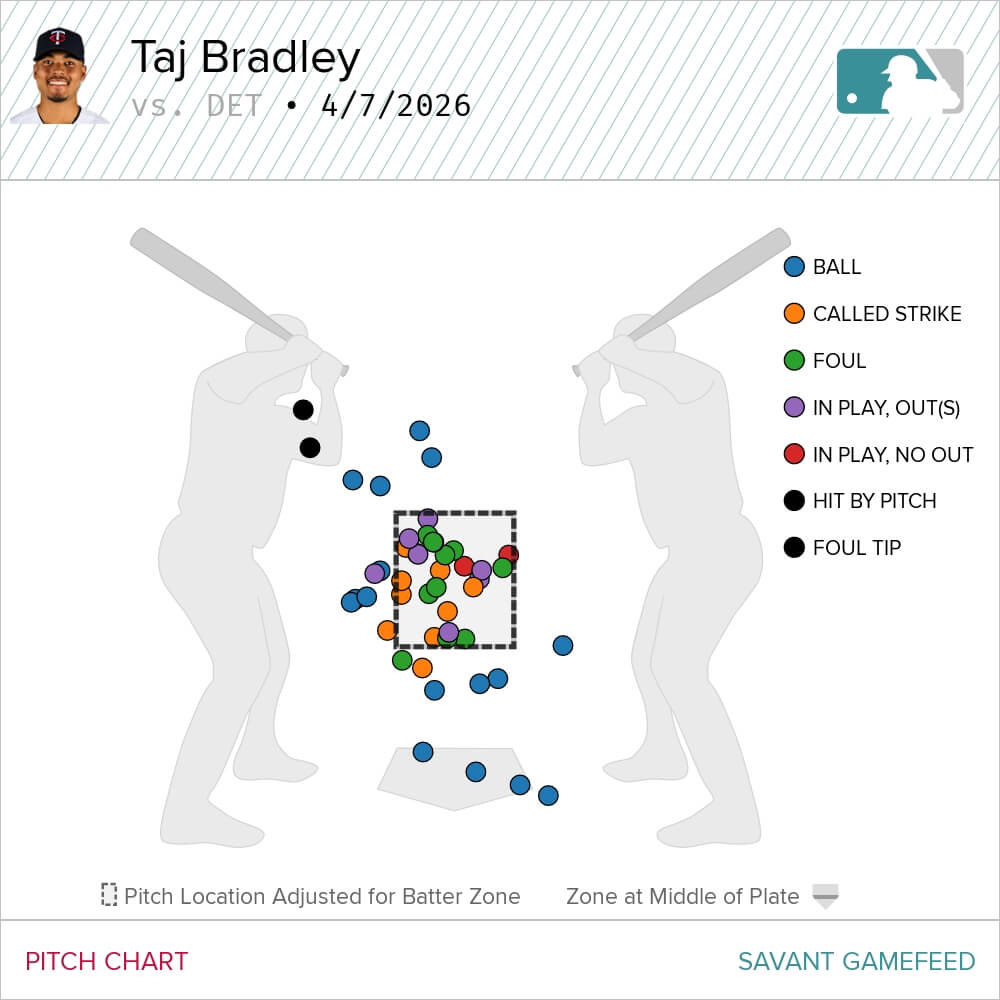
Taj Bradley’s four-seam fastballs against the Tigers. (Baseball Savant)
For pitchers like Mize, elevated fastballs can come with the best chance to get swing-and-miss. They can ensure hitters have to cover everything from the top rail to splitters in the dirt. They can change eye levels and potentially help make the splitter more effective. It helps if you can occasionally deceive a hitter with a perfectly executed four-seam at the bottom of the zone.
Even Bradley threw plenty of fastballs belt-high or above on Tuesday. He obviously had a good night and got plenty of called strikes. But the Tigers might have also had some approach issues. They did not swing and miss against his fastball. They watched the pitch far too much.