
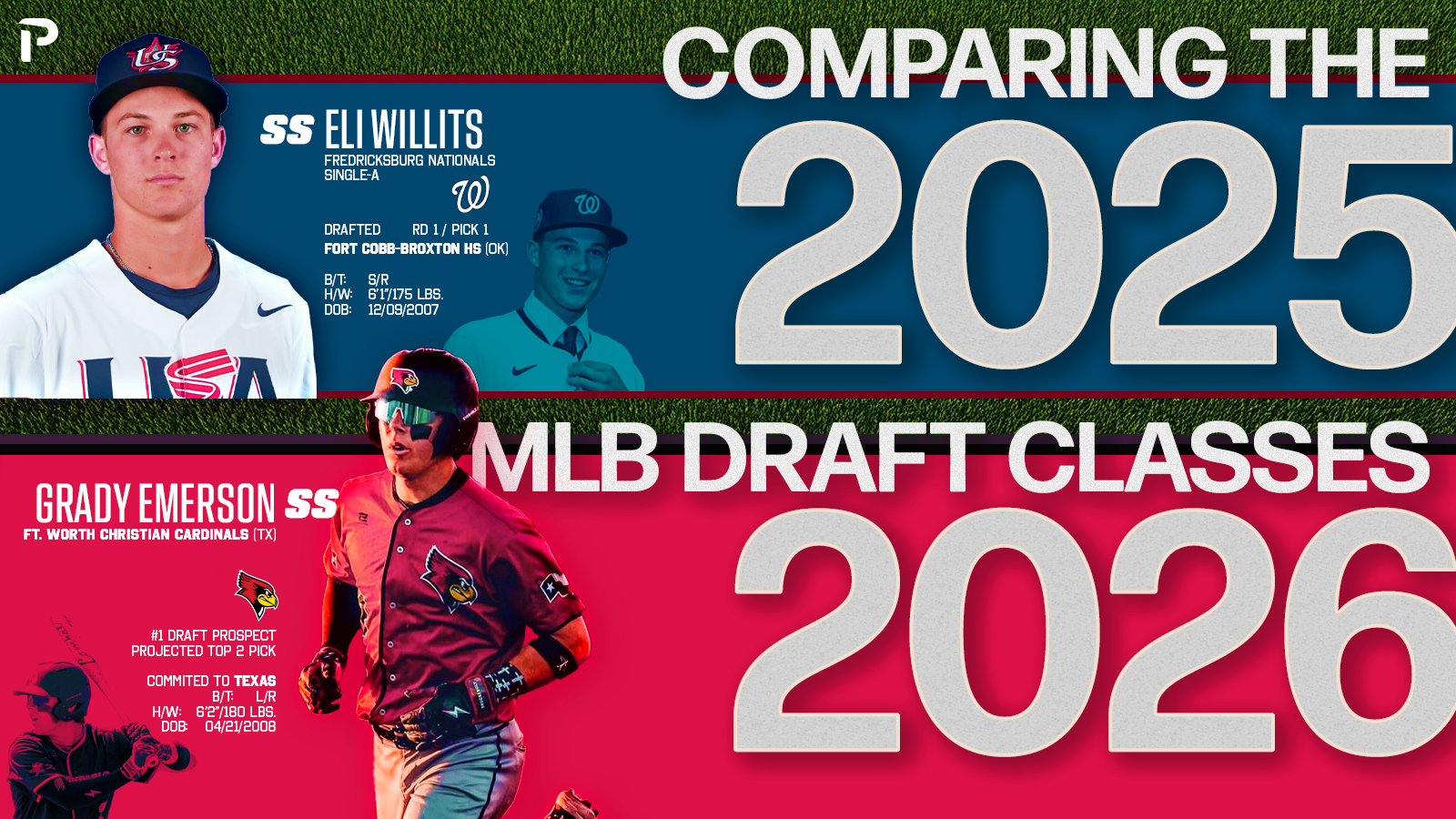
Not all drafts are created equal. So many people think just because a player is a 1st round pick, they are automatically worth a high selection in a dynasty draft. But that is not always the case.
The same holds true in Dynasty leagues — not all draft picks carry the same value. The key advantage in Dynasty, however, is that you can leverage those picks to shape your strategy. If a class is weak, you might use your pick as a trade asset in the middle of the season. If it’s a strong class, consider trading a current prospect to move up. These strategies are crucial for success and can make a significant impact.
To help you prepare for the 2026 draft, we’re going to compare it to the 2025 class, ensuring all Dynasty owners are ready to make the most of their draft decisions.
2026 Draft Class vs. 2025 Draft Class
College Position Players
When doing this exercise last year, the college position player class carried the weight of the comparison. While the 2025 group checked three out of the four boxes, the 2024 group still graded out better. I wouldn’t be shocked if this is the same.
The reason why is because draft trends have shown that the most important and reliable group of players is the college position player group. The combination of a higher level of competition, and the data accessible at the college level, allows orgs to make the most informed decisions. With all that in mind, it shows how weak the 2025 position player group was. Out of the whole 1st round, there was only one position player selected in the top 10, with seven being selected in the top 30. When MLB orgs have as much data as they do on college prospects, seeing only seven selected in the 1st round shows how weak the group was.
Comparing that to the 2026 class is a world of a difference. The 2024 group was one of the best draft classes in recent memory, and that was in large part due to the college position players. The 2026 class is comparable to that group. It’s a crop of dudes led by Roch Cholowsky, Vahn Lackey, AJ Gracia, Chris Hacopian, Justin Lebron, Drew Burress, and several others, many of which would have been the top prospect in the 2025 class.
The college position player crop is the most reliable demographic, and as dynasty owners we should recognize that. The strength of the 2026 class is in the most reliable group, and it might not even be close.
Advantage: 2026 Class
College Pitchers
Filling this out last season, I was wrong. I emphasized that I liked the depth of the 2025 class better than 2024, and while that might be true, the high end talent should be the only thing dynasty owners care about. If you are going to miss, you want to miss on high ceiling talent. Reliable starters can be found on the waiver wire every single spring.
Coming into the year, it seemed like Cameron Flukey would be the top pitcher in the 2026 class. He has battled injuries so far, and Jackson Flora has taken the reigns and run with them. He is currently on a 34 IP scoreless streak with a 0.69 ERA, 65 strikeouts and 15 walks in 52.1 IP. Considering the top 2025 college pitcher was his teammate, Tyler Bremner, it is easy to see why the 2026 class is better at the top.
Where the 2025 class buildt its strength was in the SP2 conversation. Kade Anderson, Liam Doyle, and Jamie Arnold were all selected in the top 11. That is as much a showcase of the strength of the 2025 pitcher class as the lack of top end talent of the college position player group. The 2026 class lacks in the SP2 conversation – it genuinely could be anybody. While there are some really strong arms in the group, it will not match the top end talent of the 2025 class.
Advantage: 2025 Class
Prep Position Players
The strength of the 2025 class was the prep position player group. As I can’t emphasize enough, I think that was just as much because of the lack of talent in the college group, as the strength of the prep class. But it was a strength nonetheless.
12 of the top 30 selections in 2025 were prep position players. Leading up to the draft, I was wondering what direction MLB orgs would go. And the reality is they went with the prep position players, because if you are going to be unsure of the 1st round talent in the draft, it makes the most sense to miss on ceiling and potential. While many prospects like Eli Willitts, Daniel Pierce, JoJo Parker have “safe” profiles, all 18-year-old prospects with no data are risks. Drafting is gambling, and MLB orgs felt like the 2025 prep class was the one to push the chips in for.
I say all that to say, I still think the best top end talent is in the 2026 class. To me, the combination of Grady Emerson and Jacob Lombard would both be the top overall player if they were drafted in 2025. After the prep arms race of 2025, I wouldn’t be surprised to see neither of those two selected in the top 5, but both outperform the top of last year’s group. It really is a coinflip between the top end of this year’s group and the depth of last year, but I will still give the nod to the 12 position players in the 2025 class making a larger impact.
Advantage: 2025 Class
Prep Pitchers
When talking about a coinflip, the prep pitcher class creates the most random outcomes. The combination of command and refinement, plus the ever changing injury issues in the sport, means you really never know. How is it possible to evaluate a pitcher throwing 100 mph against competition that is more likely to pledge a frat than play baseball beyond graduation? The easy answer is you can’t.
But since we have acknowledged that reality, the success for 1st round pitchers has risen. It feels like every year a high school pitching prospect rises to be one of the top prospects in all of baseball. MLB orgs are just making better decisions when they decide to go with a prep pitcher.
Where the 2025 class only had two prep pitchers drafted in all of the 1st round, the 2026 class could have two in the top ten. Gio Rojas and Carson Boleman have the potential to fill the SP2 void the college pitching class is lacking. Both Rojas and Boleman alone lead the charge in front of the 2025 class. Any names who rise up the board will just widen the gap.
Advantage: 2026 Class
Overall
This is always one of my favorite projects to work on. It is a great way to dive into each group and get beyond just the simple evaluation of every player individually. As I mentioned at the top, the college position player group will always be roughly 75% of the equation. There is so much publicly accessible information on that group, and they have at the very least competed against college level talent. The strength of that group alone makes the 2026 class the nod.
Combine that analysis with the gap between the top of the prep pitching class, and it makes it easier. The other groups feel a lot closer, and the overall sentiment is that the 2026 class has a chance to be special. The further I get away from draft day, the more I feel like the 2025 class will be a forgotten group with the best players being selected on day two.
Advantage: 2026 Class