
Get Starting Point
A guide through the most important stories of the morning, delivered Monday through Friday.
Yet behind all of that, there is a difference in the organization’s priorities and mission. The Sox under Bloom were building methodically towards (and rarely willing to compromise) the future.
But with the farm system now bearing fruit at the big league level, Breslow sees his job as taking place at a different point in “the evolution … [and] lifecycle of a baseball operation” than his predecessor.
“I think most of Chaim’s tenure was really spent trying to improve the state of the system, to have some eye on the future,” said Breslow. “And we are kind of now in a place where we’re prioritizing wins in the present.”
Given that reality — one that led Breslow and the Sox to work with Bloom on multiple trades this offseason, with the Sox acquiring Sonny Gray and Willson Contreras from St. Louis in separate deals in exchange for Richard Fitts, Hunter Dobbins, and four minor league pitching prospects — what’s an appropriate response to the way the team has played?
The Sox began the year with losses in eight of their first 10 games, matching the worst start in franchise history. Did Breslow consider benching players or changing their roles? Issuing ultimatums demanding improved performance? Staff shakeups?
Not so much. While there have been plenty of internal conversations at Fenway Park about the specific struggles of both the team as a whole and individual players, Breslow and his front office remain committed to a patient view.
“I think decisions made at the height of emotion are generally bad decisions,” Breslow said Thursday, downplaying both the team’s slide out of the gate and its two-game win streak to improve to 4-8. “We want to think about, is there anything here that we’re missing? Are there underlying trends that lead us to believe that, hey, maybe this isn’t just a small sample and we’re going to positively progress at some point here soon? We don’t want to be irresponsible in terms of looking at the players, looking at the roster, thinking about how these things come together. … I think in my role, in [manager Alex Cora’s] role, through these types of swings, you keep things as normal and ordinary as possible.
“Players know that they have to play better. Us pointing that out isn’t going to do anything. We believe in the players. We believe in the roster. There isn’t something that’s going to happen over the course of the first 12 games that’s going to change that. So I think the most important thing is just to make sure that the work that we believe is going to be productive in spring training and into the season continues.”
That view extends to the field staff. Breslow isn’t a believer in early-season firings as a catalyst.
“The coaches that got us to the playoffs last year, six months ago, our belief in them has not changed because we got off to a 10-game stretch that was underwhelming,” he said. “If we believed in a practice, method, piece of information, insight two weeks ago, we still need to believe it today.”
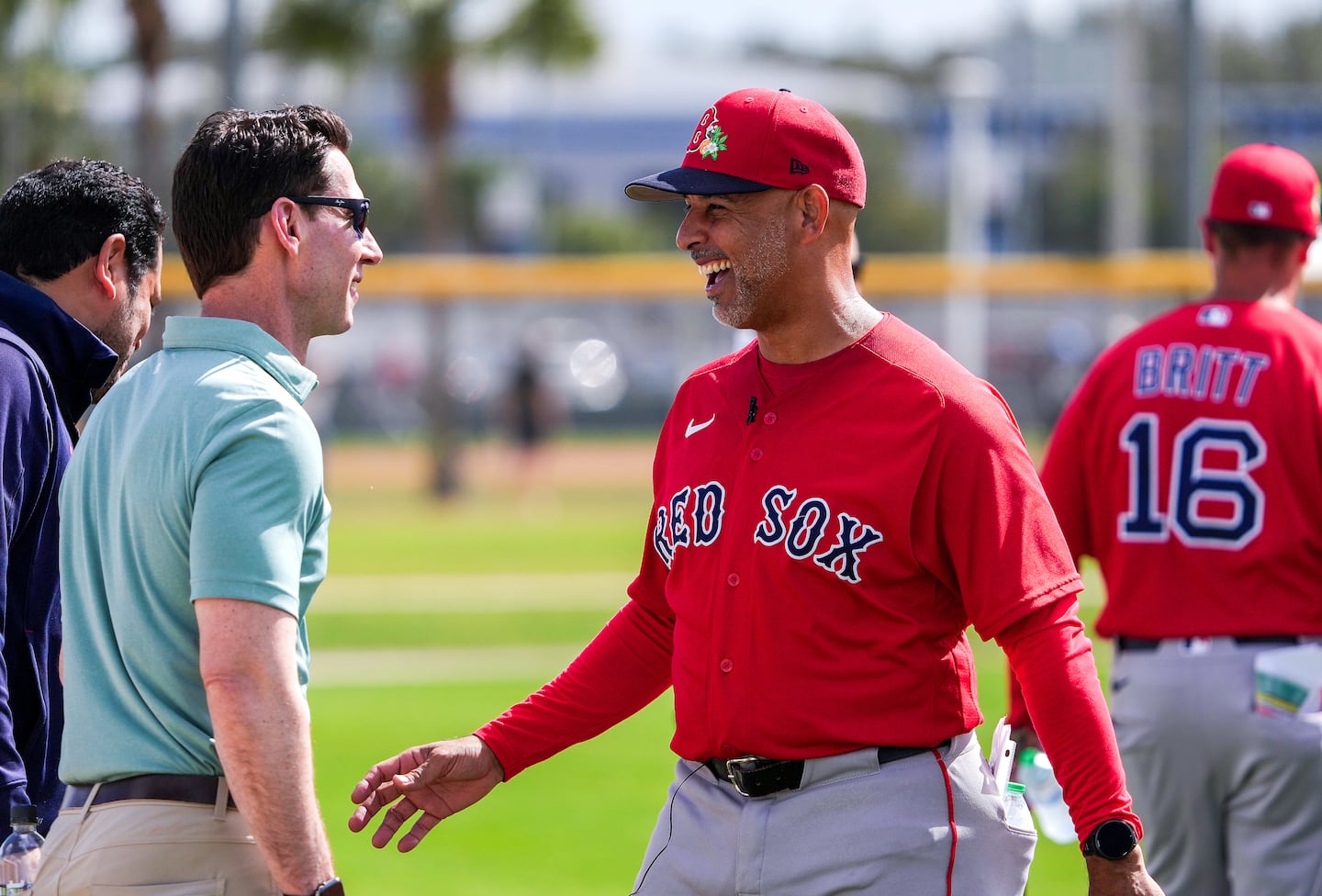 Craig Breslow has full faith in manager Alex Cora (right) and his coaching staff. Barry Chin/Globe Staff
Breslow said the Sox simply need to play with more consistency. They’ve seen glimpses that, yes, there is a path for them to succeed if they pitch well, play strong defense, and put the ball in play. The club is 4-0 when getting six innings from a starter, and 0-8 when they fail to hit that mark. They’re 0-4 in games where errors yield unearned runs, and 4-4 when they don’t.
For now, the team needs sharper execution in every facet to prove that the poor start is an aberration. Of course, it’s fair to wonder if some of these early deficiencies are reflective of the roster.
If the rotation (4.55 ERA, 23rd in the big leagues) ends the year as one of MLB’s least effective, that would qualify as a surprise. If the team’s lack of power — with nine homers, the Sox entered Thursday as one of seven teams that hadn’t reached double digits yet — continues after Breslow’s self-described “pivot” from pursuing power to emphasizing pitching and defense, he will sit in a dunk tank.
Breslow expresses little concern about the team’s lack of thump. Though the Sox as a team have posted a .356 slugging mark that ranks 17th in the big leagues, he remains convinced of the lineup’s potential.
“To grab any 12-game stretch and question the slugging feels kind of arbitrary,” said Breslow. “Our guys are very capable of doing damage — of hitting the ball hard, getting extra-base hits and home runs. Those will come. We’ve just got to give ourselves as many good opportunities to score as we can.”
Even so, the persistent questions surrounding the lineup make Breslow’s willingness to shift his offseason course fascinating. The Sox wanted to deepen their lineup by not only trading for Contreras in December but also re-signing Alex Bregman. When Bregman instead accepted a better offer with the Cubs, Breslow and the Sox quickly signed free agent lefty starter Ranger Suarez.
Breslow has frequently cited the ability to remain strategically nimble as one of his foremost lessons since taking this job. But given that he’d identified upgraded power as a key offseason focus, might a more meaningful lesson be the need to extend further beyond the team’s comfort (in dollars, prospect cost, or both) to shore up an admitting shortcoming?
“I don’t think there’s a clear answer. I think the answer is both,” said Breslow. “You are constantly solving, working backwards from building a team that wins the greatest number of games. And there are times where you can move past whatever your comfort level was, because there’s something that fits your roster so well, particularly relative to the alternatives. And then there are times where you say, ‘OK, I’m comfortable pivoting, looking at alternatives, walking away, because the other options that are here are going to enable us to build a net better team.’”
Ultimately, Breslow’s offseason will be evaluated not on a 12-game stretch, but where the Sox finish the year in the standings. There is time for his approach to succeed — or to be subjected to relentless scrutiny.
Alex Speier can be reached at alex.speier@globe.com. Follow him @alexspeier.