
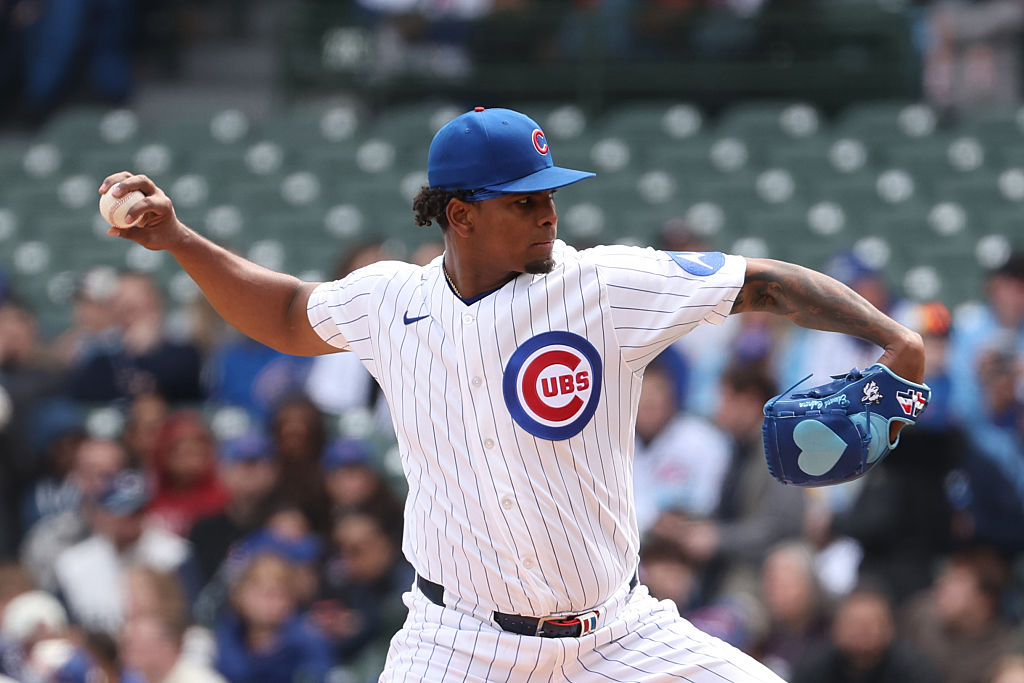
That group, along with injured starters Cade Horton and Matthew Boyd, had excelled as a whole through the Cubs’ first 13 games. Entering Saturday, the rotation’s combined 2.47 ERA was the National League’s lowest mark (second-lowest in MLB).
”Everybody going out there is just as important as the next guy,” manager Craig Counsell said pregame Saturday. “We’ve gotten very good starts from our starting pitching. Our starting pitching has been excellent. In the course of the season, we got 150 more of them, so it’s a huge part of the game. They’re pitching at a really high level and keeping us in games and keeping runs off the board. They’re doing a great job.“
Facing the Pittsburgh Pirates on Saturday afternoon at Wrigley Field, though, Cabrera struggled to keep runners off base. He managed to work through the traffic enough to still deliver five innings, but he finished allowing three runs on eight hits and three walks in Chicago‘s 4-3, extra-inning loss loss.
”His command was a little shaky, frankly, in the Cleveland game [on April 5]; just, it was 32 degrees, and he got away with some things, I think,” Counsell said. “But his command got him into a lot of bad counts.”
Cabrera’s nasty changeup didn’t record the usual making-hitters-look-foolish numbers. The velocity on 43 total changeups was only fractionally lower, and the movement profile looked similar to his previous two outings.
Yet, it recorded only a 22.7% whiff rate — well below its 35.1% rate entering Saturday.
“What can I tell you? It’s not invisible, so there’s gonna be some days that that’s gonna happen,” Cabrera said through interpreter Fredy Quevedo Jr.
For Cabrera, it seemed like a combination of the Pirates seeing him well and him not having his best command. But despite giving up each of his first three runs as a Cub on Saturday, still managing to get through the fifth inning was big. In this day and age, three runs over five frame is still giving your team a chance to win.