
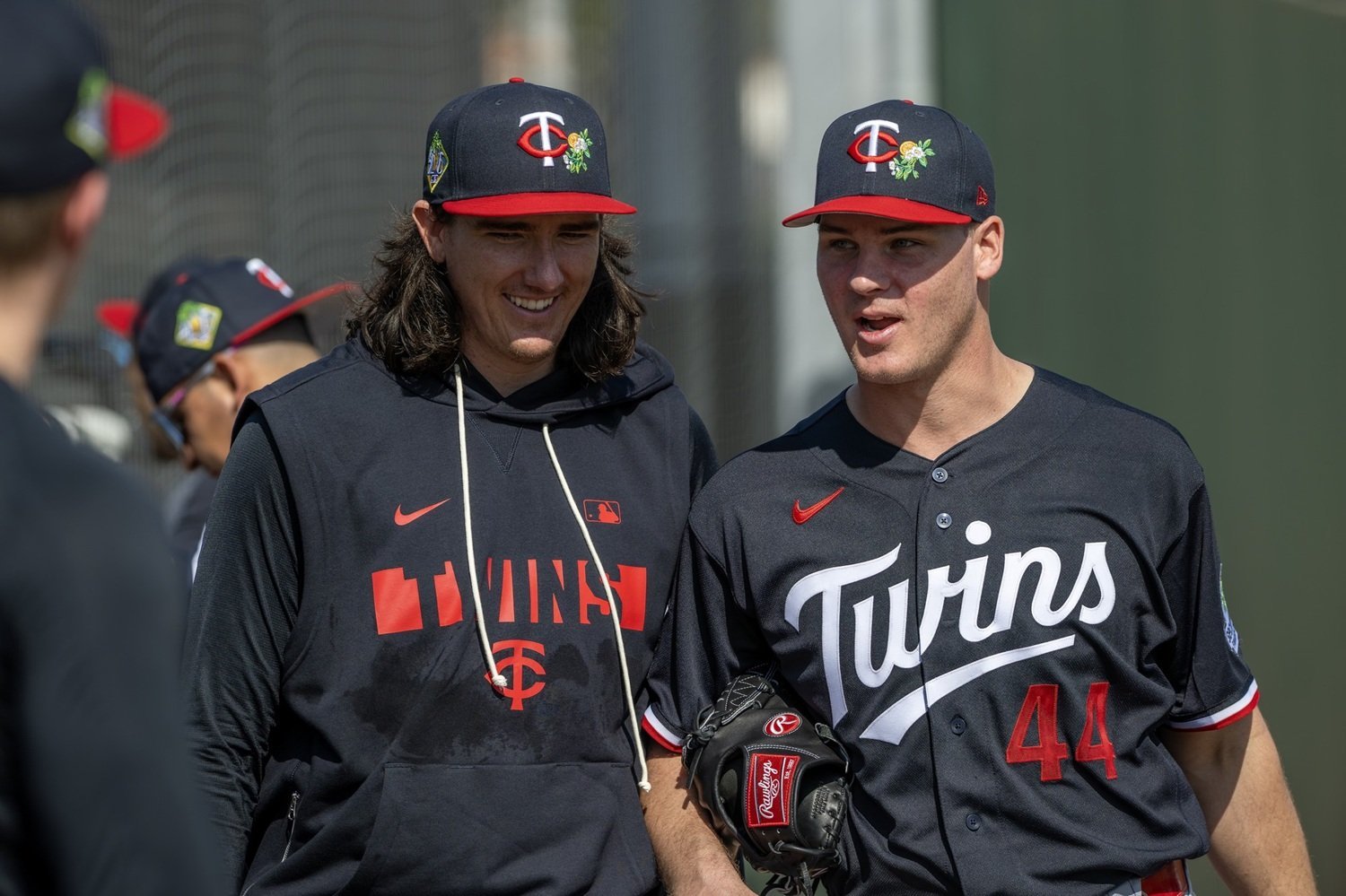
The closer-by-committee approach is common in today’s game, but the Minnesota Twins are taking it further early in 2026. In the opening 16 games, five different pitchers have recorded saves, and there’s no sign that anyone will take hold of the role more firmly any time soon.
If someone had told you that five different pitchers would get the Twins’ first five saves of 2026, that probably wouldn’t have shocked you. What is surprising, though, is just how committed the organization appears to be to avoiding a traditional bullpen hierarchy.
There is no set closer or defined eighth-inning bridge. Instead, Minnesota rotates relievers into late-inning roles based on matchups, relying on depth and adaptability.
“I think that was the plan going in,” Eric Orze said. “Closer by committee. Everybody ready to go at all times. The boys are doing their job.”
Cole Sands Continues to Evolve
Though Sands has now moved into more frequent high-leverage spots, early in the season, he initially appeared to be Derek Shelton’s preferred late-innings option. However, due to a high walk rate, his role has shifted somewhat, and he was even removed mid-inning after issuing multiple walks versus Detroit. Shelton noted later that he had almost immediately seen that Sands’s command wasn’t sharp.
Still, his ability to navigate different pockets of a lineup makes him an ideal candidate for this kind of bullpen structure. Whether it’s the seventh inning against the heart of the order or the ninth against the bottom third, Sands can be deployed wherever the matchup calls for it. That flexibility is precisely what Minnesota values most right now—even if the main reason for that is the lack of any pitchers who could be sicced on the opponent without thinking along those lines.
Justin Topa Brings Stability
Topa was brought into the Twins organization as part of the Jorge Polanco trade and came with late-inning experience. The Twins haven’t seen the same version of Topa since he joined the organization. However, he’s not being pigeonholed into a single role. When healthy, Topa offers a power sinker and the kind of ground-ball profile that plays in tight spots.
Last Tuesday, Orze was given the initial save opportunity but was pulled after yielding an RBI double to Kevin McGonigle. With Sands and Taylor Rogers already deployed earlier in the game, the Twins turned to Topa, who proceeded to seal the win for Minnesota by getting two of the next three batters to ground out. In this system, Topa is less a closer and more a fireman.
Eric Orze Adds Another Option
Orze brings a different look to the bullpen. With a plus splitter and the ability to miss bats, he gives Minnesota an option for situations where strikeouts matter. That skill set is especially valuable against contact-oriented lineups. Rather than relying on contact management, Orze can put away hitters himself when needed.
Orze earned his first save in Thursday’s 3-1 win over the Tigers, recording one strikeout in a hitless and scoreless ninth inning. With Kody Funderburk, Topa, and Sands all pitching three of the previous four days, manager Derek Shelton went to Orze in the ninth inning on Thursday. Orze threw 12 of his 14 pitches for strikes and set down the Tigers in order. Orze has a 1.59 ERA and a 4-to-3 strikeout-to-walk ratio across 5 2/3 innings this season.
His role among the early save-getters highlights how the bullpen is constructed on complementary strengths, instead of fixed roles.
Kody Funderburk and the Left-Handed Factor
Funderburk walked one and hit one batter while not allowing a hit or a run in two-thirds of an inning to earn the save in Wednesday’s 8-6 win over the Tigers. Funderburk made things interesting, but he managed to get the job done for his first save of the season. The Twins utilized Topa and Sands earlier in the contest, and Rogers was unavailable after pitching three times in the previous four days, leaving the bullpen short-staffed. This was a fifth straight scoreless outing for Funderburk, who has pitched three hitless innings while issuing four walks in that span.
Funderburk rounds out the group, giving a left-handed option for tough late-game matchups. In a traditional bullpen, he might be called a matchup specialist; here, he is simply another path to the final three outs. And he likely won’t be the last new name in the mix.
More Arms Waiting in the Wings
Don’t expect the list of pitchers with a save to stop at five. With Rogers and Anthony Banda also capable in leverage situations, the pool could expand.
Manager Derek Shelton has made it clear that this is by design.
“Well, I think, number one, it’s kind of sitting before the game and saying, ‘Hey, we like this group of hitters with this pitcher,’” Shelton said. “And then the game dictates. That’s why everybody gets caught up in analytical decisions and all these things. The numbers are really good, and we use them for that, but then ultimately, the game tells you.”
That philosophy eliminates the rigidity often associated with bullpen roles. Instead of predetermined innings, the Twins react in real time, letting matchups and game flow drive decisions.
“I think it’s just a matter of who’s available, and then also, there’s a little bit of meritocracy to it. You start to pitch well, you’re going to pitch yourself toward the back of the game, or you’re going to pitch yourself into the leverage game,” Shelton said. “And I think that’s where too many people get caught up. They think just because you pitch the eighth and the ninth—there’s so many games that are won in different situations, and you may have to use who you think is your best arm available at that juncture of the game.”
It may lack the simplicity of sticking with one closer, and it’s certainly a matter of problem-solving, not proactive planning. But it offers something more: options. In a long season where bullpen usage is critical, having as many paths to and through the ninth inning as possible could be Minnesota’s biggest advantage.
Can the Twins be successful with their closer-by-committee model? Leave a comment and start the discussion.