
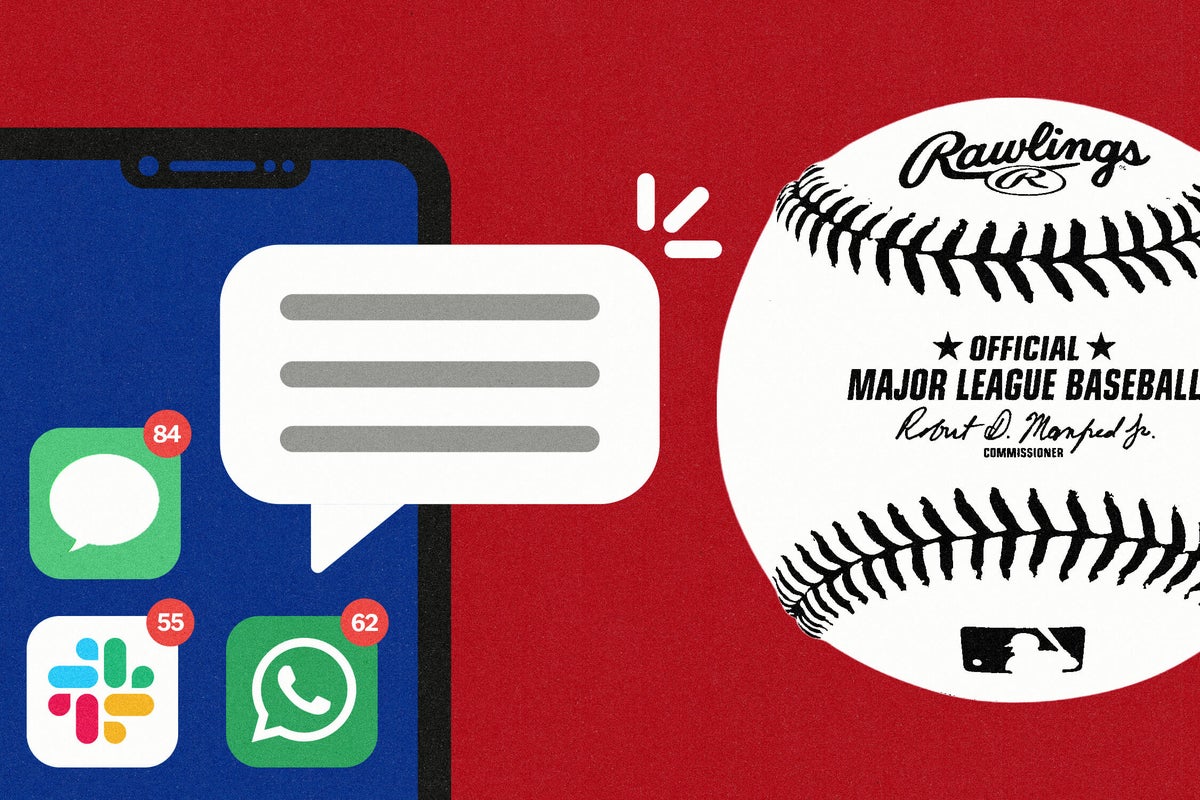
In one of his final acts as a St. Louis Cardinal, Nolan Arenado picked up his iPhone. Soon after he waived his no-trade clause and joined the Arizona Diamondbacks, he thumbed a goodbye message to his former teammates. The group chat buzzed soon after with an additional note.
Nolan Arenado left the conversation.
In baseball, as in many facets of modern life, group chats rule the world. For players, though, the venue serves as more than a repository for memes or fantasy football trash talk. The group chat connects the players to each other and to the team. The approach befits a generation of athletes accustomed to communicating via text and expectant of consistent feedback.
Need to know where the team is staying in Toronto? Wondering what the lineup might look like in an upcoming series? Searching for a scouting report? Check the group chat.
The answers can usually be found there. And so can sources of inspiration, information and occasional irritation. The chat can supply humor or sartorial guidance. When New York Yankees outfielder Aaron Judge wanted his teammates to wear suits to the ballpark for the home opener, he did not deliver the message in the clubhouse. He texted the group chat.
And like the baseball season, when the calendar turns to spring, a fresh chat must bloom. Otherwise, teammates turned rivals can become privy to proprietary intel. So a veteran like New York Mets infielder Marcus Semien can search his phone for evidence of travels across the sport: the 2020 Athletics chat, the 2021 Toronto Blue Jays chat, the chats spread across four seasons with the Texas Rangers.
“If you’re going to have a group chat, it has to be [a new one] for each year,” Semien said.
The app of choice depends on the team. Some clubs build iPhone message chains. Others use WhatsApp to stay linked with international players. Some teams pay for bespoke services. In pursuit of consistent contact, at least one big-league team has begun communicating with its players through Slack, nudging the life of a big-league player slightly in the direction of those with laptop jobs.
These rivers of text can break into wandering tributaries. One day in February, before he left camp to captain Team Italy in the World Baseball Classic, Kansas City Royals first baseman Vinnie Pasquantino chuckled when asked about group-chat etiquette. “I feel like I’m in 27 different group chats of different things,” he said.
There was a team-wide chat and a chat for the hitters. There was a text chain for infielders. Earlier in the spring, he had forgotten to bring his helmet to a sliding drill, because he missed the message in the base-running chain. The players, coaches and staff of Team Italy had a chat, but Pasquantino wanted to create a separate chat just for the Azzurri players.
He shook his head as he outlined the multi-convo pileup.
“I didn’t realize how confusing our s— was,” Pasquantino said.
For many players, the confusion may not arise until switching clubs. The door to a new team can open quickly. About five minutes after his trade from the Philadelphia Phillies was finalized this winter, Royals reliever Matt Strahm received an invitation to the group chat from vice president of major-league team operations Jeff Davenport.
Other doors can slam shut. After the Baltimore Orioles dealt Ryan O’Hearn to the San Diego Padres last summer, O’Hearn attempted to access Baltimore’s video database to scout an opponent. “As soon as I tried to log on, my log-in didn’t work anymore,” O’Hearn said. “So you pretty much get X’d out of everything with the old team really quick, and then (get) added to the new team.”
And sometimes navigating the new door requires a new app. When the Texas Rangers acquired Merrill Kelly at last season’s deadline, he needed to download Slack, which the Rangers use for scheduling. The mere mention of the platform, the bête noire of the professional managerial class, can elicit outsized reactions from other players.
“No Slack here,” Milwaukee Brewers outfielder Sal Frelick said. “That’s crazy, that people are on Slack.”
Traded by the Rangers this past offseason, Semien sounded more sanguine. “I mean, once you get on there, you get notifications, and it’s pretty easy,” Semien said.
The importance of communication between teams and players is a relatively new phenomenon. Arenado debuted with Colorado in 2013. In those days, he learned if he was playing by checking the lineup posted on the wall. Eventually he became a star, the sort of player who received notice about upcoming days off. It wasn’t until St. Louis acquired him in 2021 that he heard about a scheduling app.
“I was like, ‘App, what? OK,’” he said. “When that first happened, I was like, mind-blown, how crazy that was. But it’s so normal now. I text the wrong people all the time now, because I’m in so many group texts.”
To reduce clutter, clubs such as the Diamondbacks, Boston Red Sox and Washington Nationals use Teamworks, a system designed for sports. (The Rockies have also begun using the service.) Within the platform, players can message each other, while the team can store schedules, scouting reports and H.R. forms.
“There’s times where I’ll get something that says ‘Pitcher’s Meeting,’ and I’ll disregard it, because they must have blasted it out to everybody,” Frelick said.
The venue can change as the season progresses. In the offseason, Semien explained, the Mets chatted over WhatsApp. In the early going of the regular season, the conversations shifted to the team’s in-house video service. The Houston Astros executed that maneuver in reverse. During spring training, first baseman Christian Walker said, the Astros connect through “a regular, iPhone blue group message.” (What if a player used an Android? “Go get an iPhone,” Walker said.) Once the season starts, the chat moves to WhatsApp.
“Occasionally, somebody will talk some s—,” Walker said. “Like, we’ll (be) on the runway after landing, sitting on the bus, and somebody will fire off a message about waiting on the coaches’ bags. And the next thing you know, it’s just a waterfall of people talking crap.”
The staff can facilitate the discourse. The Athletics maintain a WhatsApp chat that includes the players, coaches and team officials. A member of the Athletics communications department will also build separate group chats for the players. The responsibility for removing members from the player-only chat when they get traded or demoted falls upon a veteran like Brent Rooker.
“It sucks sometimes,” he said. “It depends on the situation. If it’s a guy who gets optioned, and we’re expecting him back at some point, you just leave him in. But not a fun thing to have to do.”
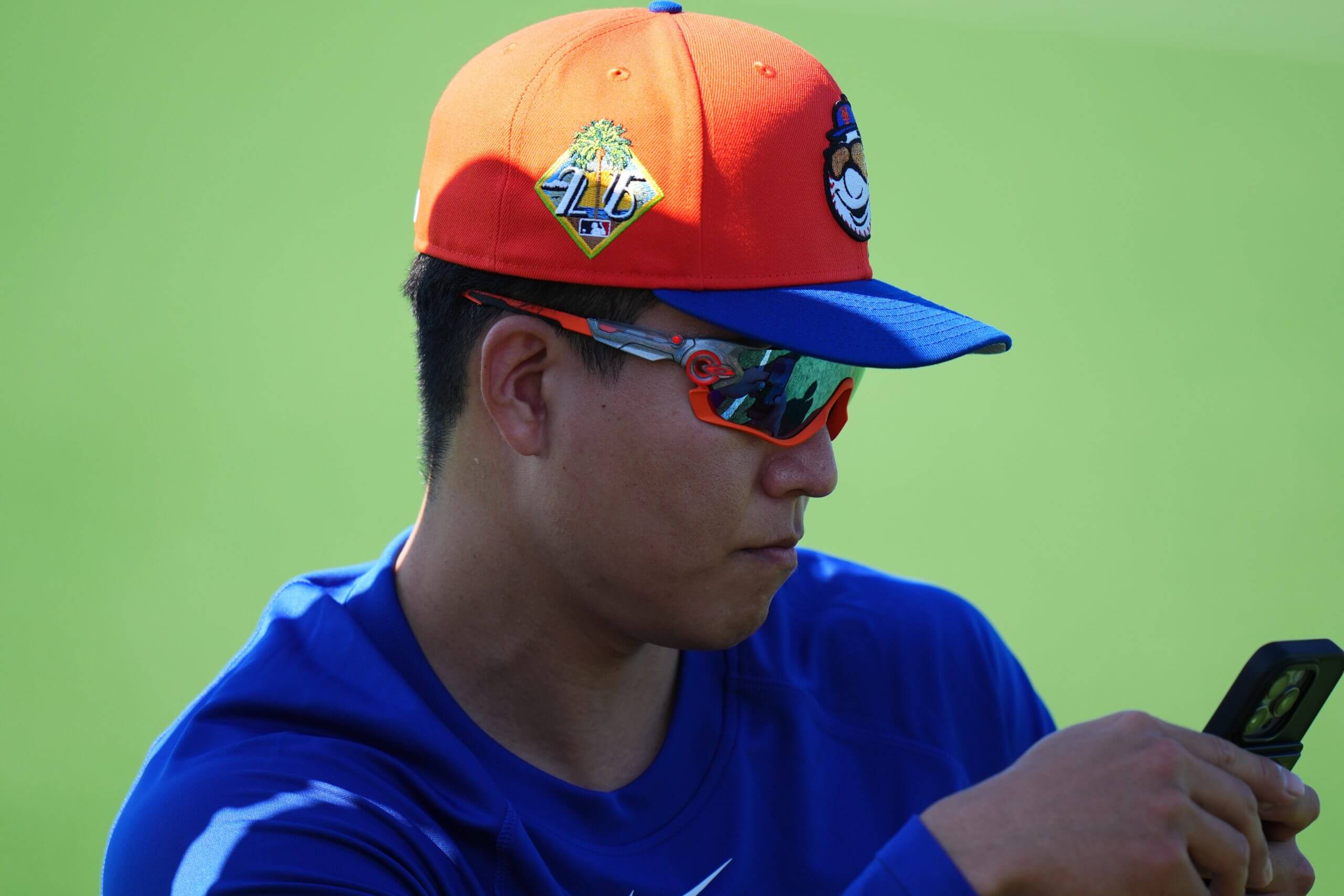
Mets starter Kodai Senga checking his phone during spring training. (Rich Storry / Getty Images)
For some teams, coaches assist with the dialogue.
Before the season began, Royals director of hitting performance Alec Zumwalt manually built a group text for the expanded roster of hitters at camp. “For spring training, I had to add everybody, so that’s a ginormous list, 30-some players,” he said. “Which, half the time, none of them read anyway.” Zumwalt likes to hype up his group, many of whom have spent their entire careers with Kansas City. He prefers the immediacy of a text to a more impersonal platform.
“This is us communicating,” Zumwalt said. “And it’s not being overseen by some other entity. Because there’s always that skepticism of ‘Is something I say here going to be used against me?’ And I think in a text message, for me, personally, I feel like guys drop their guard a little bit more, versus on Slack.”
That morning at Royals camp, Pasquantino called over pitching coach Brian Sweeney.
“Sweeney,” he said, “you’re on Slack, right?”
“I am on Slack,” Sweeney said. But the life of a coach is a bit more convoluted than those of the players. “So there’s group chats upon group chats,” Sweeney said. “And then there’s so many Slack channels, to coordinate the minor-league side with the major-league side. And then all the information that you might need — it could be in Dropbox. It could be in OneDrive. It could be in one of your emails.”
Sweeney was laughing. The job of the coaches, of the front office, of the support staff — of everything except the guys playing in the games, really — was to synthesize all those channels.
“Trying to consolidate that is really a major-league organization’s biggest issue,” Sweeney said. “Because you have the information and data to set the players up for the best experience.”
“And then,” Pasquantino said, “we’re still going to complain, no matter what.”