

Going to a Major League Baseball game is an inherently humbling experience. Away from the K-zones and close-ups, we’re reminded of how small we really are. Just stand at field level from the outfield. Home plate is more than a football field away. The men bridging that gap seem little more than insects, action figures in a game we don’t get to control. Suddenly, it makes a little more sense why these guys get paid so much money.
No one is covering more ground than the center fielder, a job so difficult that teams are willing to sacrifice offensive potency for sure-handedness and a solid first step. There will always be a role for a glove-first center fielder with the speed and savviness to shrink the gaps to his left and right. But truly elite defense in center is as fleeting as it is important. In 2024, Brenton Doyle ranked second in deserved runs prevented (DRP) among center fielders, behind only Washington Nationals speedster Jacob Young. A year later, he ranked 22nd of 23 qualifiers.
This sport doesn’t care for glove-first corner outfielders. Young’s profile is at constant risk of falling off the map, and last year’s 66 wRC+ is about as close as one gets to doing so. In an act of self-preservation, Young is making the strides necessary to stick around the nation’s capital.
Young Is Swinging Differently
Young is a different player than he was this time last April. He’s shed the 20-grade power that defined his offensive profile, and it’s turned him into one of April’s more surprising sluggers. Through 16 games, he’s matched his 2025 home run total (2) and nearly quadrupled his ISO (.204), resulting in a 111 wRC+.
It’s easy to chalk that up to small samples and good fortune. But Young’s adjustments are tangible and, thus, trustworthy. He’s optimizing the little power his 192-pound frame can generate through a new swing and improved approach.
Let’s start with his swing, the physical manifestation of his new identity. Young’s attack angle is up meaningfully from last season, up from 6° to 10°. While Young’s not a dead pull hitter, he’s pushing the ball less, too. His feet help tell this story, as his stance is 6° more open in 2026.

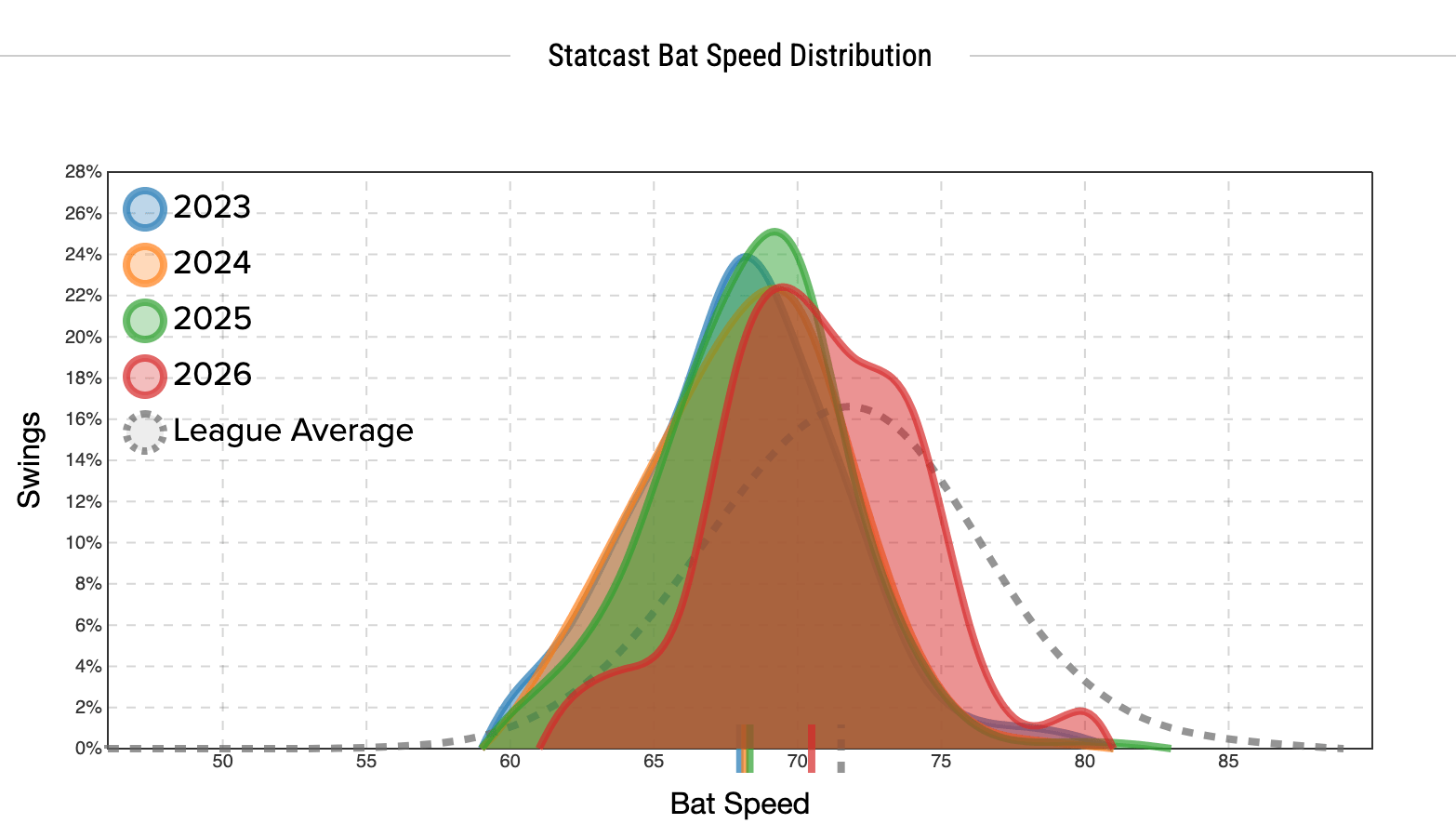
Part of this pop can be attributed to an uptick in bat speed. Normally, batters thaw out in April, swinging a little harder as the season rolls along. However, Young’s bat speed is up from 68.3 mph to 70.5 mph, a jump from the 7th percentile to the 27th. Only four hitters have added more juice this offseason.
Young isn’t built to put 30 balls in the seats, but improving from bad to acceptable is as important as good to great. If he hits 10 homers instead of two, Washington’s offense will feel the difference. By swinging faster, he’s setting himself up for more (albeit marginal) damage. 35-grade power would fundamentally change our understanding of Young, and he can give back some of his early-season gains (98 Power+) and still get there.
Naturally, an uptick in bat speed has shown itself in his batted ball data. Young’s max exit velo is down, and it’ll never be outstanding. On balance, though, he’s hitting the ball harder than ever — even if his average exit velocity is just 87.2 mph. Young’s exit velocity on fly balls has skyrocketed to 95.2 mph, an 83rd-percentile mark and nearly 12 mph more than last season. That’s an absurd gain, and it’s amplified by his intentions.
Young’s line drive and fly ball rates are the best of his career. His launch angle is up from 2.2 degrees to 9.9. His Pull Air% has nearly tripled! It’s too small a sample to truly trust, but if Young became pulled-fly-ball-pilled over the offseason, this is what it would look like.
For that reason, I’m willing to buy his surprising start. It’s no surprise that his .469 slugging percentage is the best of his career. He’s not straying too far from his expected statistics, either. Young is lifting the ball more, hitting it harder, and reaping the benefits.
Young’s Results vs. Expected
Perhaps it is paramount that Young isn’t selling out for this newfound pop. His walk rate has shrunk, but his Decision Value hasn’t. His contact rate has barely suffered, his chase rate is down, and he’s striking out less.
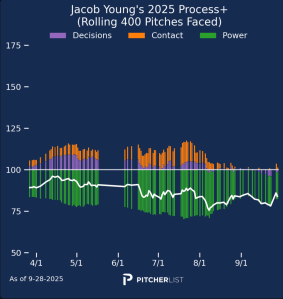
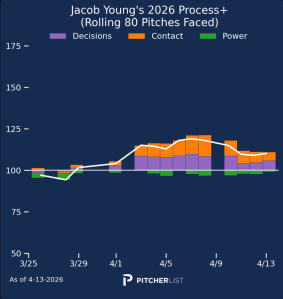
We can thank Driveline for these developments. As Matthew Creally wrote, “Imagine a center fielder with world-class range, elite sprint speed, and a very good arm, but a replacement-level bat. In theory, if our hypothetical player managed to become valuable at the plate, they’d become one of the best outfielders in baseball. That’s the current goal for Jacob Young, who fits this description to a tee and is working at Driveline to figure out that last part.” In a sport where athleticism is often akin to upside, Young’s dynamism might finally be coaxed out of his bat.
It’s also worth noting that the Nationals’ turnover has lent itself to revamped offensive infrastructure. CJ Abrams looks like a new man, too. There’s something in the water in Washington, and it’s helped their team-wide Process+ jump from 19th last season to sixth in the early going. Maybe their horrifyingly bad pitching staff is just dehydrated.
The regression monster will eventually grow hungry and feast on Young’s gains. He’s not going to run a 25% HR/FB rate forever, nor will he slug better than Toronto Blue Jays star Vladimir Guerrero Jr. Yet, Young’s offensive floor has never been higher, and he is bound to run into a few more home runs by aiming for the foul poles instead of the grass beyond center field. If these changes stick, he should have no problem surpassing the 84 wRC+ that earned him a career-high 2.7 fWAR in 2024.
For Young, a league-average bat is a lifeline. Elite defense in center field doesn’t last, and as he enters his late 20s, it will be his offense that defines his viability. By making the most of his limited power, Washington has given Young the keys to stick around a little while longer.