
Execution and fundamentals get a bad rap, in modern baseball. When present, they’re too simple to earn much praise. The league is too chock-full of talent for fundamentals and execution to win games for you, on their own. When absent, they;re too easy to grieve and bemoan. The truth is that you can’t win a big-league game with fundamentals and execution, but failures of execution inevitably beget an unfair burden of expectations for instances of successful execution. Fans see when a lack of fundamentals hurt you, and they get the mistaken idea that good fundamentals could win you games on their own.
It’s been a joy to watch the Brewers for the past two-plus years, because under Pat Murphy, they often execute and do the fundamental things better than anyone. That’s not why they win games. They win because they pair those elements with better talent than most fans and many opponents recognize; excellent preparation and situational decision-making; and team chemistry that keeps them engaged when things are bad and can snowball in a good way when things are good.
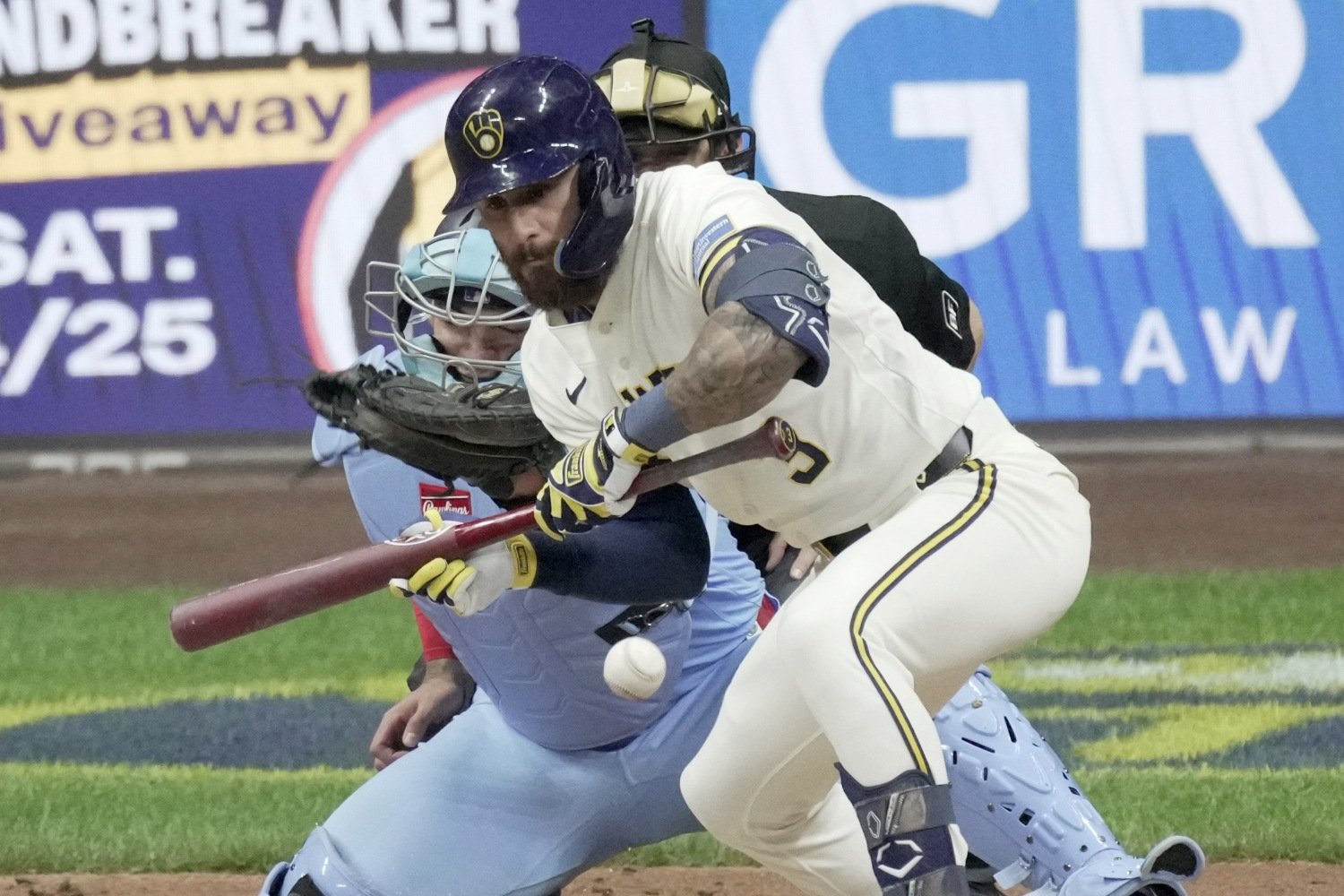
That said, we saw some faltering fundamentals from the team during their six-game losing streak, so it was a relief when those elements nudged them over the top and earned them a win Thursday afternoon. It was a taut 1-1 game going into the bottom of the seventh, but Garrett Mitchell drew a leadoff walk. That sparked the sequence that decided the game, and it happened in remarkable fashion. First, Greg Jones put down a relatively routine sacrifice bunt.
That play is uninteresting, in most respects. Jones does everything well, though. He doesn’t give away that the bunt is happening too soon, but he does give himself ample time to get into the proper position, so he’s not moving his head or poking at the ball with the bat when it arrives. Laying down a bunt in the big leagues is much harder than it looks, and arguably, that first bunt was a bad call by Pat Murphy and the Brewers. A real risk of failing to get it down existed, because pitchers in the majors are so good; that includes Toronto’s Tommy Nance. Jones is clearly an experienced and highly competent bunter, though, which was probably one factor in the Brewers’ decision-making. Knowing that Jones was more likely than the typical batter to get the bunt down made calling for it more viable, even though statistically, laying down that bunt ahead of David Hamilton and Joey Ortiz didn’t increase the team’s chances of scoring a run.
This play did.
The Jays bringing in lefty Joe Mantiply was a clever response to the Brewers’ gambit. Hamilton has a future with the team as a glove-first infielder who can handle right-handed pitchers, but left-on-left, he’s not the guy you want at the plate with the game on the line. Rather than take him down for a pinch-hitter, though, the team asked Hamilton, too, to get down a bunt. As a sacrifice, this would have been an atrocious idea, but that’s not what it ever was.
Here’s where fundamentals meet extraordinary talent, to make a victory. Hamilton doesn’t wait any longer to show bunt than Jones did, but he doesn’t give it away so soon that the third baseman can be well in front of the bag by the time he bunts the ball. He adroitly puts himself into nearly an identical bunting position as the one Jones adopted, but unlike Jones, he’s putting on the jailbreak, too. There might be five faster runners in the majors than Hamilton; there aren’t 10. His raw speed is great, but with the jailbreak coming out of the left-handed batter’s box, his time from touching the ball to touching first base is downright elite. It helps, here, that Mantiply isn’t a guy who falls off the mound much with the effort of his delivery. Had his momentum carried him toward the foul line more in the first place, he would have had a play on Hamilton. As it was, Ernie Clement had to make the play, and he never really had one.
That left it up to Ortiz to get the run in, with runners on the corners and one out. Technically, of course, the Brewers had two chances, at that point. Hamilton’s speed had created a marvelous opportunity. In practice, though, it felt very important to get the run home there, before it came down to needing a hit from Brandon Lockridge.
Ortiz, unlike Jones and Hamilton, didn’t get the bunt down on either of the first two pitches, working the count to 1-1. It’s a bit surprising that the Jays weren’t more committed to the bunt than they were, in terms of positioning, but the risk of Ortiz pulling the bat back and poking the ball into the corner was real. Ultimately, the Crew had the safety squeeze on, rather than the suicide squeeze, so Toronto didn’t need their corner guys crashing toward the plate. It was all going to come down to how good a bunt Ortiz put down. He put down a perfect one.
Some of this, of course, is luck. Bunt placement is a skill, but it’s a skill bounded by the quality of the opposing pitcher and the nature of a bouncing ball. Ortiz read a changeup from Mantiply well, lowering the bat to catch it but staying on top of it as it dipped toward the ground. It’s a pretty easy pitch to bunt, but it’s easy to push it foul or to hit it too hard. Ortiz did neither. The ball he dribbled into the dirt in front of home plate died pretty quickly, in a patch of the playing surface that has been very slow all week. It was enough to force Jays catcher Tyler Heineman into a dilemma: Should he set up to receive a flip from Mantiply on a play at the plate, attempting to thwart the go-ahead run, or should he chase the ball all the way to its spot and retire Ortiz? There’s even a third choice there, in some cases, where he could snatch the ball soon enough to twist and dive backward himself, trying to tag Mitchell out unassisted.
Mantiply was charging hard, and only veered away to let Heineman take the ball at the last instant. Watching the replay, it looks like he might have had a play, and Heineman should have held his ground just in front of the dish. Certainly, if Ortiz had touched the ball any harder, the Jays would have made the attempt on Mitchell, and probably been successful. If he’d pushed it with any less pace, Heineman would have been able to tag Mitchell himself. This ball was perfect, though. In the heat of the moment, trying to forestall a big inning and not feeling confident enough of a try on the lead runner, Heineman simply picked the ball up and fired to first, taking the out the Brewers were giving.
The game wasn’t over in that instant, and the way the Crew played that frame denied them much chance for a bigger lead and an easier top of the ninth. Happily, though Ángel Zerpa retired the Jays relatively easily, to lock down the win. It wasn’t simply a product of fundamental play. Brandon Sproat showed what a stud he has the potential to be in the starting rotation. Mitchell’s and Hamilton’s speed made the winning rally possible, as much as the excellent execution of the three bunts themselves. That’s what good fundamentals really do, though: put you in full contact with the value of your talent. The Brewers are back on track after a brutal week, and they used their combination of subtle skills and good fundamentals to get there.