
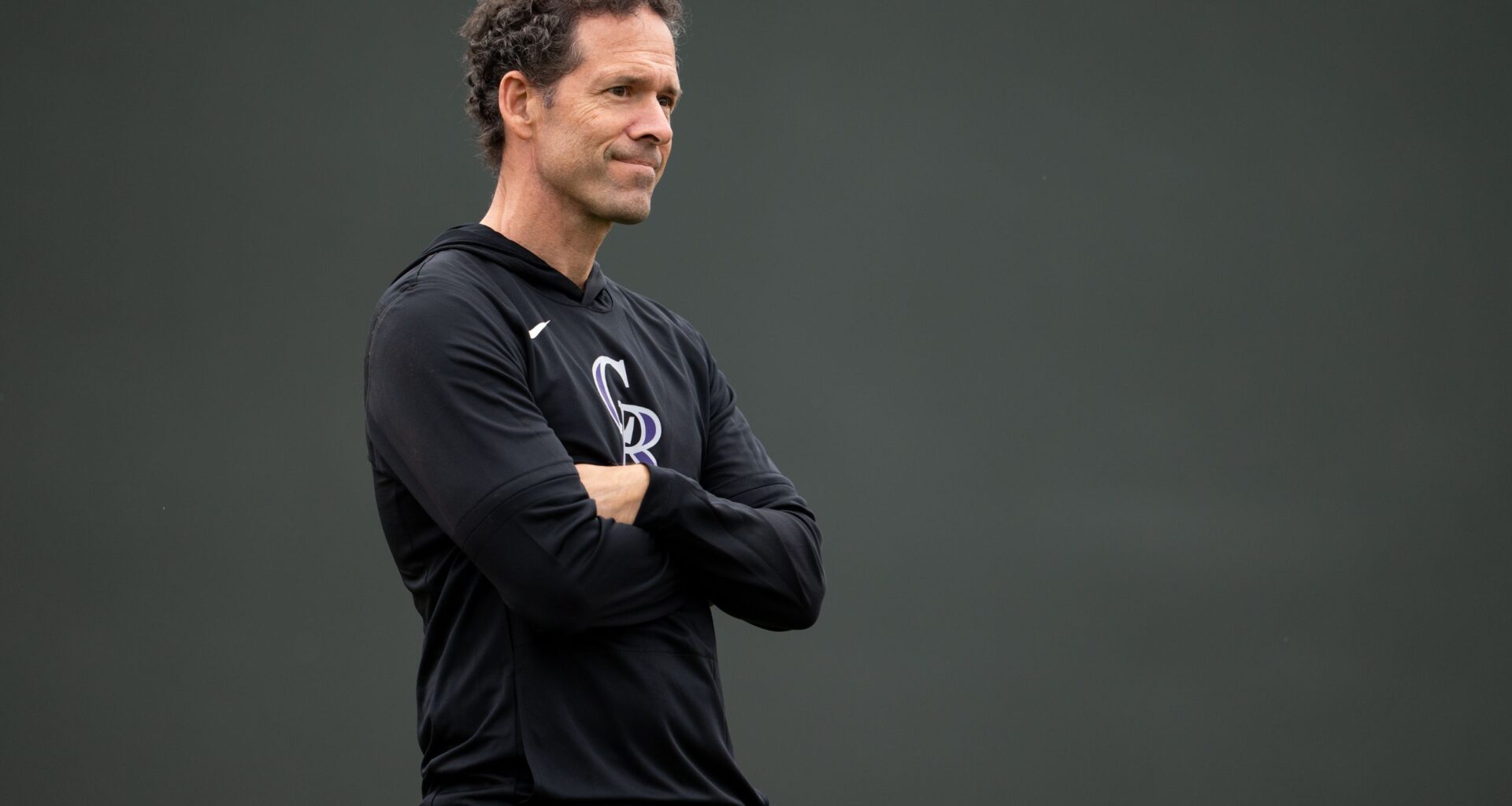
Image credit:
Rockies president of baseball operations Paul DePodesta (Photo by Kyle Cooper/Colorado Rockies/Getty Images)
Like no other ballpark in MLB history, Coors Field is a main character in the historical narrative for the team it hosts.
That’s because almost everything is amplified at altitude, and Coors Field is 5,200 feet above sea level. The ball carries nearly 20 feet farther than average in Denver, so all hit types—but especially doubles and triples—are much more common in Rockies home games than road games.
As a result, overall runs scored are typically 25-30% more common at Coors Field over the past decade. By contrast, a typical “hitter’s park” will feature 10-15% more runs in home games.
Since the introduction of the humidor in 2002, Coors Field is not the same home run haven it was in the 1990s and early 2000s. It has had the highest single-season park factor for home runs just twice in the humidor era and has not ranked No. 1 by that measure since 2014.
Instead, it is the preponderance of non-home run hits that defines Coors Field.
In the first 23 seasons of Coors Field, 10 Rockies batters won the National League batting title. The list includes Hall of Famers Larry Walker and Todd Helton—both of whom also have multiple runner-up finishes—as well as all-stars Matt Holliday, Carlos Gonzalez, DJ LeMahieu and Charlie Blackmon.
The list also includes later-career performances by Michael Cuddyer and Justin Morneau, a pair of 30-something former Twins. But the point is this: Playing half of one’s games in the best hitter’s park in MLB history is a tremendous batting boost.
Coors is kind to home run hitters, too, though Nolan Arenado has three of the Rockies’ six NL home run crowns, suggesting his transcendence is just as much of a factor.
More recently, the days of Rockies hitters leading the league in any category are a distant memory. The club hasn’t had a winning season since 2018 and is coming off three straight 100-loss seasons. Its 119 losses last year would be more notorious if the White Sox hadn’t lost 121 in 2024.
Into this context steps Paul DePodesta, whom the Rockies hired as president of baseball operations last November.
DePodesta spent the past decade as chief strategy officer for the NFL’s Cleveland Browns. Before that, he was best known as an assistant to Athletics GM Billy Beane, helping to steer the club’s amateur and professional player acquisitions, as depicted in the bestselling book “Moneyball.”
Others may remember DePodesta for a two-year tenure as Dodgers GM that ended on a sour note with a 91-loss season in 2005.
But few immediately associate DePodesta with the Mets, his last baseball job before he left for the NFL. In reality, he played an instrumental role in building up the organization in the early 2010s. Overseeing the draft and player development for New York, he helped build one of the top farm systems in MLB, which ultimately paid off with an NL pennant in 2015 and a wild card berth in 2016.
Those 2015 and 2016 teams represent one of two times in Mets franchise history that the club qualified for the postseason in consecutive seasons.
Now, DePodesta and his new front office will look to do something similar in Colorado.
Back To Basics
A quote gathered by Jack Etkin about DePodesta and GM Josh Byrnes in BA’s most recent Rockies organization report rings as both profound and, well, obvious.
“They are looking for guys who can get on base,” Rockies assistant farm director Jesse Stender said. “The guys who aren’t going to swing and miss. The guys who are going to work a count, really press a pitcher but also know what pitches to fire at.
“Understand who they are in their hot zones and when they can do damage, but also when to lay off a pitch and wait for the next one.”
That reads an awful lot like Moneyball-era DePodesta, who, along with A’s GM Billy Beane, espoused the value of on-base percentage. Twenty-five years ago, on-base percentage was undervalued by other teams—and thus cheaper to acquire. Perhaps that is once again the case. In today’s game, runs are more highly correlated with power metrics such as isolated slugging than they used to be. But teams still need runners on base to drive in.
And in the chaos of Coors Field, reaching base even by single or walk has outsized value. A double or triple can score a runner from first base. Forcing the opposing pitcher to work from the stretch or deplete his pitch count or worry about sign stealing can have cascading benefits for Rockies batters.
On top of that, strange things can happen with runners on base. First basemen have to hold baserunners close. Other infielders can’t stray as far from bases when a force play is in effect. These create holes in the defense.
Any pitch in the dirt can cost the defense a base, making the opposing pitcher think twice about that breaking ball chase pitch. A minor bobble in the outfield or inaccurate throw can cost a base. These miscues are amplified at Coors.
Bottoming Out
The Rockies didn’t do much of anything well last season. Their pitchers compiled a 5.99 ERA that was the worst in the humidor era of Coors Field. Rockies hitters had their worst year at everything in 2025, batting .237 as a team with a .293 on-base percentage and .386 slugging percentage.
That’s almost impossible to pull off in a park that once regularly crowned batting champions. But, in fact, Rockies hitters have somehow compiled a lower batting average than the MLB average in each of the past two seasons.
Even beneath the surface, Colorado hitters didn’t do much of anything right. One caveat: The Rockies have a younger lineup without a lot of established MLB hitters, thus they collectively receive few “networking” benefits that hitters in deeper lineups enjoy.
From 2023 to 2025, no team’s batters made contact less frequently—despite playing half their games in Coors, where pitchers’ stuff is diminished—or swung at more pitches out of the zone than the Rockies. The chase rate is somewhat logical given that Rockies hitters are heavily incentivized to put the ball in play in home games, while in road games they struggle to recalibrate to pitch movement at sea level.
Those factors might naturally result in higher chase rates, which is exactly what we see in the historical data. Only the White Sox have a higher team chase rate than the Rockies in the Statcast era.
An overall lack of restraint resulted in a 50.4% swing rate over the past three seasons that was more than a percentage point worse than the No. 2 White Sox. Colorado’s 13.6% swinging-strike rate in that sample was similarly more than a percentage point worse than the No. 2 Athletics.
These same issues persist down on the farm. In each of the past two seasons, Rockies minor league batters exhibited poor swing decisions and didn’t make enough of an impact to justify chasing so many pitches out of the zone. Colorado minor league batters ranked 25th or 26th among all 30 farm systems in the Baseball America Hit+ assessment blending several key attributes the past two seasons.
An Upside To Downside
The upside of so much downside is clarity. The Rockies’ offensive woes cannot be misconstrued. They need to swing less often. They need to stay within the strike zone when they do commit. They need to work the count to see more hittable pitches.
DePodesta and his front office have had only one offseason to reshape the roster, but there are positive signs to be found in the early stages of the 2026 season.
Colorado traded for Yankees 25-year-old first baseman TJ Rumfield, who spent the past two seasons at Triple-A stuck behind Ben Rice. Rumfield hit five home runs and struck out twice in spring training to win a starting job for the Rockies. He got off to a good start to the season with a mix of contact skills and hard contact to secure the No. 2 spot in the lineup.
Twins second baseman Edouard Julien failed to follow up on a productive 2023 rookie season and fell out of favor in Minnesota. The Rockies traded for him in January, buying low after Julien hit .208 with a 75 OPS+ and negative defensive value over the past two seasons. He remains a poor defender in Colorado, but he almost never chases out of the zone and has a good chance to lead the Rockies in OBP this year.
Waiver claim Troy Johnston has been another productive low-cost addition for Colorado. The 28-year-old owns a career .367 OBP in the minors and has a chance to become a roughly average hitter while holding down right field.
Just as telling as the players imported have been some of the players jettisoned. The Rockies cut ties with 2019 first-round first baseman Michael Toglia and 23-year-old corner outfielder Yanquiel Fernandez in the offseason. Both were former top prospects for the organization who have raw power mitigated with shaky plate discipline and don’t fit the new player personnel preferences.
For a Rockies team that bottomed out in 2025, the success of players like Rumfield, Julien and Johnston represent small progress, but progress nonetheless. As the Rockies continue stacking good decisions—in the draft, at the trade deadline, on the international market—the organization will continue to layer in future generations of players who fit the new paradigm.