
PHILADELPHIA — Felix Reyes stepped into the batter’s box at Citizens Bank Park for the first time around 7:45 p.m. Saturday — less than six hours after he arrived in Philadelphia after playing for Triple-A Lehigh Valley in St. Paul, Minn., all week.
He took two pitches from lefty Chris Sale before connecting with a third, a fastball up in the zone. It landed in the right-field stands.
“It just felt like I was dreaming still,” Reyes said via team interpreter Diego D’Aniello. “I still feel like I’m sleeping.”
That moment is exactly what the Phillies wanted when calling up Reyes, a powerful right-handed hitter who frequently chases, ahead of Saturday’s game. The home run put the Phillies ahead 1-0 in the second inning. Perhaps it could have been the “shot of energy” that manager Rob Thomson said they sought.
Instead, the Phillies strung together three hits in the seven innings that followed Reyes’ homer and lost 3-1 to the Atlanta Braves.
Reyes appearing in a major-league game any time soon would have seemed far-fetched just a week ago. But a 2-5 (and now 2-6) start to a nine-game homestand changed some things, particularly with the Phillies’ struggles versus left-handed pitching. They entered Saturday hitting .179/.280/.275 with a .555 OPS against southpaws — the third-worst average and fifth-worst OPS league-wide.
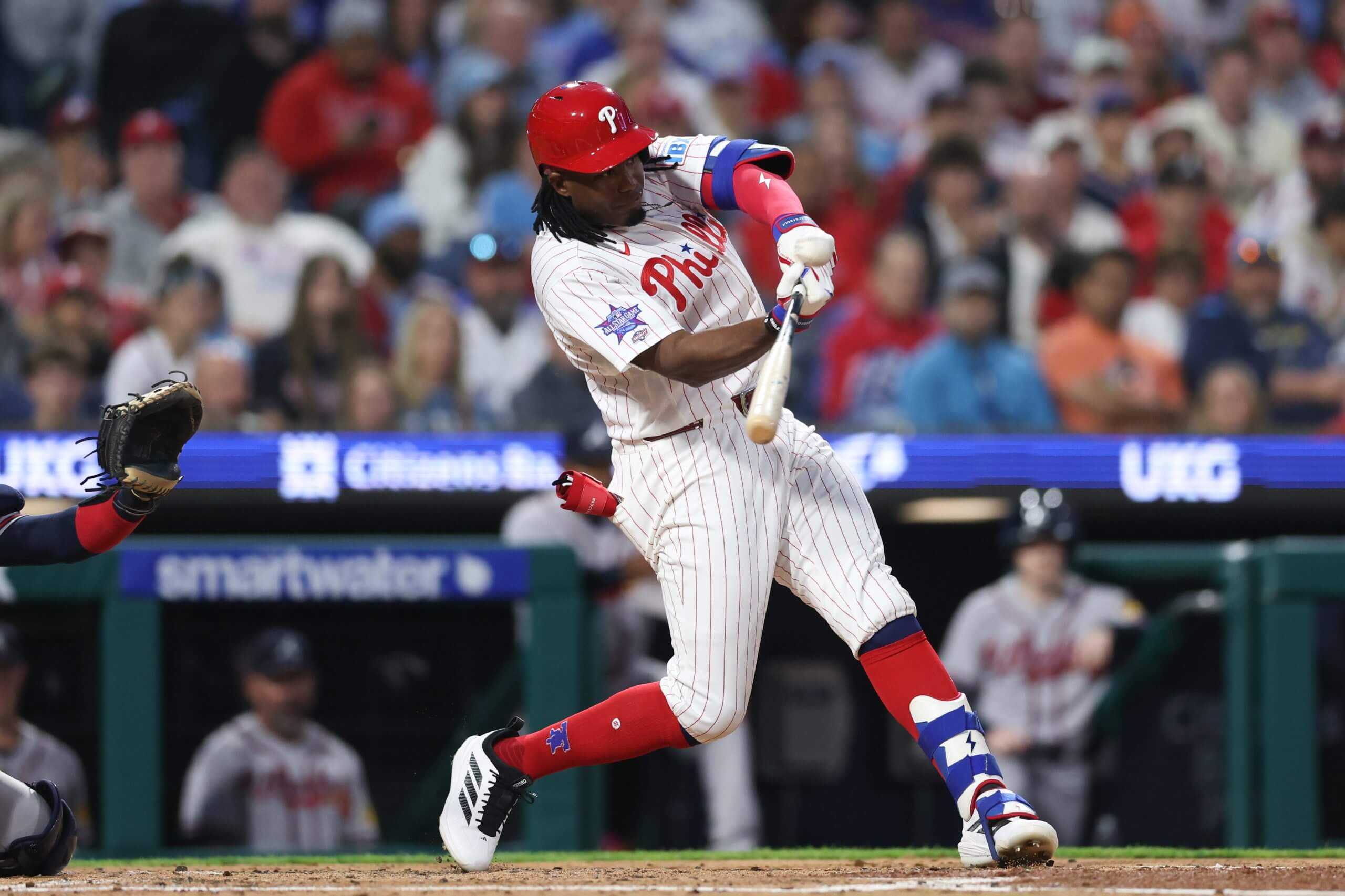
After hitting six home runs in 18 minor-league games this season, Felix Reyes homered in his first major-league at-bat. (Bill Streicher / Imagn Images)
So Otto Kemp, the platoon left fielder hitting .100 with a .282 OPS in 20 at-bats, was sent down 20 games into the season. His offense and his defense were imperfect. But one roster move is not a panacea for all the Phillies’ woes.
And sending Kemp to Triple A three weeks into the season is particularly noteworthy given how highly the Phillies spoke of him this winter. The Phillies knew they needed a right-handed platoon bat in left field and could’ve sought such a player on the market. Instead, over and over, members of the organization stressed how much they liked Kemp and how they felt comfortable with him seeing more playing time.
Thomson reiterated the sentiment Saturday: The Phillies really like Kemp. The decision to send Kemp down, Thomson said, was to get him everyday at-bats.
“It’s not his fault that we didn’t hit,” Thomson said. “It’s tough for him, for a guy that doesn’t get consistent at-bats when he’s a young guy used to playing every day (and) now you’re playing sparingly. It’s tough sometimes to keep your rhythm, contact points. This will be good for him.”
Now, Reyes gets a shot. He’s dominated Triple-A pitching (.333/.345/.654 with a .999 OPS in 18 games) but has struggled to stay in the zone with a 51.9 percent chase rate this season. That made the two pitches he took from Sale noteworthy. Or an aberration. Who knows. He is three at-bats into his big-league career, the other two being a flyout and a strikeout. He has seen just 10 pitches. More data will come with time, though again, the right-handed platoon partner in left does not play all that often.
His defense is also unlikely to be much better than Kemp’s. Reyes saw little action in the outfield Saturday, aside from a double hit toward the left-field wall and a flyout to left in the ninth.
Putting any pressure on Reyes, whose name does not appear on most top-prospects lists, to perform right away is inadvisable. But, when the rest of the lineup is struggling, it leaves players such as Kemp and Reyes with a greater weight on their shoulders. Even Dylan Moore, the rarely used 26th man and a right-handed hitter, was given an opportunity to hit against a lefty reliever Saturday. He struck out and was promptly booed.
Matters seemed to unravel as the innings wore on. The Phillies managed five hits Saturday, all against Sale. An Edmundo Sosa error on what could’ve been an inning-ending grounder played a significant role in the third, giving way to the Braves scoring three runs.
And the frustration, little by little, seems to be mounting. Trea Turner slammed his helmet, part of it breaking off, after an inning-ending out in the fifth. Rafael Marchán challenged a ball well above the strike zone in the eighth. Fans did the wave for much of that half of the inning, rising from their seats as the Braves loaded the bases against Tanner Banks.
“It’s pretty hard,” starter Cristopher Sánchez said of the Phillies’ start. “We’ve got to keep going. Keep the head up, and just keep going.”
It is April, and there are 142 games left to play. But the Phillies’ struggles on several fronts — a cold offense, bullpen injuries, poor defense, up-and-down starting pitching performances — are compounding. The Phillies have scored in 13 of 74 innings this homestand, a figure that dwindles to seven of 66 if their blowout win Monday is excepted. It is unideal.
Reyes’ deep drive to right was thrilling. But it wasn’t a band-aid for all of the Phillies’ woes.