
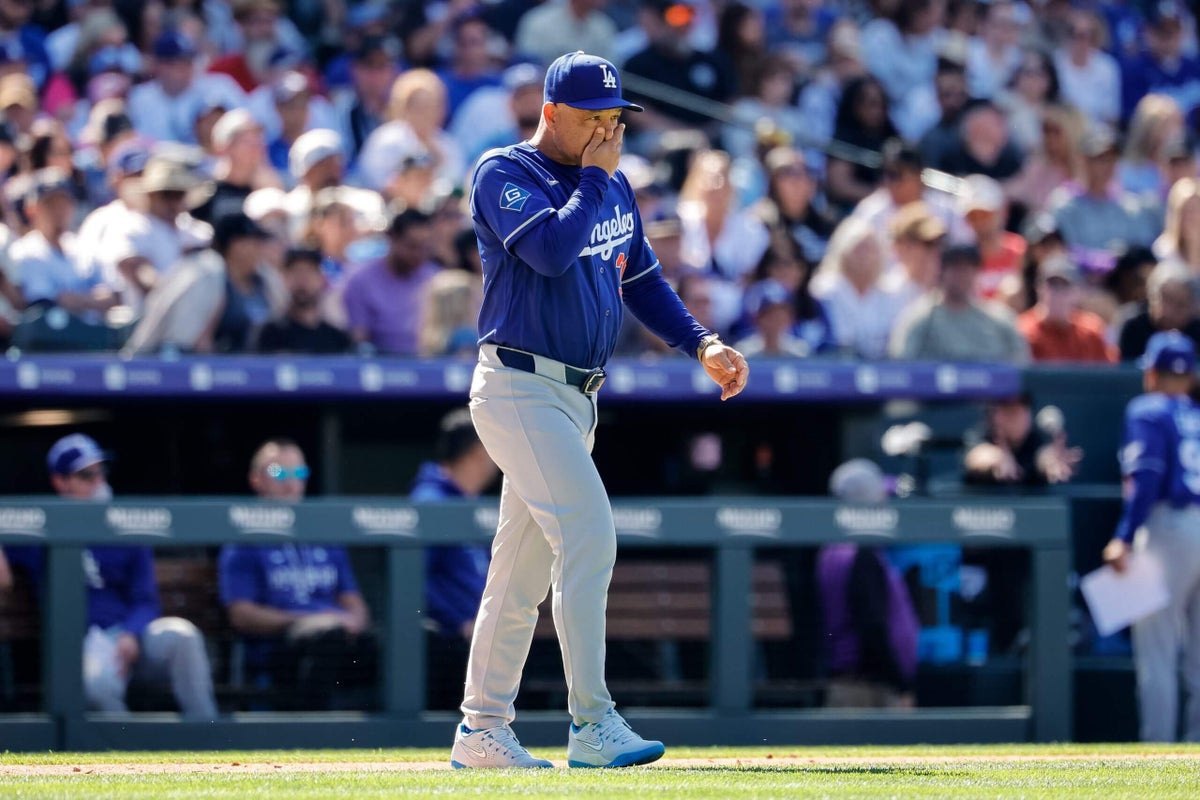
DENVER — Edwin Díaz’s first outing in nine days did little to assuage the mild panic that came before it. The Dodgers’ new closer had not pitched in more than a week due to a right knee that, he and the club insisted, wasn’t bothering him when he entered a non-save situation on Sunday.
Díaz faced four hitters and did not record a single out, allowing the Colorado Rockies to further build their lead in a 9-6 loss. His fastball continues to be a concern; after the Rockies quickly loaded the bases against Díaz, his first pitch to Edouard Julien registered at 92.8 mph, tied for the seventh-slowest fastball of Díaz’s career. His fastball Sunday averaged 95.4 mph, down again from where it’s been this season (95.8 mph).
There are possible explanations for another ugly day in the first month of Diáz’s three-year, $69 million deal. There was rust. It wasn’t a save situation. No one should read too much into what a pitcher does at Coors Field. Still, this is far from ideal. Consider the alarm bells rung.
“Today was a tough evaluation,” Dodgers manager Dave Roberts said. “I mean, it really was … I know what it’s supposed to look like, and when it doesn’t look like that, it gets a little concerning, really.
“I’ll have a conversation with him. I know our training staff, and pitching guys will (too), and make sure that there is nothing to it, because the radar gun has been consistent, and his velocity (has) been consistent in that, and it wasn’t there today. … I gotta know more.”
According to Roberts, Díaz said something “didn’t feel right” in his right knee after his outing last Friday against the Texas Rangers. It’s the same knee Díaz injured during the 2023 World Baseball Classic. Díaz has since said the issue was about feeling weakness in his leg.
Still, it was never enough for the Dodgers to place him on the injured list. Díaz has insisted he wanted to pitch.
Roberts had not checked in on Díaz’s health by the time he spoke to reporters postgame. But Díaz hasn’t reported anything else to the organization.
“I think, for us, it’s just going on what the training staff and the player tells me,” Roberts said. “You got to trust him and believe that they feel good. And a veteran player like him, no one should know his body better than he does. But obviously, today, it just didn’t look sharp.”
Díaz wasn’t alone.
Sunday turned into a Coors-esque shootout, and, for the second day in a row, a one-run lead in the sixth inning or later wasn’t nearly enough. This time, it was Blake Treinen who surrendered a 4-3 advantage and also didn’t record a single out — one day after he was struck in the head by a batted ball while standing along the bullpen wall during batting practice. It marked Treinen’s first runs allowed all season.
“I just didn’t execute good enough,” Treinen said. “Obviously, if you look at some of the swings.”
That made for an ugly day. Compared to what came before it, it marked the lowest point in the Dodgers’ early season — their first consecutive losses of 2026 and first losses to a National League opponent.
“I think that they’re a better ball club, and in this ballpark, a lot of things happen,” Roberts said. “This ballpark is certainly a neutralizer. The pitchers don’t have the same feel. Ball plays different, and so it’s still hard to still win a baseball game.”
Roberts hardly inspired confidence in Roki Sasaki on Sunday morning. Not that it’s been warranted. Sasaki’s first three starts this season, and first 11 starts in the major leagues, could generously be described as uneven. So what was Roberts expecting the first time Sasaki ever took on Coors Field?
“Um … I don’t (know),” said Roberts, pausing for a beat. “I don’t. I hope he just goes out there and attacks his guys.”
It’s unclear if Sasaki’s day on Sunday constituted progress. He did a better job of getting in the strike zone — half of his pitches were classified as being in the zone, an improvement after his effectively wild four innings last week against the Rangers. He kept his pitch count down, even if that largely came as a result of the Rockies attacking him early in counts.
Sasaki’s lower pitch count didn’t help him get any deeper in the game, lasting just 4 2/3 innings before Roberts pulled him to try to keep a 3-3 ballgame tied.
The Japanese right-hander faced one batter above the minimum through three innings and then quickly loaded the bases in the fourth. When the Rockies saw him a second time through the order, they teed off. Kyle Karros walloped a fastball into the seats. Other Rockies were content to wait out his off-speed stuff, which wasn’t sharp.
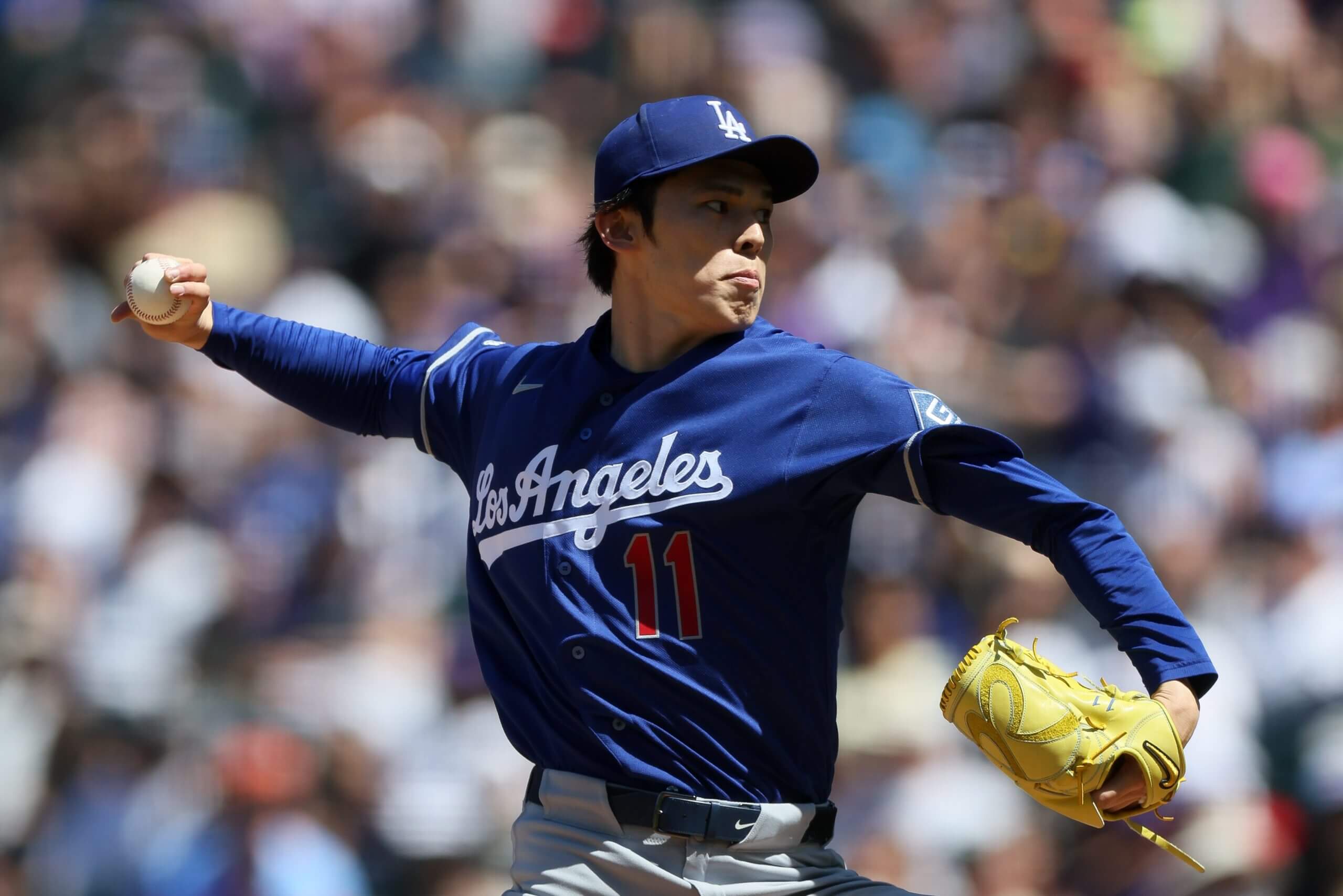
Roki Sasaki worked 4 2/3 innings on Sunday, allowing three runs on seven hits and two walks. (Justin Edmonds / Getty Images)
Sasaki only got eight swings and misses, including just one on his fastball.
His last few outings have not felt like progress. They’ve felt like stagnation. Sasaki’s ERA sits at 6.11 through four starts.
“I’m trying to make adjustments all the time,” Sasaki said through interpreter Kensuke Okudo. “In the long run, I have to do the things I need to work on.”
The Dodgers are going to keep giving Sasaki chances to work on things at the big-league level for the same reasons they put him in the rotation to start with. They are banking on this making Sasaki better in 2027 and beyond as much as they are hoping he wins games in the present.
There also aren’t really alternatives at the moment. They are going with a six-man rotation. Blake Snell is at least a month away from returning. Gavin Stone and Landon Knack are still on the injured list. The next man up, River Ryan, went on the injured list with Triple-A Oklahoma City this week for what league sources said is a “minor” hamstring issue. The organization recently acquired Jake Eder, but have used him as more of a long man in the minors than as a starter — he’s the only other starter on the 40-man roster.
No team in baseball has used fewer ABS challenges for their hitters than the 10 the Dodgers have deployed entering Sunday’s game. They’ve clearly leaned on saving their two allotted challenges for catchers, and for good reason — catchers have a league-wide success rate of 59 percent on challenges, compared to 47 percent for hitters.
That doesn’t mean there aren’t useful opportunities to challenge late in the game. Two stood out in Sunday’s loss.
The Dodgers trailed 6-4 with runners on second and third base with Alex Freeland at the plate and Shohei Ohtani on deck. Freeland worked a 3-1 count before Jimmy Herget flipped in a backdoor sweeper that home-plate umpire James Jean called a strike. It appeared to be out of the zone, at least close enough to try to draw a walk to load the bases for Ohtani.
Freeland didn’t challenge, and flew out on a fastball above the zone one pitch later.

Ryan Ward found himself representing the tying run with two outs in the ninth inning of his major league debut when he had a chance to flip a count. An erratic Victor Vodnik fired a 1-0 sinker off the plate that, again, looked off the plate. The Dodgers still had two challenges in their back pocket. Ward worked a 3-1 count before lifting a fly ball to the outfield that Troy Johnston sprawled to get to end the game.
Roberts said he didn’t take another look at either at-bat. But these were the times to use an ABS challenge.
“Especially when you have two challenges left and the ninth inning and borderline pitches,” Roberts said. “(You should) certainly try to exhaust some on those borderline pitches.”

The Dodgers did not lose because they didn’t challenge. But with the challenge system still in its first month, where and when they choose to deploy them will be interesting to watch.