
We’re roughly at the midpoint of the college season (Jacob Rudner dropped our midseason award watch lists earlier this week) and players are finally starting to defrost and get into games in the Northern states of the country. Earlier this week, MLB announced the 2026 bonus pools and slot values.
While three months can feel like a long time, the draft will be here before we know it.
Below is a rundown of how I’m currently viewing the state of the first round, based on conversations with scouts throughout the industry and player performances so far.
Roch Solid At 1-1
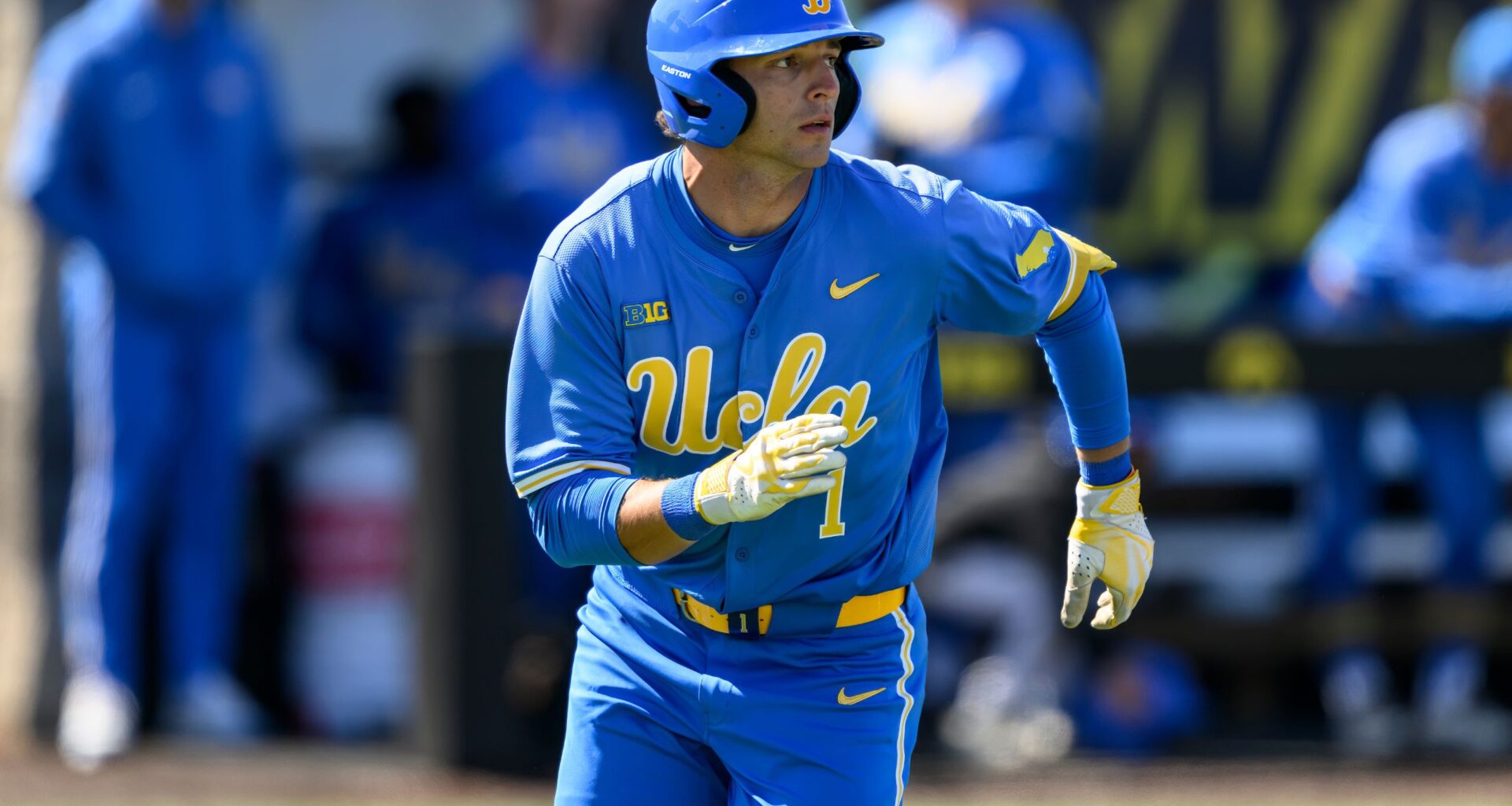
The one constant in this year’s draft class remains UCLA shortstop Roch Cholowsky.
At no point this spring have I heard even a consideration that he’s not the clear-cut No. 1 player. He’s following up on his 2025 Player of the Year campaign admirably, with numbers that are a near mirror image from what he did last spring:
YearGPAVGOBPSLGOPSHR2BK%BB%2025660.3530.4800.7101.19023199.3%13.9%2026280.3460.4890.7121.20110811.3%13.5%
He’s continued to get the ball in the air with more frequency this spring, and he’s also chasing a bit less. His 27% chase rate from 2025 was one of the few quibbles you could have had with Cholowsky entering the season. His chase rate through 28 games this spring is 23%. A modest improvement, perhaps, but still heading in the right direction.
All of his under-the-hood data looks as impressive today as it did a year ago. Here’s his final 2025 data compared to 2026 data of games through late March:
YearAVG EV90th EVMax EVContact%zContact%202591.5106.5112.181.7%89.0%202691.4107.8111.382.7%87.5%
Nothing about his defensive profile has changed either. Put simply, Cholowsky has been exactly as advertised so far this season. He remains the overwhelming favorite to be the no-brainer first overall pick by the White Sox.
The Favorites For No. 2
So, who’s next?
There appears to be a group of consistent names who get discussed after Cholowsky and solidly in the mix to be the pick for the Rays at No. 2.
Unsurprisingly, many of these are the names you’d expect based on our most recent draft update, but the list seems to include the following players, which I’ll bucket into two different tiers:
Tier One
Grady Emerson, SS, Fort Worth Christian HS, North Richland Hills, Texas
Jackson Flora, RHP, UC Santa Barbara
Justin Lebron, SS, Alabama
Vahn Lackey, C, Georgia Tech
These four players are most commonly mentioned after Cholowsky in my conversations. However, one player in that group could have significantly more volatility than the rest, and might be trending out of this tier entirely.
Lebron was one of the hottest players in college baseball in the first few weeks of the 2025 season, and likewise got off to a great start in 2026. Conference play put the brakes on his performance a year ago. His first nine games against SEC teams this season have also been a challenge. Below is a look at his performance overall and then split into conference and non-conference games:
GPAVGOBPSLGOPSK%BB%Swing%Miss%FB VeloOverall300.2650.4080.6021.01017.6%13.4%44%27%89.6Non-Conference210.2950.4510.6541.10518.6%16.7%41%28%88.6Conference90.2000.2820.4860.76815.4%2.6%51%25%91.6
Handling conference pitching and showing an improved contact rate against breaking balls were two of Lebron’s biggest checkpoints this spring. He is as aware of that as anyone. The shift in his approach in conference games makes me think he’s pressing a bit more than he was at the start of the year. His swing rate has jumped significantly and his walk rate has fallen off a cliff.
It’s just nine games, but Lebron’s conference performance this spring is as important as any player’s in this class. If he continues to struggle like he did a year ago, it would be easy to see him sliding out of this tier and behind some of the names in this next tier.
Tier Two
Ace Reese, 3B, Mississippi State
Chris Hacopian, 2B, Texas A&M
Eric Booth Jr., OF, Oak Grove HS, Hattiesburg, Miss.
Jacob Lombard, SS, Gulliver Prep HS, Miami
Sawyer Strosnider, OF, TCU
AJ Gracia, OF, Virginia
This has generally been the next grouping of names to come up. Teams picking in the latter half of the teens or in the 20s mostly think they don’t have much of a chance of landing any of these players with their first overall pick.
Reese, Hacopian and Gracia are three of the most exciting hit/power combinations in the class. While all have their flaws—likely corner profiles or injury questions—they have the sort of offensive upside that could easily lead to any of them becoming top-five overall picks with continued performance this spring.
Booth Jr. and Lombard are the top high school hitters in the class and the clear next-up prep names after Emerson, and both have high-probability up-the-middle defensive profiles with excellent athleticism and secondary tools. Both are having solid spring seasons as well. Booth Jr. has made some swing improvements and has also shown a better throwing arm. Scouts who have seen Lombard in recent weeks have raved about how he has looked.
Strosnider feels like a hybrid profile of those high school and college profiles. He has the dynamic athleticism and loud secondary tools that Booth and Lombard possess, with a much better chance to stay up the middle compared to his college peers. In contrast to the high schoolers, and despite being a draft-eligible sophomore, he has a much larger sample of high-level performance history and the additional data that comes with that.
This spring he’s hitting .333/.477/.758 through 28 games with 10 home runs and nine steals, though his jump from an 8% walk rate to a 20.5% walk rate probably overstates the improvement he’s made in his swing decisions—which is more modest than extreme.
Where Are The High-End College Arms?
Keen observers will note only one pitcher is in that group of names.
On our most recent draft update, Flora was the lone healthy college pitcher ranked inside the top 15. Florida righthander Liam Peterson might have the best pure stuff in the class, but his 15.2% walk rate kept him just out of the top half of the first round. Meanwhile Coastal Carolina righthander Cameron Flukey ranks No. 9, but hasn’t pitched since week one with a stress reaction in his rib cage.
On February 25, coach Kevin Schnall said the hope was that Flukey wouldn’t miss more than eight weeks. That would indicate a return at some point in the last weekend of April.* The industry is banking on him being the same pitcher he was before the injury. If that’s the case, he fits nicely into the top 15 picture. If not, we could be looking at one of the most hitter-heavy first 15 picks in recent memory.
*Editor’s note: the initial piece had an inaccurate timeline for Flukey’s return, which was based on total missed weeks instead of missed weeks from Schnall’s Feb. 25 statement. That has been corrected.
Below are the college pitching totals inside the first 15 picks of the last 10 drafts:
2025: 5
2024: 4*
2023: 3
2022: 2
2021: 4
2020: 5
2019: 2
2018: 2
2017: 2
2016: 2
*The 2024 count includes Jac Caglianone, who was drafted as a two-way player and pitched all spring for Florida. You can choose to count him or not as you see fit.
We haven’t seen a draft with just one college pitcher selected in the first 15 picks in a decade, and unlike those drafts in the 2016-2018 years, more teams are hesitant to take high school pitchers that high.
The college pitcher depth in rounds 2-10 looks quite strong, but scouts have lamented the lack of high-end, top-tier arms available. Friday night arms in power conferences like the SEC and ACC are down this spring. Many of the Friday night aces are either underclassmen who won’t be available until 2027 (which is shaping up as a monstrous class for college pitching) or don’t have the typical profile that warrants a definite top-30 selection.
So, will someone emerge as the season progresses? USC’s Mason Edwards is probably the favorite to join this tier if he continues to post. Arms like Tennessee’s Tegan Kuhns or Arkansas’ Gabe Gaeckle or Georgia’s Joey Volchko might not be too far off. Or perhaps someone like Ole Miss righthander Cade Townsend, who was a huge up-arrow name before missing a few weeks with a shoulder injury?
If not those arms, will teams hunting pitching in the first round instead pivot to an extremely deep high school pitching class? Or push profiles that might have more second- and third-round grades into the first to fill the void? Or perhaps the most likely outcome: this year’s first round is just going to be filled with bats.
There’s still plenty of time for pitchers to move up, and we’ve seen players like Cade Horton and Gage Wood use late-season pushes to cement themselves as first rounders before. A year ago at this stage, Wood had just two appearances under his belt and didn’t return from a shoulder injury until mid-April when he catapulted up draft boards by striking out nearly half the batters he faced.
Given what we’ve experienced in previous years, someone will fill the void. We’re just waiting to see who that will be.