
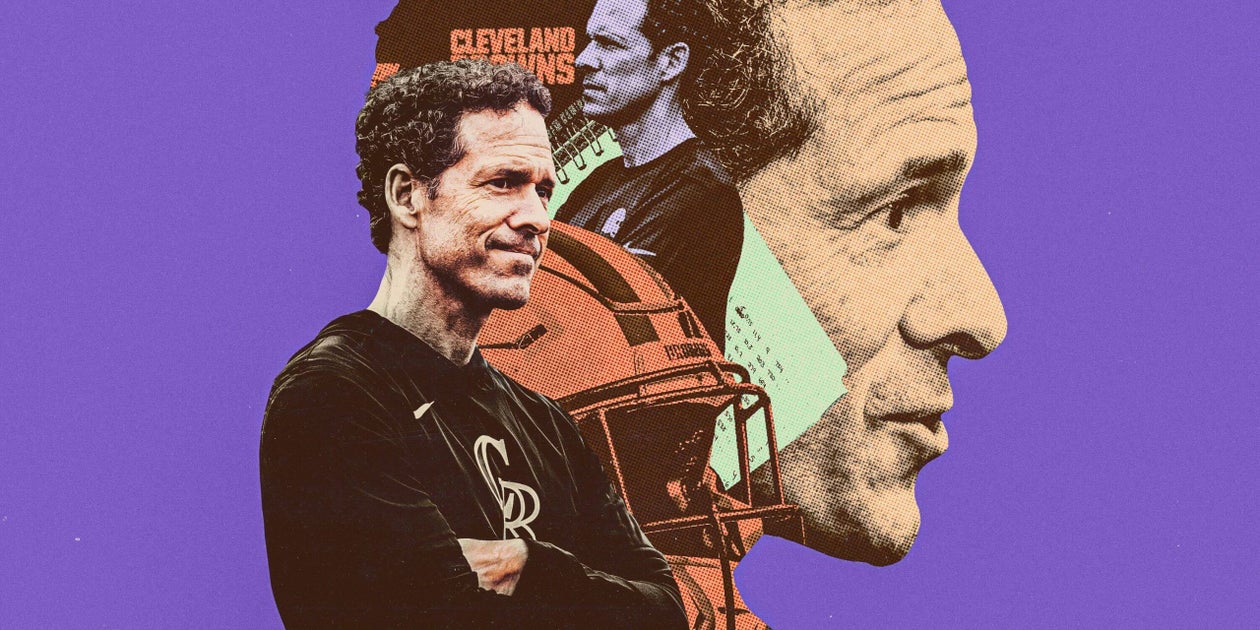
DENVER – Paul DePodesta arrived at Harvard in 1991 as a baseball recruit — expected to play a little shortstop and center field, maybe even pitch — but he couldn’t stop watching the football team. DePodesta, who also had played football at Episcopal High School in Alexandria, Va., sized up the Crimson for a season and couldn’t shake an idea. He called his high school coach to get his thoughts, then tried out and made the squad as a wide receiver.
It wouldn’t be the last time DePodesta made an audacious move toward football.
A quarter-century later, in August 2015, Jimmy and Dee Haslam told DePodesta they’d be in San Diego and wanted to meet. The Haslams, who bought the NFL’s Cleveland Browns three years prior, wanted to visit with some of sports’ brightest minds to turn around a franchise that hadn’t had consecutive winning seasons since returning to the league in 1999. They met with decision-makers for the Chicago Cubs, the Los Angeles Dodgers and the Oklahoma City Thunder, to name a few. Along the way, a Boston Red Sox exec dropped DePodesta’s name.
Then a New York Mets executive who kept a permanent home in La Jolla, the affluent San Diego suburb, DePodesta initially thought the Haslams wanted to collaborate with the MLB team, maybe something in sports science or performance. It was a slow-burn courtship, but by November, the Haslams had made their intentions clear: They wanted him to work in football full-time, for them.
DePodesta had 20 years in baseball at that point but had never stayed with one club for more than five. In Oakland, he had been at the forefront of the sport’s analytics revolution alongside longtime Athletics general manager Billy Beane, a movement that went mainstream in 2003 after author Michael Lewis espoused their data-driven approach in the best-selling “Moneyball.”
Lewis wrote that DePodesta “graduated from college with distinction in economics, but his interest, discouraged by the Harvard economics department, had been on the uneasy border between psychology and economics. He was fascinated by irrationality, and the opportunities it created in human affairs for anyone who resisted it.”
Moving to the NFL after decades of MLB experience seemed like the kind of irrational decision DePodesta normally tried to steer away from. But like that first fall at Harvard, he was intrigued by the challenge and tormented by the idea that if he didn’t take the leap he’d regret it later. He thought the same analytic principles that worked in baseball would work in football — where old-school scouting and gut instinct still ruled most front offices — but there was only one way to be sure. In January 2016, he shocked both sports when he became the Browns’ chief strategy officer.
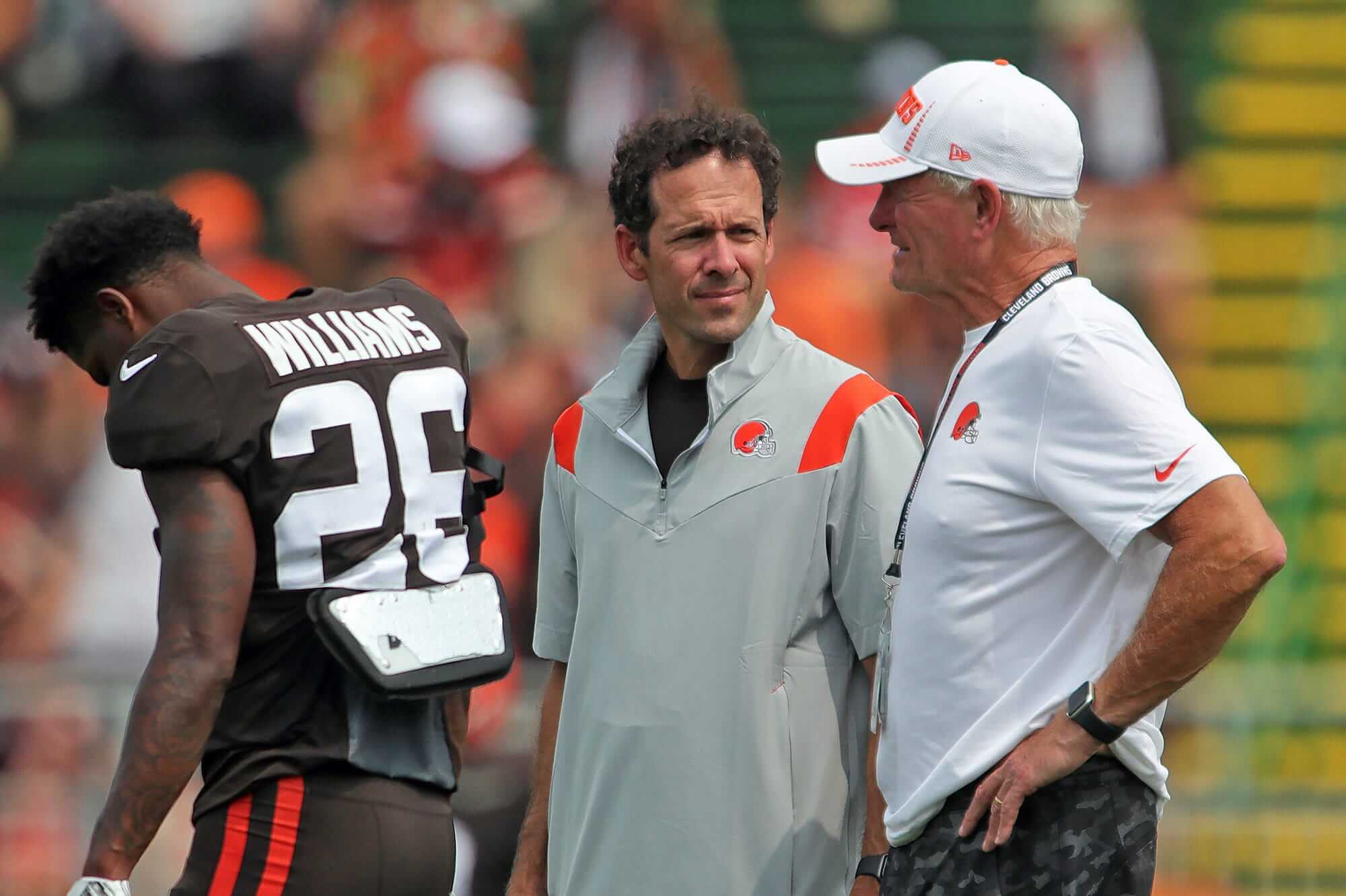
DePodesta (middle) was hand-picked by Browns owner Jimmy Haslam (right) to make the move from MLB to the NFL. (Jeff Lange / USA Today Network via Imagn Images)
Last October, when the Colorado Rockies parted ways with longtime GM Bill Schmidt following their third consecutive 100-loss season, DePodesta was nearly a decade removed from baseball. He was no longer a hot name, and the ideas that gave the A’s an edge 20-plus years ago were now accepted as conventional wisdom.
Yet here is DePodesta in early April, sitting in a conference room adjacent to the baseball operations suite at Coors Field, talking about building a model that will account for Denver’s altitude and provide hope to a moribund franchise with five playoff berths over a 33-year history. He accepted the offer to become Colorado’s president of baseball operations four months ago because, he said, he couldn’t pass up this particular challenge. The unique complexities that come with playing above sea level might prove tougher than DePodesta’s failed attempt to turn around the Browns.
At 53 years old, he’s still intensely fascinated by irrationality, perhaps even his own. “It’s a sickness,” DePodesta said with a laugh. “It was always about trying to find where the limit was, trying to find out exactly what you might be capable of.”
In February 2016, a month after his hiring in Cleveland, DePodesta found himself in a meeting preparing for the NFL Draft. It could have been a scene out of “Moneyball,” where DePodesta was often depicted as the man sitting behind an ever-present computer, answers at the ready. But as the Browns staffers cycled through player evaluations, DePodesta was stricken. He didn’t know the players or the intricacies of evaluations. How would he assess a left guard versus a strong safety? In New York, as executive vice president of player development and amateur scouting, DePodesta had felt like a tangible part of the Mets’ success. Here, he had virtually nothing to contribute.
“My competency as an executive fell off a cliff,” DePodesta said.
DePodesta’s move to the NFL attracted plenty of skeptics. He was “the baseball guy,” an interloper portrayed by Jonah Hill in the “Moneyball” movie as cold, calculating and anti-scouting. DePodesta’s newly created role in Cleveland was never fully defined for the fans or media. He reported directly to the Haslams and commuted from California, flying in more frequently in-season and during the draft. He rarely granted interviews — “It would have been a distraction to hear from ‘the baseball guy’ in football,” DePodesta said.
He had become reticent, a product of his “Moneyball” fame and a failed 20-month stint as the GM of the Dodgers during which he was widely criticized by local media and dubbed “Google Boy” by one Los Angeles Times columnist. DePodesta was just 31 when he took over the Dodgers, his first job as head of baseball operations. Subsequent stops in San Diego and New York taught him the value of building an entire organization — not just a good roster — but the Cleveland experience felt like being strapped to a rocket ship.
“Very quickly (in LA) the narrative was about me. When I went to the NFL, it was in danger of that happening again,” DePodesta said. “And the Browns were in a place … it was going to be a struggle, and we knew that for a couple of years. I wasn’t some savior. I didn’t even know what I was doing yet. It was going to take me years to try to figure it out and make some sort of positive contribution to the whole. I just didn’t want it to ever be about me.”
If Los Angeles humbled him, DePodesta’s first few years in Cleveland shook him up. He had to collaborate and lean heavily on colleagues, which he said accelerated his growth as a leader. But after his second season in Cleveland, Haslam fired executive vice president Sashi Brown, an analytics-friendly decision-maker, and immediately hired John Dorsey, who came from a traditional scouting background.
DePodesta, in his introductory news conference, had likened implementing “Moneyball” principles to a roller coaster: It would have ups and downs and wouldn’t always be fun, but he hoped the experience would prove worthwhile in the end. Instead, “the Haslams got off mid-ride,” said a former Browns executive who, like others interviewed for this story, was granted anonymity to speak freely about his experiences working for the organization. “They pulled the plug two years in,” another former employee said.
A spokesperson for the Haslams did not respond to multiple attempts seeking comment.
Multiple sources said the hiring of Dorsey as general manager undermined DePodesta’s emphasis on tanking and the draft. The two clashed ideologically, and Dorsey brought in several win-now veterans to go 7-8-1 in a season during which head coach Hue Jackson was fired. Some in Cleveland at the time wondered whether the Haslams, as hands-on as owners come, could stomach a long rebuilding process.
DePodesta “gets more hate than he should ’cause it’s easy to hate on a guy who flew in part-time and went to Harvard and was a baseball guy,” a former Browns employee who worked with DePodesta said. “He was never viewed as the primary decision-maker. His job was to integrate data and better decision models across the organization: How do we develop better systems for that? That was what Paul focused on a lot more than the roster. He was the process guy.”
A few MLB clubs expressed interest in bringing DePodesta back to baseball, he said. There was one particularly tempting opening about five years after he left, but by then he felt like he was starting to figure things out. Multiple Cleveland colleagues said he improved the team’s infrastructure and salary cap situation, and in 2020, he had helped lead the hiring process that resulted in head coach Kevin Stefanski and GM Andrew Berry. The following season, the Browns scored the only playoff win since the franchise’s post-1999 return to Cleveland.
“I’m not sure the original plan ever got to see the light of day,” a former Browns employee said. “The big question, though, is would it have mattered? If you grade all the decisions on plus-minus, I think their hit rate was better with Paul in it. The problem was you hit on a bunch of dollar bets and missed on a thousand.”
The big miss was quarterback Deshaun Watson, whom the Browns traded for in March 2022, giving up a half-dozen draft picks before signing him to a five-year, $230 million fully guaranteed contract. Watson missed the previous season after nearly two dozen women accused him of sexual harassment or assault involving inappropriate behavior during massage sessions in civil lawsuits.
The decision to acquire Watson, multiple sources said, was an organizational one and not DePodesta’s alone, with the Haslams playing an integral role in deciding to guarantee the money. Since coming to Cleveland, Watson has played in just 19 games over three seasons and performed like one of the least productive quarterbacks in the league when on the field.
“There is no baseball equivalent to it. It’s like trading for a player with your top five prospects and handing that player $400 million and being handcuffed for the next few years to get a replacement,” said one former Browns employee. “This isn’t MLB with different pitchers every night. If you don’t figure out the quarterback in the NFL, you can’t survive.”
The Browns had just two winning seasons in DePodesta’s tenure, going 54-93-1 in nine full seasons. He said he didn’t accomplish what he wanted to in the NFL, “not even close.” But it’s fair to question whether he was actually given a chance. “His process? No one better,” said the former Browns exec. “It was probably the most advanced in football. I think it failed because they didn’t weigh it enough.”
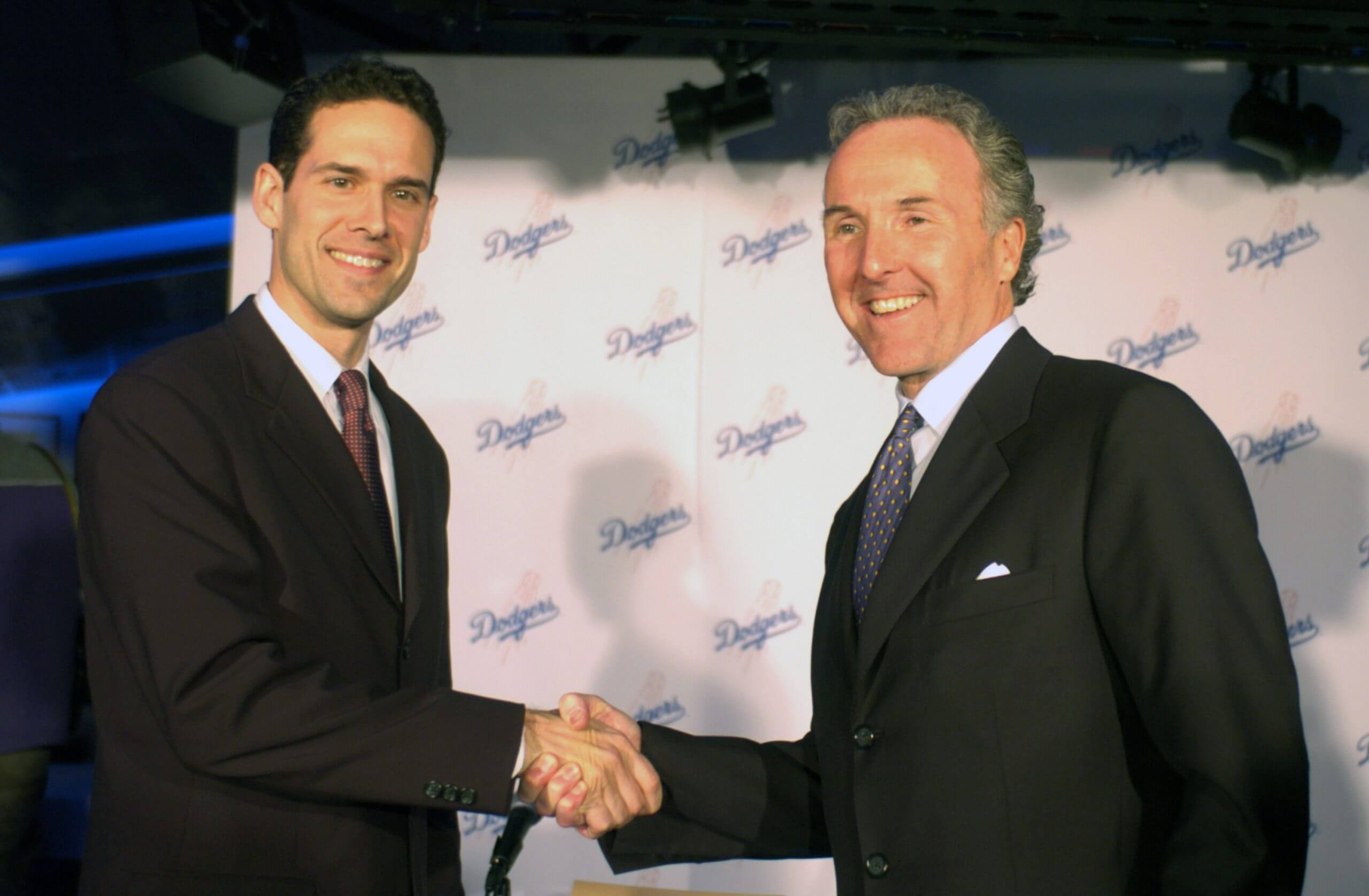
After being hired by then-owner Frank McCourt (right) in 2004, DePodesta’s tenure atop the Los Angeles Dodgers lasted only 20 months. (Kirby Lee / Imagn Images)
The Browns are facing yet another season of change. Stefanski, twice named Coach of the Year, was fired in January and subsequently hired by the Atlanta Falcons. Berry is on the hot seat. DePodesta signed a five-year extension in summer 2021, but there were rumors that he wanted to get back to baseball. He said he did not interview with an MLB team before the Colorado job.
“I had no idea what my exit strategy was,” said DePodesta. “I didn’t plan on coming back to baseball. I wasn’t planning on going to a different NFL team after a handful of years. That ownership group were the ones who took the leap to bring me aboard. I was going to be loyal to that team.”
A friend at Major League Baseball put DePodesta on Rockies owner Dick Monfort’s radar in October, and the Haslams let him leave midseason. He said he doesn’t regret the decade he spent in football or the roundabout way he got to Colorado. DePodesta’s biggest fear isn’t failure, it’s reaching his 70s and regretting not taking career risks.
“I didn’t leave (baseball) because I was bored or felt like I had it all figured out, because clearly I hadn’t,” he said. “The idea of starting out again at ground zero, at the very steepest part of the learning curve, was absolutely appealing at that time.”
A faint hum emanated from outside the conference room doors as the stadium filled up. Almost 40,000 would pack Coors Field for the team’s second home game of the 2026 season. DePodesta leaned back in his chair.
“I think there’s a little bit of that coming back.”
DePodesta’s return sent shock waves through baseball. Some felt slighted. There are, after all, only 30 jobs running major league clubs; many would-be candidates felt overlooked. Others were blindsided since DePodesta’s name hadn’t been mentioned in any earlier Rockies reports.
The search was spearheaded by Walker Monfort, Dick’s 39-year-old son, who was named executive vice president last year and elevated to president in January. Walker made it clear that the Rockies — oft-criticized for an insular approach — would seek an outside voice. The Monforts whittled down a list of 20 to a select few. They met in Denver with Arizona assistant GM Amiel Sawdaye and Cleveland’s AGM Matt Forman a few days apart; they were believed to be the only two finalists.
DePodesta, however, was the first person to speak with the Monforts. He didn’t know initially where things were headed, at one point offering to assist the Rockies’ search for a new head of baseball operations. He had hired the Browns’ top two decision-makers and helped other teams in the process. If the two men wanted his input, DePodesta would give it.
Sawydaye felt some hesitation. Forman withdrew. DePodesta had intrigued the Monforts since their first conversation. They talked to 10 people about him, with all providing glowing reviews. Not many teams would hire a top executive who had been out of the game for a decade, but the Rockies were unfazed. On Nov. 6, the news trickled out: DePodesta was coming back to baseball.
“We know he’s very smart. He’s got a kind of a sense of humor that’s unique but also fitting within our organization,” Walker Monfort said. “It seemed like he was gonna really fit in here and be able to work well with my dad and myself and my uncle (and Rockies co-owner) Charlie.
“Ultimately, we were looking for someone that could help us solve our problem. And he came off as a tremendous problem-solver.”
Much of DePodesta’s initial job involves building out understaffed departments. Front offices have ballooned in numbers in his decade away, and the Rockies have struggled to keep up. Two rival executives estimate that Colorado employed between 75-100 people fewer than an average MLB team. Employees, many of whom appreciate the Monfort family’s loyalty, have been stretched thin.
By mid-December, DePodesta had hired GM Josh Byrnes (Dodgers) and assistants Ian Levin and Tommy Tanous (Mets) to reshape the front office. The Rockies overhauled their organization’s pitching coaches. In March, they posted openings for a director of baseball systems, director of baseball data science and principal analyst for research and development. Multiple MLB executives have been surprised by the amount of outside additions DePodesta has already made given Colorado’s reputation. There haven’t been mass layoffs, a departure from the path often taken by other clubs changing baseball operations. DePodesta may have taken a different approach elsewhere, but he said he values “institutional knowledge about a unique environment.”
“Whenever I hear that somebody goes in (to a new place) and lets go of all these people, they don’t know those people yet,” Walker Montfort said. “One of the things that we’ve tasked Paul with is, let’s figure out what we have and if there’s people that are doing a great job, let’s figure out ways to invest in those people and make them even better.”
DePodesta said it will take a full calendar year before the Rockies are fully operational and not playing catch-up. Rival executives are curious how DePodesta will alter Colorado’s typically stagnant approach to the draft and wonder if the team’s polarizing experiment of suggesting pitches from the dugout will pan out.
In the meantime, the riddle that is Coors Field remains. How quickly can DePodesta and his staff come up with a predictive model for success 5,280 feet above sea level? The Rockies’ offense and base-running will get immediate attention as the front office tries to solve a problem that has long flummoxed some of the sport’s brightest minds: developing pitching for team that plays half its games at elevation.
The Rockies have had nine winning seasons and zero division titles since joining MLB in 1993. Some inside the organization believe that moderate success — including an improbable World Series appearance in 2007, when they were swept by the Boston Red Sox, and back-to-back wild-card spots in 2017-18 — hurt the argument to modernize sooner. Still, the Rockies job was attractive in the industry. They’re the only team in the Mountain time zone and maintain impressive attendance numbers, especially given their performance of late.
Colorado lost a league-worst 119 games in 2025. There aren’t many jobs where there is literally nowhere to go but up. DePodesta, who will have a place in Denver while his two high-school-aged kids finish up school in California, said he and his wife, Karen, always had the Rockies job circled.
DePodesta helped transform baseball, but he never conquered it. He hasn’t won a World Series. The Athletics, for all their savvy, haven’t since 1989. Small-market clubs such as the Milwaukee Brewers, Tampa Bay Rays and Cleveland Guardians have had sustained regular-season success, but 20 of the last 28 World Series winners had top-10 payrolls.
For the Rockies — who rank 23rd in 2026 spending — there may be hope on that front, too. On April 10, the Penner Sports Group purchased a 40 percent stake in the team, a cash infusion they said would eliminate all debt and allow for greater financial flexibility. The group is led by Greg and Carrie Walton Penner, granddaughter of Walmart founder Sam Walton, co-owners of the Denver Broncos who have made significant investments in the franchise since purchasing it for $4.65 billion in 2022. Based on Forbes’ $1.68 billion valuation of the Rockies, the investment is valued at north of $670 million.
It could be the first move in an eventual path to majority ownership. At the very least, it’s an admission from the Monfort family, part of ownership since the team’s inception, that their current model isn’t enough in the modern MLB landscape.
DePodesta wasn’t aware of the talks between the Penners and Monforts before he took the job, but the presence of the new minority owners should bolster the Rockies’ ability to invest in its big-league roster when the time comes. MLB owners are expected to push for a salary cap when the league’s collective bargaining agreement expires in December, a move that could spark a work stoppage and forever change how front offices operate. Colorado is projected to lose more than 90 games this season. Even the most optimistic industry timelines give the Rockies several seasons to catch up.
Walker Monfort, credited for leading the charge to modernize and diversify the organization, said the goal is to build a sustainable winner as quickly as possible and that DePodesta will have the resources to compete. “Within our means, we’re going to do everything we can to turn this place into a winning baseball team,” he said.
DePodesta understands some of the skepticism surrounding his return to baseball. In Oakland, he wasn’t a true baseball guy because he relied on analytics and sat behind a computer. In Cleveland, he was the guy from “Moneyball” who rode the roller coaster behind the scenes. “I had to go to football to become the baseball guy,” he said, laughing. He hopes this is his last stop, but he can never be sure.
For now, at the beginning of what he hopes will be a prosperous climb in Colorado, DePodesta is the football guy, an outsider again.