
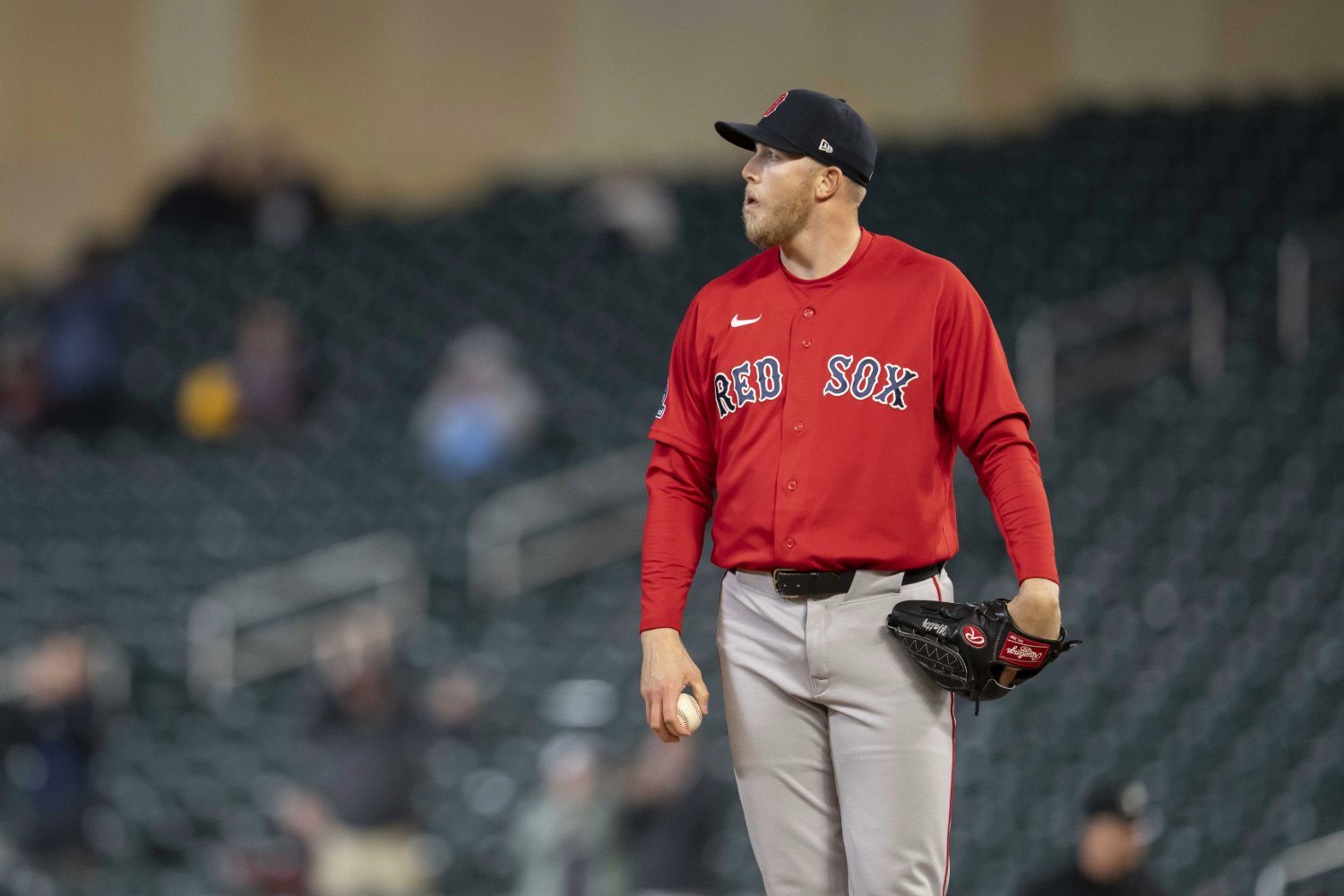
Not much was known about 28-year old Ryan Watson when he was acquired by the Boston Red Sox back in December in a complicate process in which he was selected and then promptly traded by the Athletics in the Rule 5 Draft. Then again, the same could be said about Garrett Whitlock after he was taken from the Yankees’ minor league system in 2021, and Justin Slaten when he was acquired from the Mets via trade in 2024. It was the continued success of those two however, that gave fans some hope that the Red Sox could once again strike gold via the Rule 5 Draft, something most teams don’t usually hit on once let alone potentially three times.
On paper, Watson profiled as an arm that checked a lot of boxes the Red Sox have gravitated towards in their recent reliever acquisitions. Pitching for Sacramento, the Triple-A affiliate of the San Francisco Giants, the 6-5 righty with great extension and a five-pitch mix owned a 4.26 ERA and 3.73 FIP across 50.2 innings while amassing 11.37 K/9 (28.1 K%) and 2.84 BB/9 (7.0 BB%) ratios. Those who follow FanGraphs will know that while those walk numbers put him into the average (2.9 BB/9, 7.7 BB%) to above-average (2.5 BB/9, 6.5 BB%) tier, his strikeout numbers graded out as excellent. It was those numbers one would think that made Watson a standout target for Breslow and ones he’d hoped Watson would carry over in his opportunity with Boston.
Now ten appearances into his big-league career, and the owner of a 8.10 ERA and 7.38 FIP, it would appear the only thing Watson has carried over (outside of continuing to throw the kitchen sink at hitters), is his borderline elite ability to get downhill. His 7.2 feet of extension is good for the 95th percentile across MLB. After that, not much else has gone right; he’s not attacking hitters nearly enough to consistently be successful, and when he is, they’re lighting him up.
Watson finds himself in just the second percentile in K% (10.5%) and 27th percentile in BB% (12.3%), both far cries from what made him such an appealing option to the Red Sox in the first place. Add in a league-average 25.3 Whiff% (48th percentile), a lack of chase on really any of the pitches in his repertoire (23.1%, 11th percentile), and the fact that he’s getting barreled up at a pretty frequent pace (16.3 Barrel%, 7th percentile) and 44.2% HardHit% (31st percentile), and you have a pitcher who is flirting with danger pretty much every time he steps out on the mound.
Those choosing to come to Watson’s defense may argue that it is far too early to write him off after just 13.1 innings in the majors. Instead, time must be given to him like it was expected to be given to Whitlock and Slaten, who, similarly to Watson, were looked at as multi-inning arms out of the bullpen in their rookie campaigns. That argument falls apart rather quickly though when you look back and realize just how soon both were able to shed that label and become legitimate weapons and important pieces to Boston’s bullpens during those seasons.
The 2021 campaign saw Whitlock dominate right out of the gate on route to becoming one of the most trusted relievers the Red Sox have had to this date. In his first ten outings, he accumulated a 1.77 ERA and 2.97 FIP over 20.1 innings pitched with a strong 9.30 K/9 (27 K%) and 1.33 BB/9 (4 BB%). If there was a spot where Whitlock struggled similarly to Watson, it was in his HardHit%, which came in at 46%, though the former was far better at keeping away from danger, holding opponents to a measly .227 average against.
Fans will remember Slaten’s 2024 debut as the spot where he was tasked with coming into the 10th inning of a 3-3 game on Opening Day in Seattle and being asked to get out of a first-and-third, zero-outs jam with Mariners star Julio Rodriguez at the plate. As we all know that matchup went to Rodriguez, who walked off Slaten and the Sox, ruining the start to his big-league career. Following that, he absolutely dominated in his next 10 outings, pitching to a tune of an 1.40 ERA and 2.07 FIP in 17.1 innings with a 7.27 K/9 (23 K%) and similarly to Whitlock, outstanding 1.04 BB/9 (3 BB%). Contrary to what Watson has done so far, Slaten was also able to stay away from opponents’ barrels, with a HardHit% of just 37% and opponents average of .140.
While it is a totally fair case to make for giving rookies time to adjust to the top level, Watson, who is older and therefore should arguably be more polished, has not done a whole lot to instill any confidence in continuing to send him out there. Especially when he hasn’t been able to do the main thing that garnered him praise from Alex Cora in spring training when he was fighting for a roster spot: pound the strike zone.
What may also be damning for Watson — outside of another rough outing yesterday where he entered the ninth with a five-run lead and ended up giving way to Aroldis Chapman to secure what became an 8-6 Boston victory — is the fact that the organization has not been shy at bringing up reinforcements so far this season. We’ve already seen the debuts of Tyler Uberstine, Tyler Samaniego, and Jack Anderson. With the likes of Payton Tolle (three starts, 3.00 ERA, 15.0 IP), Jake Bennett (four starts, 0.55 ERA, 16.1 IP), Seth Martinez (six appearances, 2.51 ERA, 14.1 IP), Devin Sweet (seven appearances, 3.86 ERA, 11.2 IP) and Tayron Guerrero (seven appearances, 1.42 ERA, 6.1 IP) all off to strong starts in Worcester, it’s beginning to feel like Watson may need to go on his Whitlock/Slaten-type run sooner rather than later if he wants to continue Boston’s trend of Rule 5 Draft Pick supremacy. Otherwise, he may wind up with a one-way ticket back to Sacramento.