
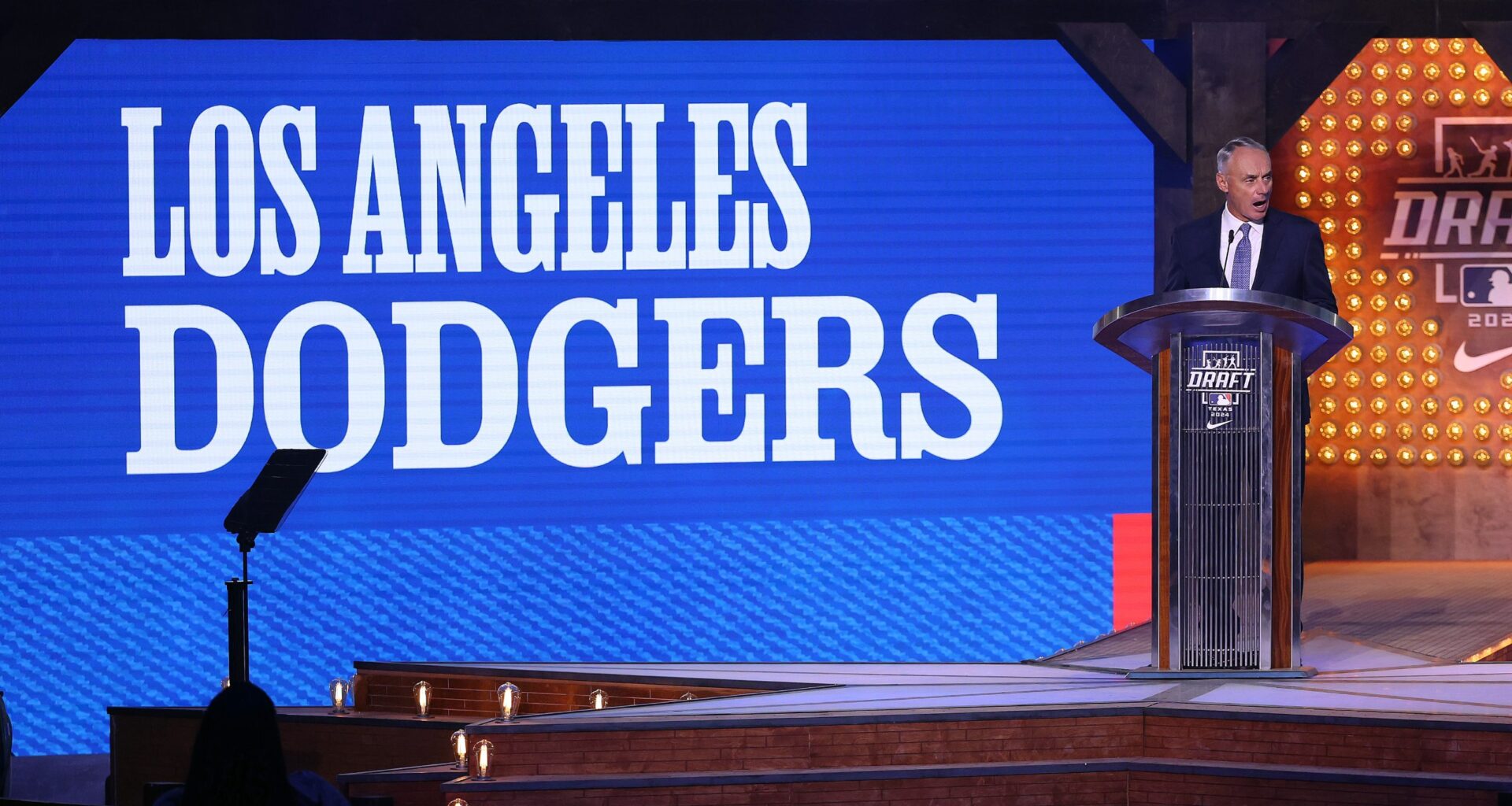
On almost every day of the year, the Dodgers are operating with more resources than the other 29 MLB teams, not less.
Don’t tell that to Dodgers scouting director Zach Fitzpatrick, though. At least not on draft day. And especially not this year.
The Dodgers have become accustomed to picking at the back of the first round. As back-to-back World Series champions who are favored to make it a three-peat, they’ve won the NL West 12 of the last 13 seasons and have made the playoffs 13 consecutive years. They haven’t had a single-digit draft pick since 2007 when they just so happened to select future Hall of Famer Clayton Kershaw.
Fitzpatrick has been with the Dodgers since November 2015 and became the team’s scouting director ahead of the 2023 draft. In the 10 drafts he’s been with the organization, the team has picked no earlier than 20th in the first round. Since the 2021 draft, he and the Dodgers scouting department have also had to deal with both the lost-pick penalties that come with signing high-profile free agents and the 10-spot penalty that comes when a team spends beyond the second tax threshold of the CBA.
But the 2026 draft represents a new extreme in limited draft capital for the Dodgers, who have just six picks in the first 10 rounds.
“We’re a little bit used to it at this point,” Fitzpatrick told Baseball America. “Obviously, this pick structure is more extreme than we’ve had.”
In December, Los Angeles lost its second- and fifth-round picks by signing free agent Edwin Díaz to a three-year, $69 million deal. Then in January, they lost their third- and sixth-round picks by signing Kyle Tucker to a four-year, $240 million deal.
Those pick losses, combined with being docked 10 spots for their first-round pick, mean the Dodgers will make just two picks within the first six rounds, the first coming at No. 40 overall and the next at No. 132. Since bonus pool money is tied to slot values in baseball’s draft, that also means LA will have just $3,951,900 in bonus pool funds to work with. That’s the smallest bonus pool of the draft and $1.59 million less than the Blue Jays, who have the second-smallest bonus pool.
Excluding the pandemic-shortened 2020 draft, only two teams in draft history have had as few picks inside the first 10 rounds as this year’s Dodgers. The 1981 Angels and the 2002 Rangers both had just six picks after losing their round 2-5 selections because of free agent signings.
“In a lot of ways, we’re used to the challenge of trying to do more in the draft with less, which our guys really embrace and take a lot of pride in,” Fitzpatrick said. “Our job is to produce major league value and impact, so that kind of focus never changes. I think with fewer picks and dollars, you definitely have smaller room for error. It puts an emphasis on precision and the execution of those picks, which is really important to us.”
The first 22 picks in this year’s draft come with higher individual slot values than the total bonus pool LA will have to work with for 16 rounds of picks. If the Dodgers choose to push to the full 5% overage that comes before pick penalties trigger—something they do regularly—it will give them just under $4.15 million to work with.
Despite their early-round disadvantages, the Dodgers have made a habit out of finding big league value with later picks in recent seasons. They drafted three big leaguers after the first round in 2020 in Landon Knack, Clayton Beeter and Gavin Stone while also boasting hits like Emmet Sheehan (2021, sixth round) and Dalton Rushing (40th overall, 2022) more recently.
The strength of the 2026 draft could work in the Dodgers’ favor as they attempt to add to that list.
While many players inside the first round haven’t made the sorts of strides that teams picking at the top would have hoped, the depth of the class is perceived as a real strength. There are appealing profiles in all sorts of different demographics as teams begin to line up players for their second, third, fourth and fifth picks.
Or, if you’re the 2026 Dodgers, your first and second picks.
Fitzpatrick and the Dodgers are remaining open-minded about any profile given that depth and the uncertainty that comes from picking later.
“Rather than trying to shortcut, ‘Hey,,this type of demographic doesn’t really work for us,’ we’ve taken high schoolers, we’ve taken proven college performers, we’ve taken college pitchers,” Fitzpatrick said. “We’ve kind of dabbled in every area, and I think that’s a credit to trying to stay open-minded, at least early. Obviously, as we whittle down, like all teams, we’ll narrow our focus and try to collect as many important pieces of information as we can.”
Even with the extreme lack of picks and smaller bonus pool, the team hasn’t changed how it’s operating this spring. The Dodgers are casting a wide net and trusting their area scouts to dive deep on players and be comfortable with their backgrounds, makeup and player development arcs, while also folding in data and feedback their analysts bring to the table.
Handling the uncertainty about which players will actually get to them at the 40th and 132nd picks is pretty straightforward. There’s no real meta-game being played in an attempt to try to eliminate players or project ahead of time who they won’t have a shot at drafting.
“We’re really just focused on lining up our favorite 40 players,” Fitzpatrick said, noting the potential mistakes the team could make in trying to game plan for what other teams might do in front of them. “Our job is to line up our favorite 40 players who we think are going to have the 40 best careers in the big leagues.”
The same is true for their next pick in the fourth round.
“We’re really confident in our ability to do that,” Fitzpatrick said. “Collect information, have really critical conversations at the same level that we would for the 40th-overall pick.
“Confident in our process, our scouting information, our data, our (quantitative analysis) team, everything that we gather from combine to backgrounds to area scout opinions and kind of lean into our information and our process with a lot of belief that we can do that. It might be the 60th player on our board that gets there. It might be the 100th player on the board that gets there. There’s a lot of uncertainty and unknown that could create some issues if you’re trying to predict what other teams are going to do.”
In baseball’s draft, lining up the board is just the first part of the process. It’s not always as simple as taking the top player who’s available on your board. Because the draft is a soft-slotting system, teams also need to make sure the players they want to take are actually signable at a given pick.
That’s especially important for a team like the Dodgers who, at least in the draft, have precious few extra dollars to move around.
In the draft room, it will be an all-hands-on-deck process, with Fitzpatrick relying on the networks and relationships of his entire department to get information on signability as the draft unfolds and the board develops.
“We have a big draft room for that reason,” Fitzpatrick said. “(We’re) able to step out, make calls, collect information, notate it and deliver it in real-time so that we can try to make the best assessment of the optimization problem of, ‘Hey, how do you stretch your minimal dollars up the most that we can?’”