
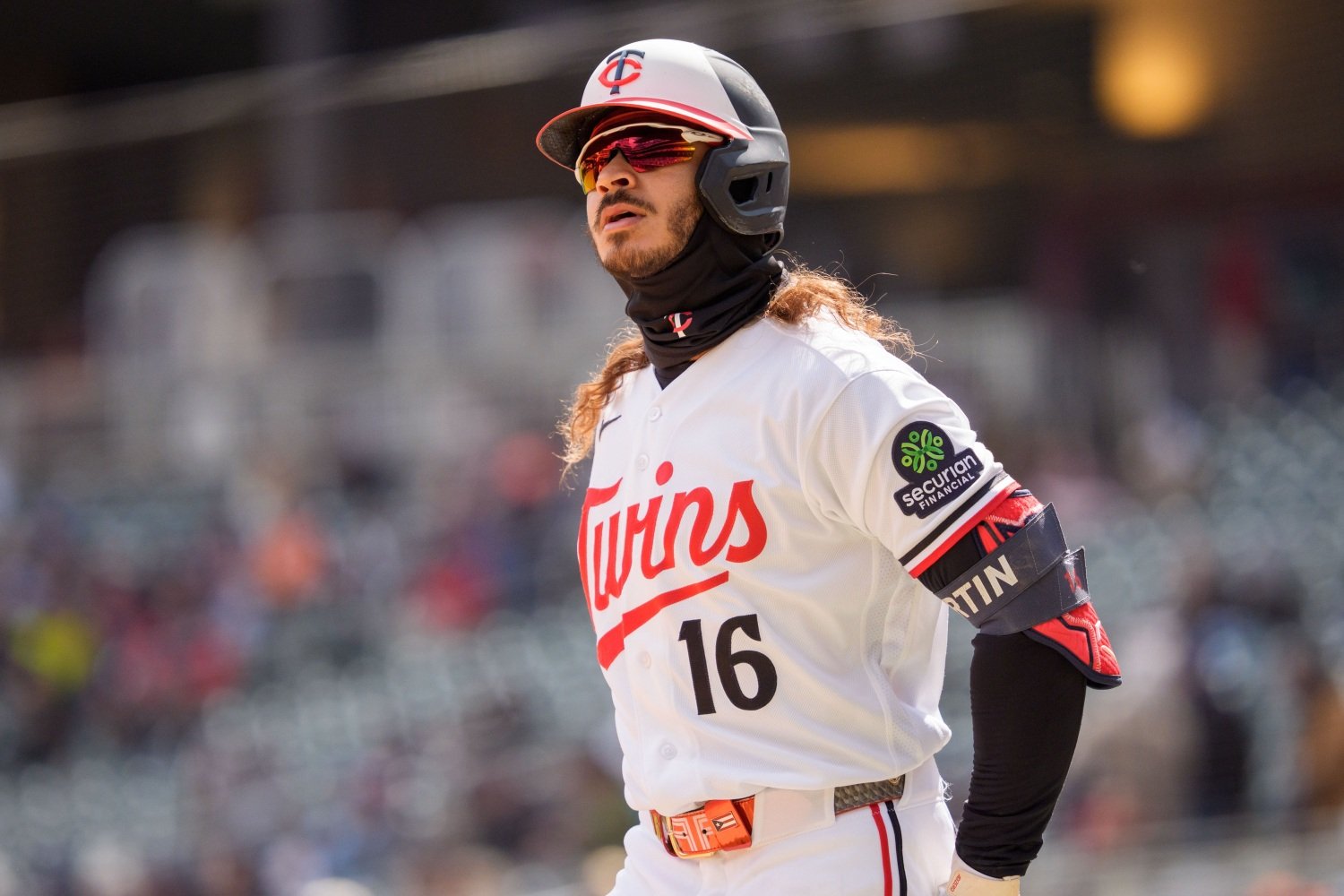
So far in 2026, Austin Martin has mostly been used as a true platoon option. He’s started 14 of the team’s first 22 games, but that’s because the Twins have faced left-handed starters 13 times. Martin has only gotten the nod once in nine games against righties, and he’s not in the lineup Tuesday against Mets righthander Nolan McLean.
Even with that limited role, you could easily argue Martin has been the Twins’ best hitter. At a certain point, when the production looks like this, it’s fair to start questioning whether that platoon-focused role still fits the player.
Entering Tuesday night, Martin is hitting .311 with a .484 on-base percentage, both of which lead the team. More importantly, he hasn’t just been quietly productive. He’s come through in big spots, consistently putting together quality at-bats when the lineup has needed it most. For a player who’s largely been penciled in based on matchups, he’s been far more impactful than that role would suggest.
Obviously, the huge caveat must be stated. Martin has had the platoon advantage in 45 of his 62 plate appearances, pushing 73%. That’s a ratio more typical of a lefty batter being shielded from southpaws than of a righty; everyday right-handed batters enjoy the platoon edge more like 28% of the time. So far, though, Martin has held his own just fine when he’s encountered righties, too. Is it time to let him prove himself against them in more playing time?
For his career, Martin is a .257 hitter against righties. On the surface, that number might not jump off the page. But when you zoom out and look at his full offensive profile, it becomes a lot more valuable than it initially appears. His career on-base percentage against right-handers sits at .343, driven largely by an advanced approach and a willingness to take pitches.
That approach has been on full display so far this season. Martin leads the Twins with 14 walks, and it’s not the result of a lucky stretch or a handful of passive at-bats. He’s been one of the most disciplined hitters in the league to start the year. His chase rate, whiff rate, and walk rate all sit in the 95th percentile or higher among major-league hitters, and his zone contact rate is up at 94%. That, too, is driven by having the platoon advantage most of the time. It’s a lot easier to make good swing decisions when you can pick up the ball sooner, which is one of the crucial advantages for a batter facing an opposite-handed pitcher. Facing more righties would put more pressure on that approach, and with breaking balls moving away from him much more often (the other key to the platoon dynamic), his contact rate would surely fall, too.
Up to this point, his role has been pretty clearly defined. He’s been splitting time in left field with Trevor Larnach, with the decision largely dictated by the opposing starting pitcher. If it’s a right-hander on the mound, Larnach gets the nod. If it’s a lefty, Martin’s in the lineup. But what if that doesn’t need to be an either-or situation? There’s a case to be made that both bats should be in the lineup on a daily basis.
Coming into the season, Forest Lake native Matt Wallner was expected to handle right field on an everyday basis. His power is real, and when he’s right, it adds a different dimension to the lineup. But through the early part of 2026, it’s getting increasingly difficult to argue that he’s earned that role.
The swing-and-miss issues have been extreme. Wallner currently sits near the bottom of the league in both whiff rate and strikeout rate. He’s swinging through just under half of the pitches he offers at, and striking out in 42% of his plate appearances. That’s incredibly difficult to carry in a regular role. It, too, is colored by the distortion of the early season, because a whopping 38 of Wallner’s 81 plate appearances have come against lefties. His track record is checkered enough, though, that the cold start still mutes any optimism about him.
Defensively, Wallner has been ghastly. He’s slow, he takes bad routes, and he did this.
OHliS2JfWGw0TUFRPT1fVlFVSEJWRUVBQVVBV1ZFRUF3QUhVZ0VFQUZnTlZsZ0FVRmNIVWxJRFVsQUFDUXBT.mp4
Taking Wallner out of the lineup more often and putting either Larnach or Martin in right field (with the other in left) would improve the team’s defense, for certain, and it might be the best way to optimize their run production, too.
The Twins are in the middle of a four-game losing streak and about to start a week-long road trip. This is the kind of moment where small adjustments can make a real difference, and the lineup feels like an obvious place to start. Martin has shown that he deserves more than a platoon role. Wallner, at least for the time being, looks like someone in need of a reset.
That doesn’t mean Martin is going to step in and start launching balls into the seats every night; that’s not his game. What he will do is give the Twins competitive at-bats, work counts, get on base, and play solid defense in the outfield. You can put him near the top of the order and let him set the table, somewhere in the middle, or even drop him into the nine spot and essentially create a second leadoff hitter. But regardless, he lengthens the lineup and will challenge opposing pitchers.
At a certain point, roles have to adjust to production. Right now, Martin’s production is making a pretty clear case. The platoon weirdness of this March and April muddies our evaluations, but to the extent that one is possible, it seems like Larnach and Martin should get more playing time, at Wallner’s expense.