
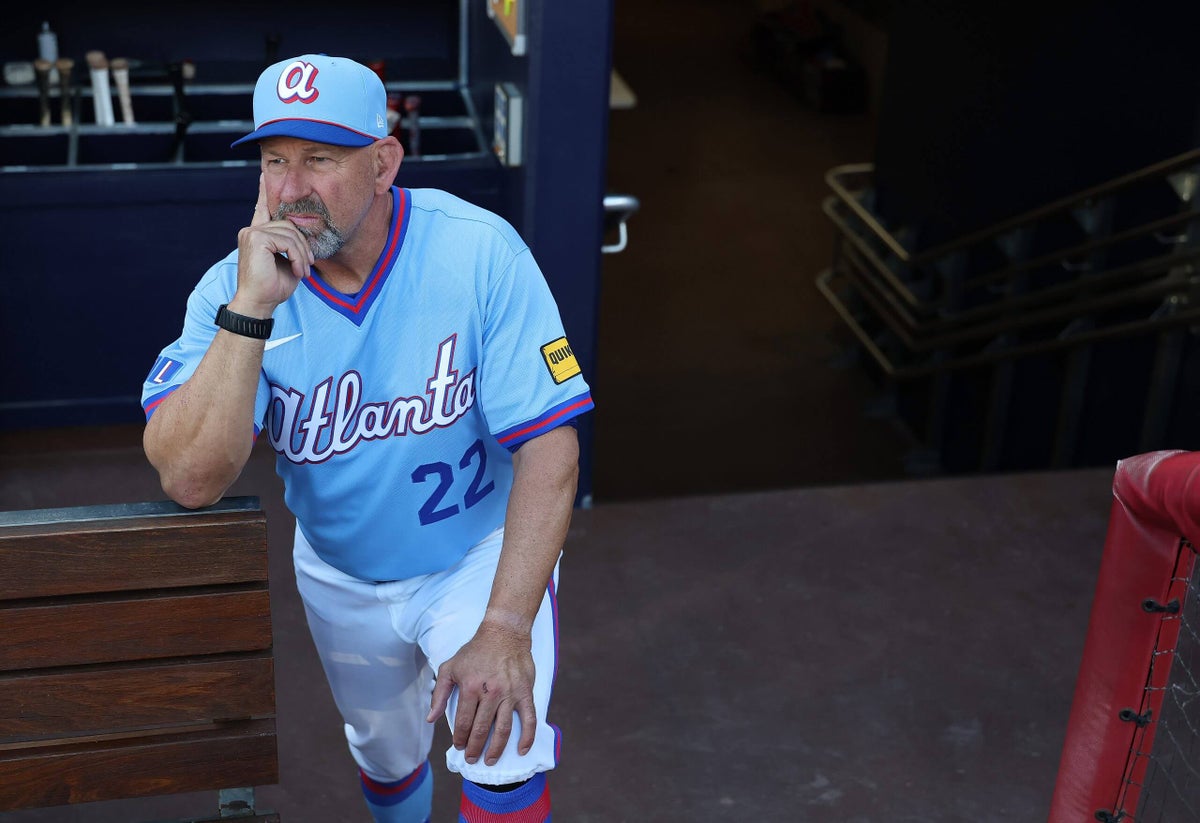
As Dansby Swanson recalls, the conversation took place in the spring of 2019, before he was fully established as a player.
Walt Weiss, entering his second season as a coach with the Atlanta Braves, pulled the young shortstop aside for a pep talk.
“Never stop being the winner you are,” Weiss said.
The message, coming from a former shortstop and World Series champion, made a powerful impression on Swanson. Weiss not only saw beyond his early struggles as a hitter, but also grasped his intangible value, understood his essence.
“That was such a cool moment for me,” Swanson said.
Swanson, now with the Chicago Cubs, is just one of countless people in baseball to experience Weiss’ personal touch.
Weiss, in his first season managing the Atlanta Braves after spending eight years as their bench coach, has guided the team to a 16-8 start and a five-game lead in the NL East. He is intensely competitive. Unfailingly humble. Something of a hitting nerd. And, as the baseball world witnessed during a brawl between the Braves and Los Angeles Angels on April 7, a black belt in taekwondo who, at 62, was capable of tackling a player considerably larger and nearly three decades younger, Jorge Soler.
But according to another of Weiss’ former players with the Braves, Los Angeles Dodgers first baseman Freddie Freeman, his defining quality, the one that could make him a great manager, is how much he cares about others.
Three new members of the Braves noticed that in Weiss immediately. Utility man Mauricio Dubón called him a “father figure.” Infielder Kyle Farmer was struck by how Weiss remembered his children’s names. First baseman Dominic Smith said both Weiss and president of baseball operations Alex Anthopoulos checked on him daily before he lost his mother, Yvette, to cancer on March 15, and have kept up their inquiries since.
“It’s not like fake, ‘Hi, how are you, how’s your family?’ And then he doesn’t talk to you for three weeks,” Freeman said. “It is every day, making sure, ‘Is your family OK? Are you OK?’ That makes you want to run through walls.”
Freeman said even when hurt, he fought to get on the field to play for two managers he described as similarly empathetic, his current skipper, Dave Roberts, and Weiss’ predecessor, Brian Snitker. In Freeman’s view, a manager’s ability to elicit such passion is far more important than, say, his rationale for bullpen decisions. Many of those moves, Freeman said, are scripted based on which relievers are available and which are not, knowledge often kept from the media and fans.
Weiss, though, isn’t just compassionate with players under his current watch. During the World Baseball Classic, he reached out to Team USA manager Mark DeRosa, whom he mentored as a teammate toward the end of his playing career with the Braves.
DeRosa had created a firestorm by mistakenly saying Team USA qualified for the quarterfinals when it had not. Weiss called him and said, “You’ve got great baseball instincts. Tune out the noise and trust those instincts.” DeRosa, recalling those who offered him the most support, mentioned Weiss.
“I lean a lot on my own experiences,” said Weiss, who spent 14 seasons in the majors with the Oakland Athletics, Colorado Rockies and Braves. “I’m not saying you had to have played to be a manager. Obviously, we can debunk that theory. But I do think it adds an element to it.
“I like to encourage guys. That’s my nature. I always go out of my way in the toughest of times to encourage players. Because I know what it feels like when you’re not playing well, and it feels like everyone hates you because you’re not playing well. I remember that. I don’t want guys to feel that.”
Weiss’ takedown of Soler was perhaps the most vivid example of how he will stand behind his players. Almost as telling, it created no hard feelings with Soler, who played for the Braves in 2021, when they won the World Series, and in ’24.
“We’re friends,” Soler said. “I think he was trying to protect me.”
Freeman remembered that even during Weiss’ first tenure as a manager, with the Rockies from 2013 to ’16, he often was the first on the field during brawls.
“You want to know the manager has your back,” Freeman said. “And that is Walt Weiss, to a T.”
Former Rockies general manager Dan O’Dowd considers Weiss his best friend in baseball “by far.” But O’Dowd acknowledges that when he gave Weiss his first managing job in Nov. 2012, he did not put the newcomer in a position to succeed.
The Rockies’ front office was in transition. O’Dowd was focusing more on player development, leaving assistant GM Bill Geivett to oversee the major-league club. Weiss did not connect as well with Geivett as he did with O’Dowd. And he admits now he wasn’t prepared to manage.
“I had been out of the game for four years,” Weiss said. “A lot of people don’t realize that.”
After retiring as a player in 2000, Weiss served as a special assistant and instructor with the Rockies from 2002 to 2008. At one point, he turned down an offer from O’Dowd to become the team’s hitting coach, steadfast about wanting to help his wife, Terri, raise their four sons. He coached one of the boys, Brody, for one year at Regis Jesuit High School in Aurora, Colo., but was even more involved with them in youth football than baseball.
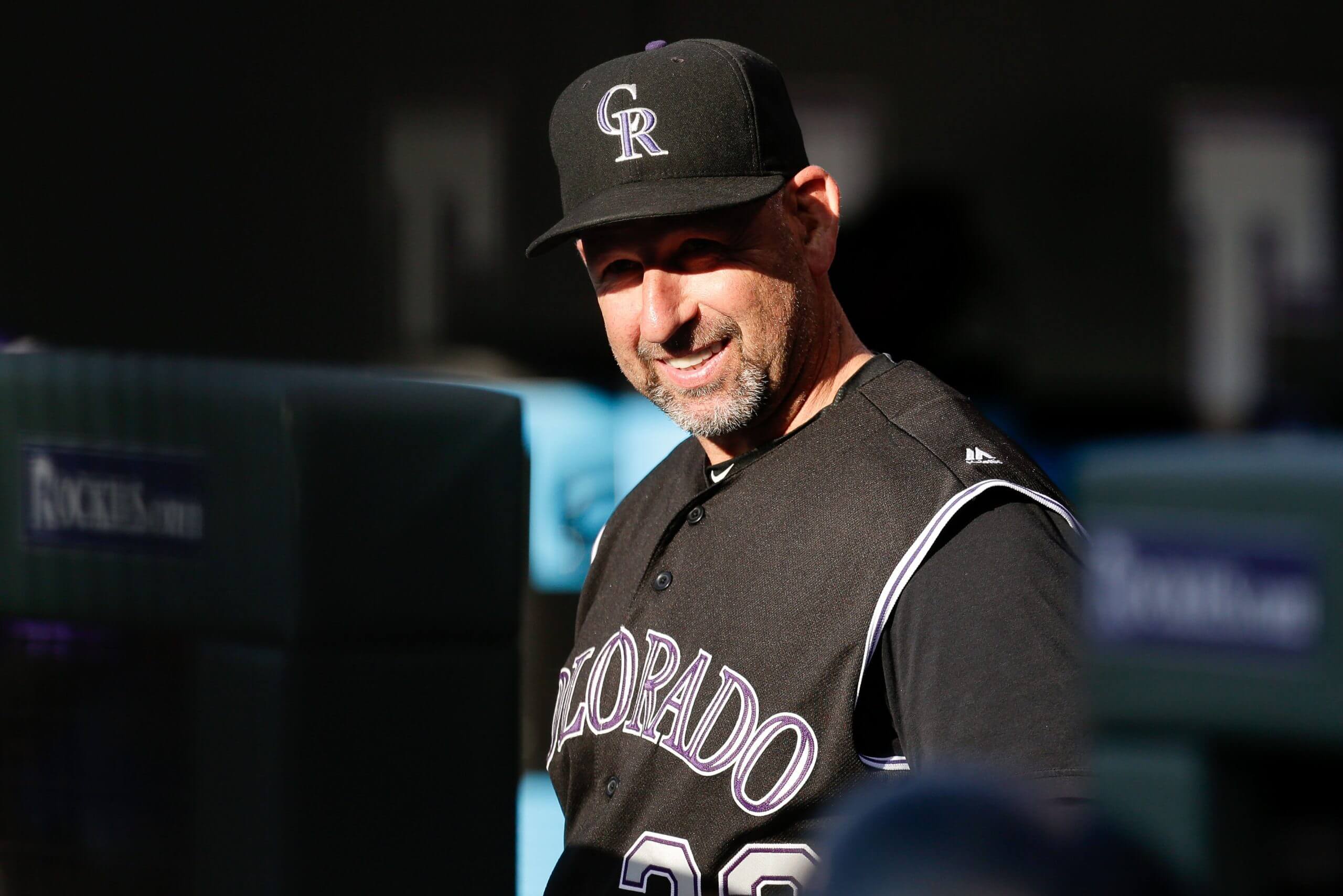
Weiss (pictured in 2016) had a rough tenure in Colorado, never coming close to a winning season in his four years managing the Rockies. (Isaiah J. Downing / USA Today)
O’Dowd wanted him to replace manager Jim Tracy after the 2012 season anyway, saying, “Walt’s been preparing for this role his entire life.” But for Weiss, the learning curve was steep. The Rockies were coming off a 98-loss season, at that time the worst in club history. Weiss knew what he valued as a player, but not as a manager. During his four seasons, the Rockies averaged 91 losses, never coming close to a winning campaign.
Making matters worse, Weiss had differences with GM Jeff Bridich, who took over for O’Dowd midway through the manager’s tenure. Upon stepping down after the 2016 season, Weiss cited his strained relationship with Bridich as a factor. And yet, Weiss’ time with the Rockies wasn’t all for naught.
“I think he’s the manager he is today because of the experiences he went through there, albeit not great experiences,” said O’Dowd, who is now an analyst at MLB Network. “That was a perfect indoctrination for him on the demands, the uncertainty, the unpredictability, how to manage up, how to manage down, how to be pulled in a million different directions.”
Weiss was only 52 when he left the Rockies. He remained out of the game for only one year. Prior to the 2018 season, the Braves hired him to replace Terry Pendleton as bench coach. The way Weiss saw it, his job was to promote Snitker’s vision. And he was content in that role.
He turned down managerial interviews. He did not politick for a second chance.
“I always say, if Snit would have managed for 10 more years and he would have had me for 10 more years as his bench coach, I would have done it for another 10 years,” Weiss said.
Snitker, who ended his managerial tenure to become an advisor at the end of last season, said he was grateful Weiss showed no ego. He dreaded the thought of Weiss departing for a managing job with, say, a rebuilding club.
“Every year when his name would come up in managerial vacancies, I’d break out in hives,” Snitker said. “My first call would be to Walt: ‘This isn’t true, is it?’ I would just freak out.”
Still, Weiss wasn’t necessarily the obvious choice to be the Braves’ next manager. Anthopoulos might have preferred an attractive candidate from outside the organization. He inherited Snitker upon taking over the Braves in Nov. 2017. He had yet to hire his own man.
Six current managers went from the No. 2 position to the No. 1 with the same club, including the Milwaukee Brewers’ Pat Murphy, the back-to-back National League Manager of the Year. But some heads of baseball operations are reluctant to promote bench coaches, O’Dowd said, viewing them as extensions of the previous manager, not a fresh start.
“It takes a really good leader to look past that,” O’Dowd said.
Anthopoulos had experience hiring a hot name — he did it with John Farrell in Toronto and it didn’t work out, though Farrell later won a World Series with the Boston Red Sox. Weiss, perhaps, was not the sexiest choice. But Anthopoulos saw him as similar to the most successful managers in Braves history, Snitker and Bobby Cox.
“They share the same values and love for the organization,” Anthopoulos said.
Weiss’ greatest success as a player was under Tony La Russa in Oakland, where he was the 1988 American League Rookie of the Year. But he spent his final three seasons playing for Cox and another eight coaching under Snitker. His ties to the Braves, he said, got his “juices flowing” when Anthopoulos asked if he wanted to be a candidate for the job. And to Freeman, Weiss’ institutional knowledge mattered.
“The Braves are different, they really are,” said Freeman, who played for Atlanta from 2010 to 2021 before leaving for the Dodgers as a free agent. “When you put on that uniform, it means something. They care about the ‘A,’ the Braves, how it runs over there.
“Walt knows all that. But he has his own style.”
The Braves hired Weiss on Nov. 3. The team’s first full workout in spring training was Feb. 15. Weiss said he spent virtually every day in between thinking about what he would say the first time he addressed the club.
The transition from bench coach to manager often is tricky. Relationships with players change. Managing again for the first time in almost 10 years, Weiss no longer was in a supporting role. He needed to separate from the bench coach’s role. He was in charge.
“Clarity was paramount,” Weiss said. “I tried to, more or less, make things as black and white as I could. About what the expectations were. How we were going to operate. What our identity needed to be. All those things.”
Clarity, Weiss said, is more important than agreement — his message will be clear, even if a player disagrees with him. Yet, his emphasis on direct communication wasn’t the only thing that resonated with his players and coaches.
Pitching coach Jeremy Hefner, one of eight new coaches on Weiss’ staff, said one word stuck with him: Gratitude.
“I hadn’t really heard that in a baseball locker room,” Hefner said. “A lot of times, for me personally, it’s not ungratefulness, but it’s almost like you’re expected to be here. Instead of a posture of humility, grateful to put the uniform on, grateful to show up to the yard and work.”
Gratitude, though, wasn’t Weiss’ principal theme. He focused more on how a player’s mentality can be a difference-maker, especially in a sport where games take place nearly every day.
As a player, Weiss was hard-nosed. He wanted his team to be the same way.
“I talked about how that mentality needs to be very aggressive,” he said. “Not reckless in how we play the game, but a very aggressive mindset. Because once you start getting careful in this game, you start to get dominated.
“It’s human nature when you’re struggling. You don’t want to make a mistake. It’s got to be just the opposite, especially when you start to struggle. You’ve got to become even more aggressive in your mindset.”
It was not the kind of speech Snitker necessarily would have given – Snitker never played in the majors, and had a different kind of competitive edge. But Weiss is different than Snitker, just as Snitker was different from Cox. And the Braves players seem to welcome the fierceness of their new manager.
“Someone who had the career he did, with the intensity he played with, it kind of trickles down to us,” Braves first baseman Matt Olson said.
Farmer added, “His personality speaks for itself. He’s managing like we’re trying to win every game. It’s a playoff mentality, which is really good.”
San Francisco Giants infield coach Ron Washington, Weiss’ colleague on the Braves’ staff from 2018 to ’23, said he loved how Weiss was no-nonsense, straight from the hip, not one to sugarcoat his point if tough conversations were required.
As a manager, Weiss said, those conversations are inevitable, making it imperative that he not only earn his players’ trust, but also sustain it.
“Then, when you do have the tough conversations, the relationship’s not fractured,” he said. “If there’s no trust and then you have a tough conversation, they don’t want anything to do with you.”
The beauty of going from bench coach to manager — and the risk — is that Weiss already had relationships with his core players. He knew in his new position of leadership, “everything would change.” But Braves people say his personality did not.
“The biggest compliment I can give him is that he’s the exact same,” Anthopoulos said. “He has different responsibilities, but he’s the same person.”
Freeman related a story from the Freeway Series in late March, when he asked Angels star Mike Trout about the club’s new manager, Kurt Suzuki. Both Freeman and Trout are former teammates of Suzuki’s, and Freeman calls him a friend.
What Trout told Freeman about Suzuki matched what Anthopoulos said about Weiss. In their new positions, they acted just as they did before.
“That’s the key,” Freeman said. “Everybody loves you. Don’t be anybody different. Don’t try to go on a power trip. Don’t do all that.”
O’Dowd said Weiss is too humble to give off a “smartest guy in the room” air. But when it comes to analyzing swings, O’Dowd regards Weiss, a hitter whose career OPS was 22 percent below league-average, as practically a savant.
A few years back, O’Dowd met Weiss for several days at a biomechanical lab in Arizona. The visit, O’Dowd said, educated him about players’ movement patterns, “opening up a whole world to me” about why some hitters can do things others can’t.
Braves hitting coach Tim Hyers, one of two holdovers from Snitker’s staff, said Weiss told him that after his playing days, he went on a journey to learn as much as he could about the swing.
Hyers, after joining the Braves last year, learned that he and Weiss share similar philosophies about how a hitter’s lower half and upper body must work together, but also with separation to allow the hands to work and create force. Hyers discovered as well that Weiss on his phone keeps video of all-time greats he enjoys studying — Ken Griffey Jr., Barry Bonds, Ted Williams.
“It surprised me that he went that in depth and understood the body,” Hyers said. “The terms he was using are terms not every person uses. He’s got a passion for fielding and all parts of the game. But the hitting part, at the beginning, I wouldn’t say it shocked me, but I didn’t know that he had spent so much time looking into the swing.”
Weiss is cerebral in other ways, too. O’Dowd said the Rockies did not use analytics during Weiss’ time as manager; he was exposed to them only after joining the Braves. Weiss did not hesitate to embrace the information. As bench coach, he was “intellectually curious,” Anthopoulos said.
Swanson, who has stayed in touch with Weiss since leaving the Braves for the Cubs as a free agent after the 2022 season, admires the way his former coach blends old-school principles and new.
Making clear that he is in no way criticizing Snitker, his former manager, Swanson said, “The reason I say they’re different is that Walt has such a good feel for the way the game is changing and evolving. And he’s willing to evolve with it, while also understanding some of the old-school things.
“Discipline is important. Being on time is important. Hustling is important. A lot of that Snit believed in as well. I just think Walt has this edge to him, ‘Hey, the game is trending in this kind of direction. We need to figure out ways we can play in this new style.’”
Or, as O’Dowd put it, “He’s totally open-minded to other people’s opinions, that they might be better than his. He’s not so arrogant that he thinks only his ideas are good.”
In the end, though, Weiss believes his job is less about outsmarting the opposing manager and more about getting the most out of his own players.
Weiss said a player asks three questions when evaluating his coach or manager: Does he care about me? Can I trust him? Can he help me get better?
In Weiss’ view, the first two answers are far more important than the third.
“We get judged by our bullpen moves, more or less, in this seat,” Weiss said. “You go to the playoffs and when (people) rehash the game, it’s, you should have brought in this guy, you brought in that guy. It’s always about the bullpen moves.
“But this position is all about leadership. Are you a good leader or not? Period. If you’re a good leader, and these guys believe what you say and they trust you, they’ll do anything for you.”
Play hard. Play hurt. Play not for themselves, but for the greater good.