
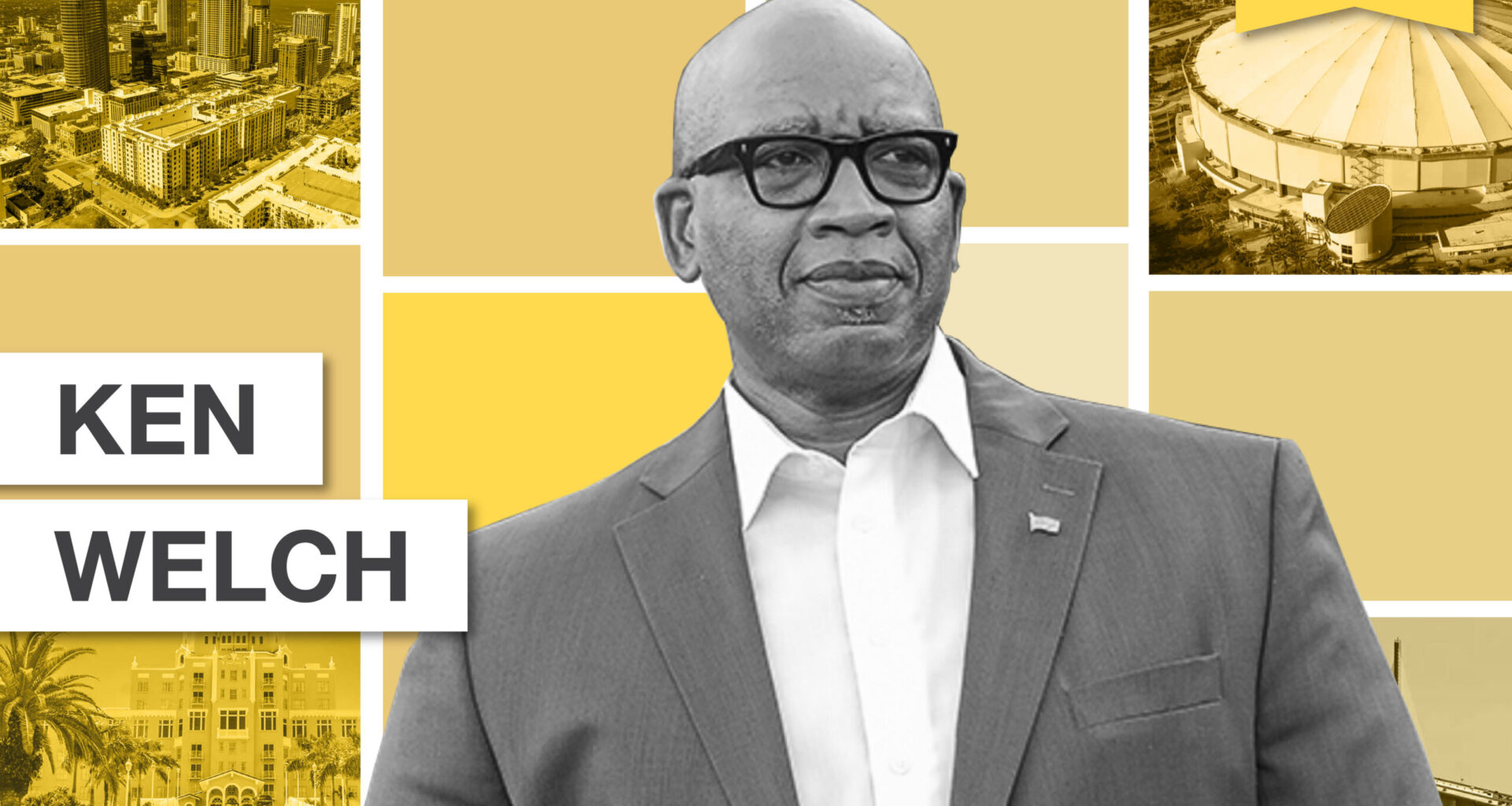
St. Petersburg Mayor Ken Welch enters his re-election campaign under mounting political pressure, with more questions than answers about his standing with voters and his grip on the city’s future.
Welch was one of the last St. Petersburg residents to attend school under segregation policies, attending kindergarten and first grade at Melrose Elementary near the Historic Gas Plant District — just blocks from where Tropicana Field now stands.
Now the city’s first Black Mayor, he took office in 2022 following a 20-year stint on the Pinellas County Commission. A former lawyer, Welch built his political brand on coalition-building and a methodical, consensus-driven approach to governance, earning support that has kept him in public office for decades.
He took office promising to equitably redevelop his former neighborhood, the Gas Plant District, and to mitigate the impact of sea-level rise and climate change. But unlike years past, he now finds himself reacting to the political fallout from the collapse of a deal to rebuild the Tampa Bay Rays ballpark and surrounding Gas Plant District — a shift that is testing both his leadership and his staying power.
That shift is reflected in this year’s rankings, where Welch falls from No. 10 to No. 15 after previously ranking as high as No. 4 in 2024.

The collapsed deal has given political opponents an opening to challenge Welch as the race takes shape. City Council member Brandi Gabbard, former Fire Chief Jim Large, Shore Acres Neighborhood Association President Kevin Batdorf, and perennial candidates Paul Congemi and Maria Scruggs have all entered the contest. Former Gov. Charlie Crist is also widely expected to join the race, though he has not yet filed.
Even amid challenges, Welch’s influence remains substantial. As Mayor, he still controls the city’s policy agenda, budget priorities and the direction of major redevelopment efforts — placing him at the center of decisions that will shape St. Petersburg for decades.
For now, Welch remains a central figure in shaping the future of one of Tampa Bay’s largest cities, and his supporters remain ardent defenders of his work.
“Mayor Ken Welch leads with intention, and a clear focus on delivering for the people of St. Petersburg,” Mercury Public Affairs Managing Director Ashley Bauman said. “He’s bringing accountability to long-standing priorities like the Gas Plant District, expanding housing options, and strengthening public safety. His approach is steady, community-driven and focused on results, and this recognition reflects that.”
However, a recent poll — commissioned by a political committee supporting Crist — offered the clearest signal yet of the shift in Welch’s approval among residents themselves. His approval rating is hovering just below 40%, leaving little margin for error for an incumbent just months out from Election Day.

The challenge is not just polling, it’s financial. Welch has been forced to reset his campaign after an alleged $207,000 theft from a political committee tied to his re-election effort by its former Treasurer, prompting the creation of a new committee — his third since first running for Mayor.
The episode has now added another layer of scrutiny to his operation and a major financial hurdle for the campaign. The incumbent amassed just under $220,000 in the first quarter this year, entering April with just under $193,000 on hand.
The political landscape around Welch may be shifting, but he still has a tight-knit group of allies in his corner. Supporters say Welch has stayed true to the priorities he outlined from the start of his tenure, giving them reason to trust that Welch can finish what he’s started with another term in office.
They recognize that the Gas Plant District redevelopment effort is deeply personal for Welch and central to his vision for the city. His administration has pushed to move forward with selecting a development partner despite some resistance by the City Council — spearheaded by Gabbard — arguing that the site has already undergone years of planning and that further delays risk repeating decades of inaction.
Welch is also standing at the forefront of local officials rallying support for an estimated $600 infrastructure bond that is meant to appear before voters during the August city election — on the same ballot as his re-election bid. Beyond the bond proposal, Welch has also consistently prioritized housing affordability, workforce development and infrastructure investment throughout his term in office.
“A servant leader requires patience, an aptitude for engaging in difficult conversations, empathy and apathy, and a huge dose of love for the community you serve,” Pinellas County Commissioner Rene Flowers said. “Mayor Welch has exhibited all of the above. I can think of no one better to have this honor bestowed upon them. Congratulations, my friend.”
Welch also hopes to mobilize his supporters in favor of a proposed $600 million infrastructure bond aimed at addressing stormwater, sewer and neighborhood resilience needs.
Welch himself has recognized that it is unusual for a Mayor seeking re-election to also campaign in favor of a bond referendum appearing on the same ballot. But true to form, he believes the matter is too important to St. Petersburg not to — especially after hurricanes in 2024 exposed coastal resiliency needs throughout the city and much of coastal Florida.
The city has not finalized details about the bond proposal, but it will likely have a real imprint on the mayoral election at the polls. Welch’s support could be pivotal for the measure’s chance of success, making the bond another test of his standing with voters outside of his own race for re-election.
Welch still carries significant clout, landing him squarely on this year’s list of on the list of Tampa Bay’s Most Powerful Politicians. But Welch is no longer setting the pace in his own race, polling behind a candidate who has not even declared, causing him to slip out of the Top 10 this year. The biggest question is how Welch performs on Election Day, and whether he will still hold a spot on this list next year.
___
As for methodology, the Tampa Bay region is defined as Pinellas, Hillsborough and Pasco counties, with Hernando, Polk and Sarasota included when their elected officials impact Pinellas or Hillsborough.
A politician is defined as someone currently in office or actively running for office.
Panelists ranked their Top 25, with a first-place vote earning 25 points, second place earning 24, and so on down to 1 point for 25th. Those totals were combined to produce the final list.
We also want to thank our experienced and knowledgeable panelists, who were essential to developing the 2026 list: Vinik Family Office Chief of Staff Christina Barker; Mercury Public Affairs Managing Director Ashley Bauman; Michael Corcoran and Matt Blair of Corcoran Partners; former Sen. Jeff Brandes; Stephanie Cardozo of The Southern Group; Shumaker, Loop & Kendrick managing partner Ron Christaldi; political consultant/strategist Barry Edwards; Vicidial Group President Matt Florell; Sunrise Consulting Group President Shawn Foster; businessman Michael Griffin; St. Pete Catalyst Publisher Joe Hamilton; Clay Hollis of Tucker/Hall; Natalie King of RSA Consulting Group; Moffitt Cancer Center VP of Public Affairs and Communications Merritt Martin; political consultant Chris Mitchell; Mike Moore of The Southern Group; RSA President and CEO Ron Pierce; Tucker/Hall CEO Darren Richards; political consultant Jim Rimes; political consultant Preston Rudie of Catalyst Communications Group; TECO Vice President of State and Regional Affairs Stephanie Smith; lobbyist Alan Suskey of Shumaker Advisors; and Michelle and Peter Schorsch, publishers of Florida Politics.