
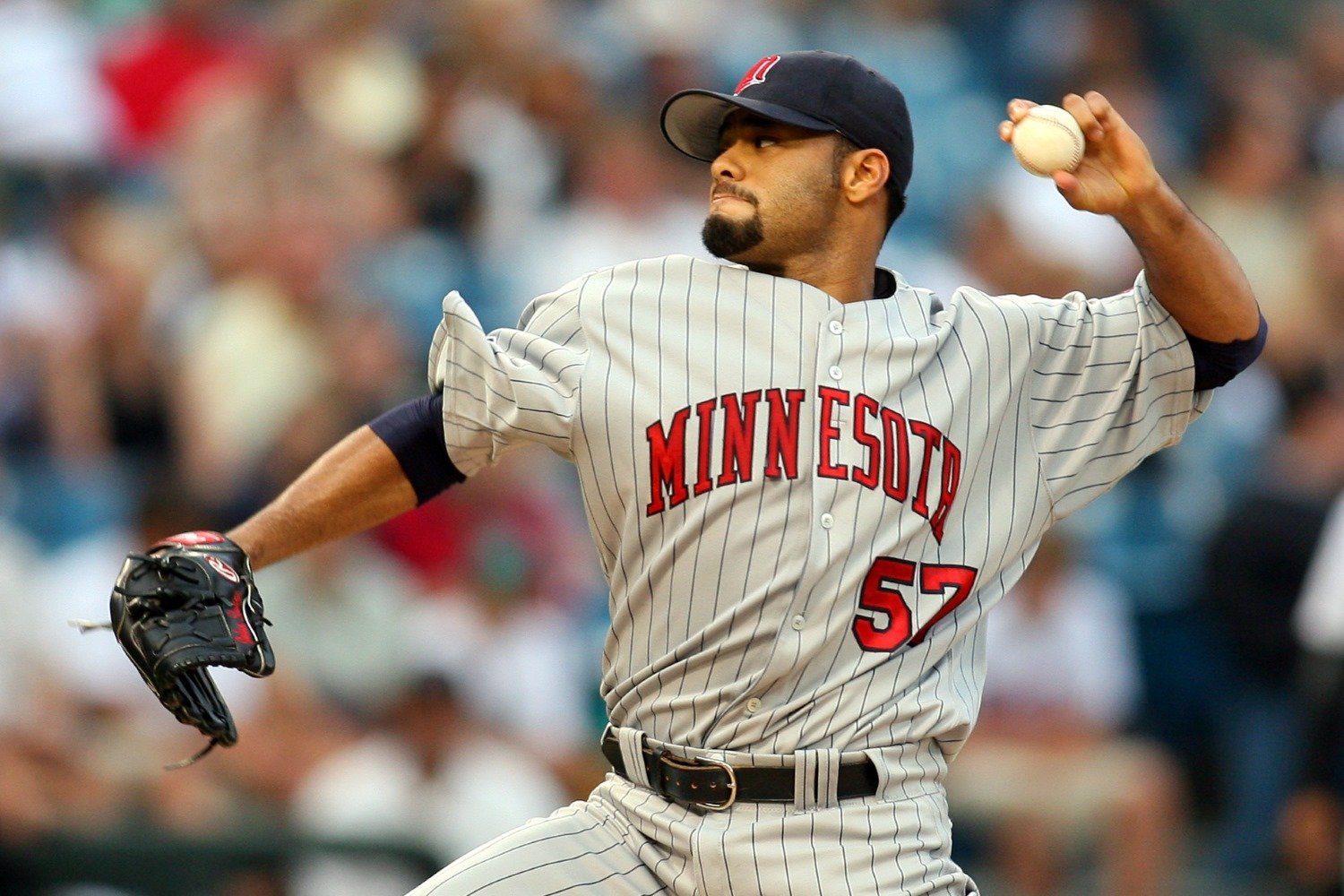
Even hitting records tell the story of how the game has changed at the plate, but pitching records show that evolution more clearly. The modern pitcher is handled carefully, protected from overuse, and often asked to dominate in shorter bursts, rather than grind through entire games. That shift has left a collection of Minnesota Twins pitching records standing tall, with little reason to believe they will ever be seriously threatened.
Santana at His Absolute Peak
When Johan Santana was at his best, there may not have been a more dominant arm in baseball. His single-game team record of 17 strikeouts still feels attainable on the surface, but it requires a perfect blend of efficiency, dominance, and managerial trust that is rarely seen now.
His 33 consecutive scoreless innings during the stretch from late August into September of 2004 might be even more impressive. Pitchers today are often limited by pitch counts before they can string together outings long enough to threaten a streak like that. It takes not only dominance, but durability and consistency over multiple starts. One might be more likely to leave before tiring and giving up a run, but that’s easily offset by having to string together five or six straight starts with your ‘A’ stuff, rather than four or five. Santana did it in, basically, four starts, plus small pieces of the outings on either end.
Then there are the 17 consecutive wins spanning the 2004 and 2005 seasons. With starters now often removed earlier in games and bullpens playing a larger role in decisions, stacking wins in that fashion has become increasingly unlikely. Even elite pitchers struggle to control that stat in the modern era.
When Starters Carried Everything
Looking back at the workloads of past generations almost feels like reading fiction. Bert Blyleven and Jim Kaat were asked to do things that simply are not part of today’s game plan.
Blyleven’s 325 innings pitched in 1973 stands as a staggering total. In a time when 180 innings is often viewed as a benchmark of durability, adding another 145 frames feels nearly impossible. That same season included 25 complete games by Blyleven; the entire league had 29 in 2025.
Kaat’s 42 starts in 1965 is another mark that reflects a completely different era. With five-man rotations now standard and teams occasionally using six, the opportunity to even approach that total no longer exists—unless, of course, another usage revolution is around the corner. A designated opener could “start” 50 times in a season, but that feels unlikely.
Blyleven’s 2,035 career strikeouts with the Twins reflect both longevity and consistency. Players change teams more frequently now, and maintaining that level of production with a single organization is increasingly rare. A pitcher might pile up more punchouts in one year than Blyleven ever did, but avoiding the scalpel and sticking around long enough before free agency beckons feels like a tall order.
The Records That Sneak Up on You
Some of the most unbreakable records are not the flashiest ones. They’re the totals that quietly pile up over time or exist because the game no longer creates the same opportunities.
Eddie Guardado appeared in 648 games as a left-hander for the Twins. Relievers today are often used in more specialized roles, and careers are less likely to stay anchored with one franchise long enough to build that kind of total.
Then there’s Jim Merritt, throwing 13 innings in a single game on July 26, 1967. It’s difficult to imagine any modern pitcher even being allowed to attempt such a feat. Between pitch counts, bullpen depth, and injury prevention, that record feels completely untouchable. That season, pitchers went at least 10 innings in a game 54 times. The post-World War II peak for that total came in 1976, when there were 85 10-inning appearances. Since the league expanded to 30 teams in 1998, however, there have only been eight total instances of this. The last was by Cliff Lee, in 2012.
What stands out most about these pitching records is how clearly they highlight the evolution of baseball. Santana’s dominance represents the bridge between eras, while Blyleven and Kaat belong to a time when pitchers were expected to carry a workload that would be unthinkable today.
The modern game values efficiency, health, and longevity in a different way. That’s not criticism; it’s just reality. But it does mean that many of these records are protected not just by greatness, but by philosophy. That combination is what makes them feel permanent.
What other pitching records are unbreakable for the Twins? Leave a comment and start the discussion.
Are you interested in Twins history? Then check out the Minnesota Twins Players Project, a community-driven project to discover and collect great information on every player to wear a Twins uniform!