
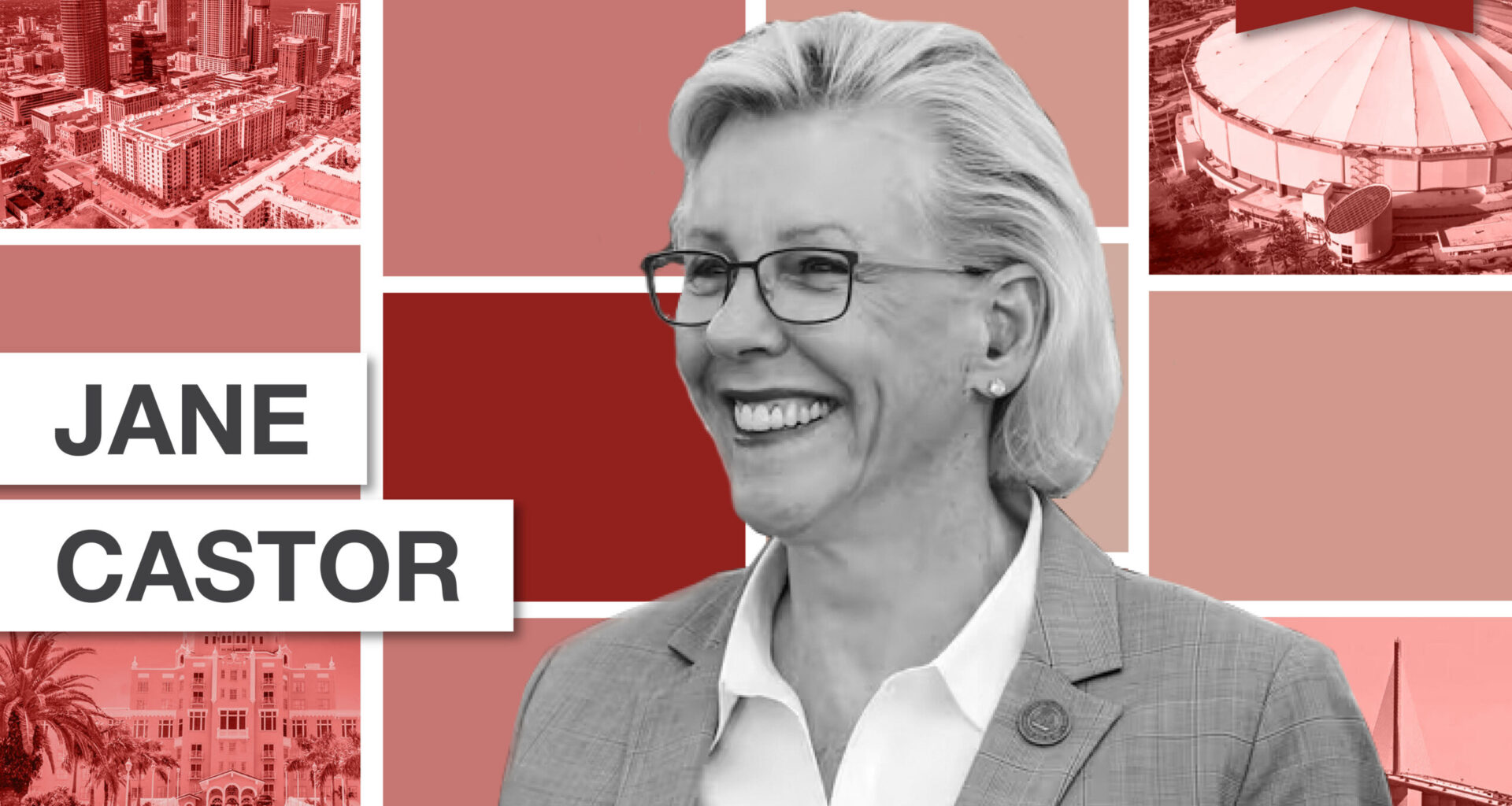
Tampa Mayor Jane Castor is the most influential Democrat on the list of Tampa Bay’s Most Powerful Politicians as she enters the last stretch of her final term — though she did slip slightly this year, falling from No. 3 to No. 5.
She has continued to push her influence on the region’s biggest issues, including a major proposal by the Tampa Bay Rays to build a new ballpark and mixed-use district in Tampa — a project that could become a defining centerpiece of her tenure. Castor’s tenure has featured practical investments in infrastructure, housing, transportation and other core city needs.
The Tampa Bay Buccaneers and Tampa Bay Lightning have each won recent championships, giving rise to the “Champa Bay” moniker. A financing deal between the Rays, Tampa, Hillsborough County and the state to bring the team into the fold would cement Tampa as a premier sports destination — although it may come at a significant price to taxpayers.
Bringing Major League Baseball directly into Tampa, a stone’s throw from those facilities, would further unify that identity and set the city on a path with impacts that would outlast Castor’s time in office.
She is also at the center of many other major conversations shaping the Bay Area, including transportation funding, hurricane resilience, culture wars and the political dynamics of the next mayoral race.

“Mayor Jane Castor has delivered real results for Tampa, from strengthening our economy to supporting working families and helping our community prepare for the challenges ahead. She provided strong leadership during Hurricanes Helene and Milton, elevated the Tampa Bay region on the national stage, and has helped shape updates to national disaster response and improve resiliency. Mayor Castor is widely respected for her focus on the affordability squeeze, expanding housing and investing in often-overlooked neighborhoods,” said U.S. Rep. Kathy Castor, no relation.
“Neighbors across Tampa know their Mayor because she’s always present — listening, showing up, and working side by side with the community. She is a trusted local leader with a national profile. It’s fitting to see her recognized on Florida Politics’ list of Tampa Bay’s Most Powerful Politicians, as she is one of the city of Tampa’s greatest Mayors.”
Castor’s final year unfolds against a backdrop of a 2027 Tampa mayoral race that is already taking shape, with a growing field of candidates filing to replace her. Castor remains a central figure in that conversation as a political force capable of swaying its direction. Castor has said that transportation, in particular, remains an “Achilles heel” for the city that a future Mayor should look to tackle.
Castor’s leadership style is often pragmatic and rooted in experience gained serving with the Tampa Police Department (TPD) for 31 years, including almost six years as Chief. She has built a reputation for working across party lines to advance major initiatives, a balancing act that continues to define her tenure.
“Jane Castor is finishing up her second term the same way she began 7 years ago — focused on the work of the city, the needs of each neighborhood, and tackling some big issues, including homelessness, city infrastructure, and affordable housing. Mayor Castor has the ability to lead with a positivity that has helped her remain popular among residents and build relationships and trust with stakeholders,” said Christina Barker, Chief of Staff in the Vinik Family Office.
“As she approaches the end of her time as Mayor, the city will undoubtedly remember her for a dedicated, hardworking approach that successfully combined significant investments in infrastructure and housing with a vision of an inclusive and welcoming Tampa.”
Still, her time in office did not come without conflict — although she has proven strong enough to trudge through political clashes to make it to the end of her run at City Hall on her own terms.
One of the most high-profile flashpoints came early in her administration with her appointment of Mary O’Connor as Tampa Police Chief. The selection drew pushback from the City Council and community advocates, who raised concerns about O’Connor’s past arrest while off duty from TPD, which led to charges of battery on a law enforcement officer. The incident occurred when another TPD officer, whom she was accompanying, was pulled over for suspicion of drunk driving.
The confirmation ultimately passed in a split vote, reflecting Castor’s influence, only to blow back politically against her in the end months later. O’Connor would be placed on administrative leave and resign after body camera footage showed her invoking her position during a traffic stop to avoid a citation.
Castor has also clashed with members of the Tampa City Council throughout her tenure, particularly over issues tied to governance, public access and disputes over her vetoes.
Recently, though, she proved she knows how to dodge a bullet as well. The Police Department changed immigration enforcement policy following public criticism from Attorney General James Uthmeier, who threatened Castor’s removal from office over TPD policies he deemed uncooperative with federal and state immigration law. Rather than take on the state’s top lawyer, Castor simply revised the policy and moved on with her busy agenda without consequence.
Castor has had time to hone her steady hand. She’s been an influential force for so long that some of Castor’s most notable controversies are a decade behind her. During her initial run for Mayor, Castor faced sustained attacks targeting her record as Police Chief, including criticism over pension “double-dipping,” and scrutiny over the “biking while Black” controversy based on a 2015 Tampa Bay Times report that TPD policy targeted low-income black bicyclists.
They say heavy is the head that wears the crown, but Castor has made a career out of walking a political tightrope as a Democrat leading one of Florida’s largest cities at a time the state has turned deep red. She has invested in infrastructure and is in the middle of negotiating a development proposal that could leave a lasting impact on Tampa and the region for years to come.
“Jane Castor has shown she’s a finisher and a closer. I call her the Mariano Rivera of infrastructure,” said engineer Joe Robinson, an influential community leader and chairman of the West Tampa Community Redevelopment Agency.
“She’s connecting the west side to downtown and everywhere else with the West Riverwalk, and she’s moved infrastructure from people just talking about it or starting it to putting actual pipes in the ground, asphalt on the streets. Water, wastewater, stormwater, you can see it happening.”
While her imprint on Tampa has been long-lasting, she is also among the notable Democrats on this list, leaving office after the end of their current term.
“I’ve seen firsthand the impact of Mayor Jane Castor’s leadership. She’s helped position Tampa as one of the most dynamic cities in the country by staying focused on growth, public safety, and economic opportunity. This recognition is well deserved,” Mercury Public Affairs Managing Director Ashley Bauman said.
___
As for methodology, the Tampa Bay region is defined as Pinellas, Hillsborough and Pasco counties, with Hernando, Polk and Sarasota included when their elected officials impact Pinellas or Hillsborough.
A politician is defined as someone currently in office or actively running for office.
Panelists ranked their Top 25, with a first-place vote earning 25 points, second place earning 24, and so on down to 1 point for 25th. Those totals were combined to produce the final list.
We also want to thank our experienced and knowledgeable panelists, who were essential to developing the 2026 list: Vinik Family Office Chief of Staff Christina Barker; former St. Petersburg City Council member Robert Blackmon; Mercury Public Affairs Managing Director Ashley Bauman; Michael Corcoran and Matt Blair of Corcoran Partners; former Sen. Jeff Brandes; Stephanie Cardozo of The Southern Group; Shumaker, Loop & Kendrick managing partner Ron Christaldi; political consultant/strategist Barry Edwards; Vicidial Group President Matt Florell; Sunrise Consulting Group President Shawn Foster; businessman Michael Griffin; St. Pete Catalyst Publisher Joe Hamilton; Clay Hollis of Tucker/Hall; Natalie King of RSA Consulting Group; Moffitt Cancer Center VP of Public Affairs and Communications Merritt Martin; political consultant Chris Mitchell; Mike Moore of The Southern Group; RSA President and CEO Ron Pierce; Tucker/Hall CEO Darren Richards; political consultant Jim Rimes; political consultant Preston Rudie of Catalyst Communications Group; TECO Vice President of State and Regional Affairs Stephanie Smith; lobbyist Alan Suskey of Shumaker Advisors; and Michelle and Peter Schorsch, publishers of Florida Politics.