
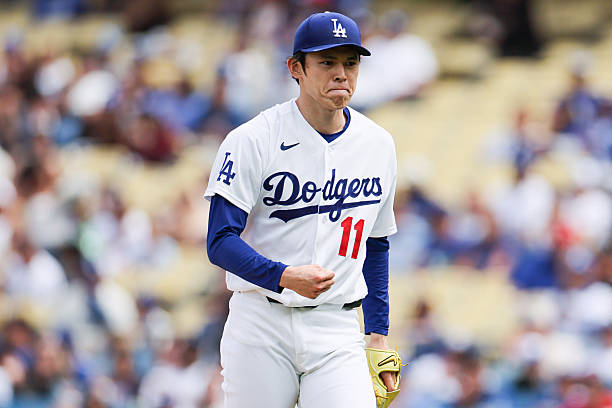
LOS ANGELES — Dave Roberts said something honest about Michael Conforto that probably applies to more players than anyone inside the Dodgers’ clubhouse would like to admit.
“It’s not for everybody,” Roberts said of being a Dodger. “Playing in front of 50,000 every night… a clubhouse full of superstars… the expectation to be great every night.”
That is what being a Dodger means now. That is the job. It sounds glamorous from the outside. The packed ballpark. The bright lights. The giant payroll. The superstars lined up from one end of the clubhouse to the other. Shohei Ohtani. Mookie Betts. Freddie Freeman. Yoshinobu Yamamoto. Tyler Glasnow. Will Smith. The ring ceremonies. The October expectations. The idea that anything short of a parade feels like a failed season.
Conforto’s Rough Year
For some players, that environment sharpens them. For others, it swallows them. Conforto found that out the hard way. He came to Los Angeles with a good big-league résumé, a professional approach, and a chance to rebuild himself inside baseball’s deepest lineup. Instead, he had the worst statistical season of his career with the Dodgers, hitting just .199 in 2025 and eventually missing the postseason roster. He still earned praise from teammates and coaches for how he handled himself, and he recently received his World Series ring as a member of the Cubs. But the baseball part of his Dodgers season never really clicked.
Roberts’ quote wasn’t cruel. It was not some throwaway line. It sounded like something learned from watching good players come to Los Angeles and suddenly look smaller. And there have been plenty.
The Pressure is Real
Dodgers fans are not Yankees fans. They are not Red Sox fans. They are not Phillies fans. They do not live to boo their own players from the first pitch of April. They are not waiting at the clubhouse door with talk-radio torches every time somebody goes 0-for-4. But the pressure in Los Angeles is real in a different way.
Yankee Stadium can feel hostile. Fenway Park can feel impatient. Philadelphia can turn on a player loudly, personally, and all at once. Dodger Stadium is usually warmer than that. The crowd wants to believe. The fans love stars. They love big moments. They love players who give them a reason to cheer.
But the expectations are enormous. A player can feel 50,000 people waiting for the swing, the pitch, the inning, the answer. A slump does not stay quiet here. A bad week becomes a storyline. A bad month becomes a referendum. The Dodgers do not have many hiding places because they are built to win every night, and everyone knows it.
It is fair to start asking whether the same quote applies to him.
Sasaki arrived with a myth around him. In Japan, he was not some ordinary young pitcher with upside. He was the phenom with triple-digit velocity, the perfect game, the splitter, the aura. Then he walked into a Dodgers clubhouse where he was suddenly not the biggest story. He was not even the most accomplished Japanese pitcher in the room.
Ohtani is the biggest baseball star on the planet. Yamamoto has already handled the transition, the contract, the October stage, and the weight of being a front-line arm in Los Angeles. Sasaki is younger, less polished, and still trying to figure out how to get major-league hitters out consistently.
A tough place to grow up.
Through his first four starts this season, Sasaki has a 6.11 ERA, a 1.87 WHIP, and 17 strikeouts in 17⅔ innings. The stuff still flashes, but the command keeps disappearing. His walk rate has been a major problem, and the Dodgers are dealing with it at a time when injuries have left them with fewer clean alternatives.
The easy explanation is mechanical. He falls behind hitters. He loses the zone. His fastball does not always play the way it should. He has not consistently looked comfortable finishing at-bats.
But maybe there is more to it. Maybe Sasaki is not just fighting his delivery. Maybe he is fighting the room.
That does not mean Ohtani or Yamamoto have done anything wrong. By all accounts, their presence should help him. They understand the language, the culture, the transition, the attention, and the burden of coming from Japan to Major League Baseball. In theory, no young Japanese pitcher could ask for a better support system.
But support and shadow are not always easy to separate.
Every Sasaki start comes with comparison baked into it. Ohtani became a global baseball unicorn. Yamamoto became a polished ace. Sasaki is still trying to become a reliable major-league starter. The problem is that Dodger Stadium does not always have the patience of a development lab. This is a championship machine. Young players can grow here, but they are expected to grow while winning.
That is not a small thing.
Cultural Differences
In Japan, Sasaki played in a different baseball culture. The criticism exists there too, and the attention can be intense, especially for a player of his profile. But the environment around players is different. The rhythm is different. The media pressure is different. The fan culture is different. The jump to Los Angeles brings a new language, a new baseball schedule, a new baseball, new hitters, bigger travel, and a clubhouse where greatness is the daily standard.
Maybe that is part of what we are seeing.
Maybe Sasaki is overwhelmed.
Maybe he is pressing because he sees Ohtani and Yamamoto, and he knows fans expected him to join them as another Japanese superstar instead of developing at his own pace. Maybe the Dodgers’ brand itself is heavy on his shoulders. Maybe the same thing that crushed Conforto’s bat is now squeezing Sasaki’s arm. That is the uncomfortable question.
Being a Dodger sounds easy because the team wins. In reality, it might be one of the harder jobs in baseball. The Dodgers have resources, stars, coaches, technology, and a winning culture. They also have the kind of expectations that turn every slump into a public trial.
Conforto could not hit his way through it. He helped the club in quieter ways, kept his professionalism, and walked away with a ring. But his time in Los Angeles will still be remembered as a baseball failure.
Sasaki is not there yet. He is too talented to write off, and pitchers with that kind of arm deserve more than four starts before anyone stamps a final verdict on them. There are real signs he is making adjustments, and some of the underlying stuff has improved from last year.
But Roberts’ quote hangs over the conversation.
“It’s not for everybody.”
Maybe Sasaki will prove that it is for him. Maybe this is just the ugly early part of his adjustment. Maybe one good start settles him down and reminds everyone why the Dodgers believed in him. The Dodgers are a patient team, willing to weather poor performance in April if it leads to dominance in the fall. However, their patience is not unlimited. And with Blake Snell starting to rehab in Ontario, it’s only a matter of time before somebody has to be moved out of the rotation. Glasnow, Ohtani, and Yamamoto aren’t going anywhere. Justin Wrobleski’s looked awesome. Emmet Sheehan seems to be figuring things out. That leaves Roki.
If the struggles continue, the question is not only whether Roki Sasaki has enough stuff. It is whether he has enough comfort, confidence, and stubbornness to survive the full weight of being a Dodger.
Have you subscribed to the Bleed Los Podcast YouTube channel? Be sure to ring the notification bell to watch player interviews, participate in shows & promotions, and stay up to date on all Dodgers news and rumors!
Related