
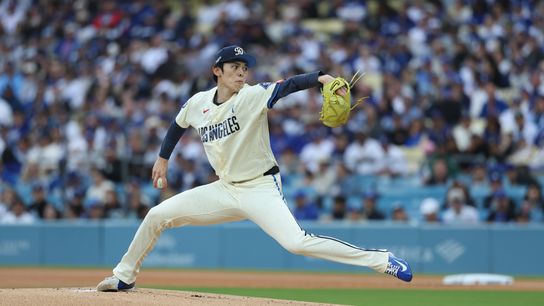
LOS ANGELES — On a night that was supposed to belong to a bobblehead, it ended up belonging, at least in part, as Roki Sasaki is still trying to find himself.
The Dodgers take the Cubs, 12-4, on Saturday at Dodger Stadium, snapping Chicago’s 10-game winning streak in emphatic fashion. But the real intrigue came on the mound, where Sasaki delivered something he hadn’t yet this season: real progress.
Advertisement
Not perfection. Not dominance. But progress.
“I thought tonight was Roki’s best outing,” Dave Roberts said postgame.
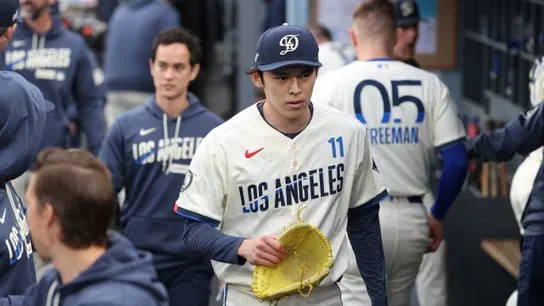
Los Angeles Dodgers starting pitcher Roki Sasaki (11) walks in the dugout after the first inning against the Chicago Cubs at Dodger Stadium.
Kiyoshi Mio-Imagn Images
Los Angeles Dodgers starting pitcher Roki Sasaki (11) walks in the dugout after the first inning against the Chicago Cubs at Dodger Stadium.
That might raise eyebrows considering the final line, five-plus innings, seven hits, four runs, three home runs. On paper, it was uneven. In context, it may have been a turning point.
For the first time in five starts this year, Sasaki looked like a pitcher building toward something rather than searching for it. His fastball command was sharper. His walk total, just one, was his lowest of the season. And most notably, his splitter, the pitch that once made him one of the most electric arms in the world, showed new life.
Advertisement
Sasaki threw it harder, nearly five miles per hour above his season average, and with more conviction. It generated late swings and, perhaps more importantly, confidence.
“I made a small adjustment,” Sasaki said, offering a slight smile before declining to elaborate. “I can’t tell.”
Fair enough. For a pitcher whose season has been defined by inconsistency, a little mystery is a welcome trade for tangible results.
There were still reminders of the work ahead. All three home runs he allowed came with two strikes, mistakes in put-away counts that major league hitters don’t miss. Yet even then, the damage was contained. Solo shots. Manageable innings. No unraveling.
Advertisement
That, too, is progress.
Sasaki even pushed into the sixth inning for the first time this year, exiting to a supportive ovation after a leadoff walk and single ended his night at 99 pitches. It wasn’t dominant, but it was enough.
The Dodgers made sure of that with an offensive eruption that overwhelmed Cubs pitching by the middle innings. After a slow start, the lineup flipped the game in a six-run fourth inning that turned a tight contest into a rout.
Max Muncy sparked the surge with a two-run homer, his ninth of the season. Teoscar Hernández delivered a bases-loaded, two-run single that broke things open. Andy Pages continued his breakout campaign with three RBIs, including a two-run double later in the game. Pages is now batting .337 this season.
Advertisement
Even Shohei Ohtani, who had been scuffling, showed signs of life, reaching base, snapping an 0-for-12 skid, and swiping just his second base of the season.
By the time the dust settled, the Dodgers had sent 11 men to the plate in the fourth inning alone and piled up 12 runs on 13 hits, chasing both Cubs starter Colin Rea and reliever Javier Assad before the game reached its late stages.
“I think when everyone gets going, we’re just about unstoppable,” rookie Alex Freeland said.
On nights like this, it’s hard to argue.
Still, the larger question lingers: what exactly is the Dodgers’ plan for Sasaki?
Advertisement
The organization committed to a six-man rotation, a structure designed to maximize talent and manage workloads. But it requires consistency from every arm involved, something Sasaki has struggled to provide since arriving.
Last season, that inconsistency led to a demotion, then a surprising reinvention. Sasaki returned in September not as a starter, but as a bullpen weapon. By October, he was closing postseason games, posting a 0.84 ERA and emerging as an unlikely October force.
That version of Sasaki, confident, aggressive, electric, has felt distant for much of this year.
Until, maybe, Saturday.
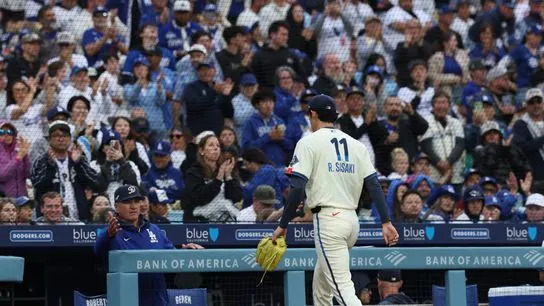
Fans acknowledge Los Angeles Dodgers starting pitcher Roki Sasaki (11) after a pitching change against the Chicago Cubs during the sixth inning at Dodger Stadium.
Kiyoshi Mio-Imagn Images
Advertisement
Fans acknowledge Los Angeles Dodgers starting pitcher Roki Sasaki (11) after a pitching change against the Chicago Cubs during the sixth inning at Dodger Stadium.
This wasn’t the postseason closer. It wasn’t even a clean start. But it was a step, built on better command, a sharper splitter, and a willingness to attack the strike zone early.
For a team with championship aspirations, the margin for patience is thin. For a pitcher with Sasaki’s ceiling, the margin for hope remains wide. On a night when the Dodgers didn’t need him to be great, Sasaki gave them something else.
A reason to believe he still might be.