

An early-season, double-digit winning streak is great for players, managers and the marketing department.
Everyone’s in a good mood, fans are checking the schedule to purchase tickets for upcoming homestands and it sets a tone that hopefully can last the rest of the season.
The Chicago Cubs entered Saturday night’s game in Los Angeles with a 10-game winning streak, their longest in April since an 11-game streak in 1970.
They’ve done it in comeback fashion, such as Friday’s 6-4 win over the Dodgers after trailing 4-0 in the seventh inning, and with walk-off hits, such as Dansby Swanson’s 10th-inning RBI single Thursday in an 8-7 win over the Philadelphia Phillies.
They’ve done it while losing closer Daniel Palencia to an oblique injury and then losing his replacement, Caleb Thielbar, to a hamstring injury.
And they’ve managed to win while some of their biggest run producers were off to cold starts.
Some of it can be attributed to luck, and some to facing teams in the midst of horrific slumps, such as the New York Mets and Phillies.
“You can say they’re struggling,” manager Craig Counsell said after Thursday’s win. “Hopefully we’re part of (the reason for) that. That’s what I’d like to say. We’ve made it tough on them.”
In the end, it doesn’t really matter how they did it or who they did it against, as long as the Cubs keep stacking up wins like beer-cup snakes in the Wrigley Field bleachers. It’s a tight-knit group that made a decent playoff run in October and should be capable of going further this fall.
But since streaks like these happen so infrequently at the start of a Cubs season, I set the Wayback Machine to 1970 to see if there were any lessons to learn from that mostly forgotten year.
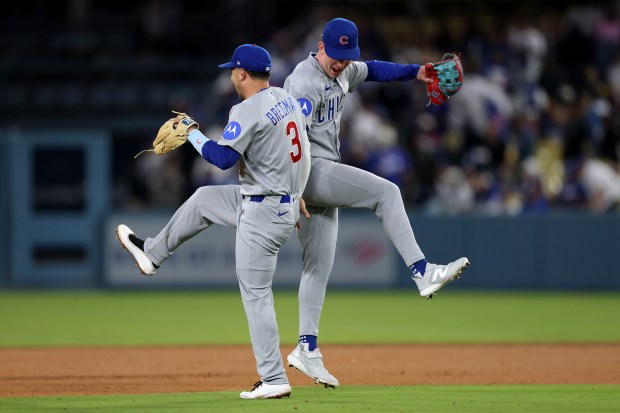 The Cubs’ Alex Bregman (3) and Pete Crow-Armstrong celebrate after a 6-4 win against the Dodgers at Dodger Stadium on Friday, April 24, 2026, in Los Angeles. It was the Cubs’ 10th straight victory. (Luke Hales/Getty)
If you’re a Cubs fan, chances are you know all about the 1969 collapse, which has been rehashed by baby boomers for the last 50-plus years to explain their PTSD over every late-season loss. You have to feel sorry for Gen Zers who just want to enjoy the nostalgia of 2016 without boomers constantly reminding them of how long they suffered before the drought ended.
But you almost never hear about that 1970 team, which in today’s terminology would be put in the “run it back” narrative. Manager Leo Durocher was still around, even though he had been blamed for running his position players into the ground by September. Like the ’26 Cubs, the starting lineup was almost exactly the same, except for newly acquired right fielder Johnny Callison. And the 1970 rotation was led by the three horses: Fergie Jenkins, Ken Holtzman and Bill Hands.
Cubs owner P.K. Wrigley figured if it wasn’t broke, don’t fix it, knowing fans loved the team and would forgive and forget the ending of ’69. He was half-right — they never forgot.
The ’70 Cubs started 1-3 before the home opener at Wrigley Field, where Billy Williams snapped an 0-for-19 start and a riot broke out in the grandstands after a 5-4 win over the Phillies.
It didn’t get anywhere near the publicity of the so-called “Disco Demolition riot” at Comiskey Park in 1979, which was primarily kids like me running around the field in a haze after Steve Dahl’s antidisco promotion ran amok.
According to a Tribune report, the fans on opening day at Wrigley in 1970 were battling with ushers and security after the game in several sections of the park, though it noted “the Bleacher Bums were not involved.” Police were not allowed to work in Chicago sports arenas at the time, and there were no arrests made.
Cubs general manager John Holland asked for police protection afterward, saying: “I don’t know what was wrong with the opening-day fans. They all seemed to have something on their minds.” Chicago Police Superintendent James Conlisk responded by saying the Cubs might welcome a riotous crowd in the summer if the season went astray, blowing off their request.
It was a story made for indignant newspaper columnists, like my old Tribune friend Robert Markus.
“I’m afraid this is going to be a common phenomenon this year, not just in Chicago but all over the country,” Markus wrote. “There is no reason to believe the sickness that pervades our society will spare the hitherto sacrosanct world of sports.”
I’m pretty sure no one told Markus to “stick to sports.” It was a different era.
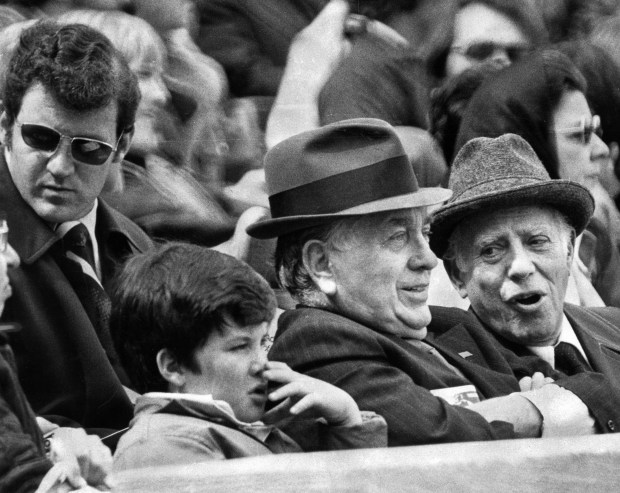 Mayor Richard J. Daley, second from right, attends a Cubs-Cardinals game with his grandson, second from left, and longtime judge Abraham Lincoln Marovitz on April 26, 1975, at Wrigley Field. (Don Casper/Chicago Tribune)
Either way, the blowback was heard at City Hall, and Mayor Richard J. Daley agreed to allow policemen into the ballpark whenever the Cubs requested. The atmosphere was more subdued the next game, when the Cubs played before only 7,120 fans.
“There ain’t gonna be no rioting in the friendly confines of Wrigley Field today,” first baseman Ernie Banks predicted before the game.
Banks was correct, and the Cubs got back to .500 behind four hits from Williams and a complete game from Hands in a 5-1 win over the Phils. Despite the return to normalcy, the Cubs announced several new policy changes to avoid a recurrence of the opening-day riot.
But most of them were aimed at the Bleacher Bums: reduced bleacher ticket sales from 4,000 to 3,300 and the elimination of standing room; beer vendors prevented from patrolling the bleachers; and the announcement that a “42-inch wire-mesh extension” would be added to the outfield walls to stop anyone from jumping onto the field.
“We don’t want to change the home run trajectory any more than we have to,” Holland said. “That’s why we’re going to pitch the screen out into the playing area.”
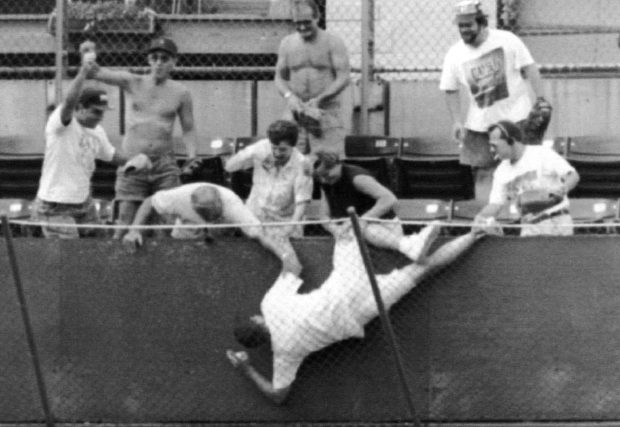 A fan falls into the left-field basket after trying to grab Andre Dawson’s home run ball during a Cubs game on Sept. 17, 1982, at Wrigley Field. (Chicago Tribune historical photo)
That was the birth of the “basket,” which has been the depository of hundreds of wind-aided home runs since. It even became a landing spot for some fans, including former team President Theo Epstein, who “fell” into the left-field basket on a dare for a photo op during a going-away party with friends before leaving Chicago in 2022.
The basket was installed during a Cubs trip and was ready for use on May 6, 1970. It remains intact after 56 years, though many fans feel the ballpark was better without the basket.
But Cubs management focused on fan safety, just like current management last week dealt with a rat on the field. But a riot in ’70 and a rat in ’26 could not keep the Cubs from streaking.
In ’70, back-to-back extra-inning wins made it four straight, and the Cubs eventually finished their first homestand with a perfect 10-0 record. Holtzman and Hands won three games apiece, and Jenkins won twice. After his 0-for-19 start, Williams hit six home runs on the homestand and increased his average to .321.
After a 1-0 win over the Pittsburgh Pirates at Forbes Field made it 11 straight, the streak ended the next day.
Still, Cubs fever had been rekindled, albeit in a more cautious approach with the collapse of ’69 still fresh in fans’ minds. The skeptics returned in June, and all goodwill the team had built up in April vanished that month when the Cubs went on a 12-game losing streak.
The ’70 Cubs were still only 1½ games out of first in the National League East on Sept. 20 but lost seven of their next nine and finished 84-78, five games behind the Pirates. On the final day, Tribune baseball writer George Langford wrote that Durocher’s “serious communication problems with his players” made him a likely scapegoat after a second straight disappointing ending:
“Thus in an atmosphere of question, some relief and a bit of nostalgia, one of Chicago’s leading sources of entertainment and heartbreak withdrew their act one final time wondering how many would be in next year’s cast.”
Most of them returned, including Durocher, but the magic was gone.
The next time you see someone fall into the basket at Wrigley, hoist a cup for the 1970 Cubs, and remember it’s a long, long season.