
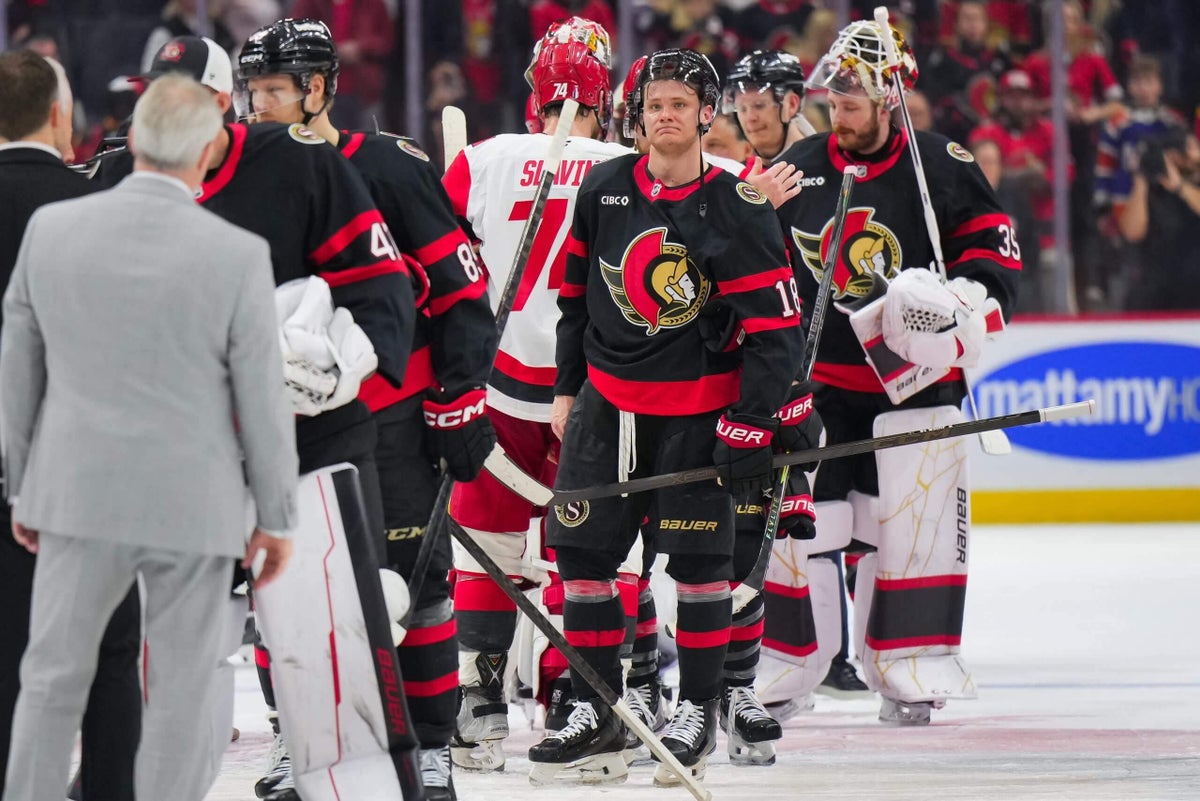
OTTAWA — Just like last year, the Ottawa Senators made sure to hug goaltender Linus Ullmark after the final horn sounded. And just like last year, the Senators remained near center ice to salute their home fans after their season ended in the Stanley Cup playoffs.
Hope lingered amid the emotions of a six-game series loss to the Toronto Maple Leafs last spring, when many members of the Senators’ young core were introduced to their first-ever postseason. With this year’s elimination, which came at the hands of the Eastern Conference-leading Carolina Hurricanes in a four-game sweep that ended with Saturday’s Game 4 loss at Canadian Tire Centre, that hope feels more mixed with pressure.
Because as long as the Senators remain a playoff team, expectations for results will only continue to grow. And any missed opportunity to further their playoff experience is understandably “heartbreaking,” as Senators captain Brady Tkachuk put it.
“You come in, and you just want to win a Stanley Cup — everyone believed that in here,” a softspoken Tkachuk said after his team’s 4-2 defeat. “For it to be as tight a series and not go our way every game, it’s really tough.”
The feeling might’ve been a bit different if the Senators had won a game or two in this series, especially as this team progresses towards being labelled a true contender in the Eastern Conference. Instead, said Tkachuk when asked how his emotions compared to those of last year, “it’s kind of the same.”
The first-round sweep capped an eventful year that, were it a television show, would be worth a rewatch. And the Senators weren’t shy to embrace the adversity they faced all season as a storyline entering the playoffs.
The Senators endured an up-and-down year for Tkachuk, who battled injury, won a gold medal for Team USA at the Olympics, drew criticism for celebrating at the White House, and had to answer for controversial comments made on his podcast by his father, Keith. Ullmark, meanwhile, struggled to find consistency in the first half of the year before stepping away for mental health reasons, only to help lead the Senators down the stretch to the East’s second wild-card spot.
And just as the team was getting back on track in March, injuries to its defense corps piled up. The Senators weathered that storm to make the playoffs but couldn’t overcome the significant hurdle against a healthier, deeper Canes team — especially without top-pair blueliners Artem Zub, who never returned after exiting partway through Game 1, and Jake Sanderson, who was knocked out of Game 3 with a concussion.
“Played 10 defensemen in the first four games of a playoff series, which I don’t know if I’ve heard of that,” coach Travis Green said.
But underneath all of that, during the regular season, the Senators still hung around the NHL’s best in possession and shot suppression metrics, profiling as an elite defensive team. They got a lot out of their best forwards, and Sanderson, who also won gold at the Olympics, showed great progression on the back end. And the Michael Amadio-Shane Pinto duo had many moments in the regular season when they proved their worth.
“We’ve taken a lot of steps this year to really having a lot of belief that we’re a lot closer than we were to hopefully competing for a Stanley Cup,” Green said. “That’s what we’re here for. And you don’t say that very often when you lose 4-0. But after last year, I felt like we’d taken some steps. And then after this year, I feel like we’ve taken a lot more steps.”
The Canes edged the Senators in most statistical categories in their series. But Ottawa did keep some of Carolina’s best players — namely Andrei Svechnikov, Sebastian Aho and Seth Jarvis — at bay. Still, they couldn’t stop Carolina’s second line of Taylor Hall, Logan Stankoven and Jackson Blake, which supplied the bulk of the team’s offense. And when the Senators had chances of their own to respond, they fell flat.
Only two Senators players scored goals in the series — Drake Batherson and Dylan Cozens — as their power play went 1-for-15. Some of their other best players, including Tkachuk and Tim Stützle, were even more limited in offensive production: Tkachuk and Stützle combined for 1 point in the four games. Their shutdown line of Pinto, Amadio and Nick Cousins was rendered ineffective and eventually broken up.
“What we learned was that we knew it was going to be an absolute grind of a series,” Tkachuk said. “I think every game showed that (there’s) not much room. Sometimes you don’t get the luck with some of the posts, some of the chances that don’t go in. It’s just heartbreaking.”
Their biggest positive was goaltending, which was supposed to be a major question mark entering the series. Ullmark played Vezina Trophy-quality goaltending with a 2.03 goals-against average and a .932 save percentage but embraced his teammates after the final horn with nothing to show for it.
“(Ullmark) has shown a lot of people, a lot of doubters,” Green said. “And I’m proud of him because it hasn’t been an easy year for him.”
So, how much of the Senators’ inability to produce in the playoffs falls on them? And how much of it stemmed from them facing a buzzsaw in Carolina that refused to cede any ground? Ultimately, the responsibility lies with general manager Steve Staios to sift through the aftermath as he enters a pivotal offseason while trying to capitalize on the Senators’ growth and keep pace in a busy Eastern Conference.
With the Senators being the first team out of the playoffs, they’re left to watch other division foes compete to advance. The Montreal Canadiens hold a series lead on the Tampa Bay Lightning, whom many picked to represent the East in the Stanley Cup Final, powered by their young players. The Boston Bruins returned to the playoffs this year after some offseason tweaks, only to run into the Buffalo Sabres, whose talented roster finally lifted them out of the lottery.
The Detroit Red Wings and Florida Panthers also missed the playoffs out of the Atlantic Division, though neither is far off. Particularly Florida, which could benefit from a summer of rest after three consecutive Cup Final appearances and two victories. The Maple Leafs might be closer to missing the playoffs next year than making them, but pressure will be on them to make the most of any season when they have Auston Matthews and William Nylander on their roster.
And that’s just in-division.
This playoff series ultimately proved that the Senators still have some ways to go before they can hang with the conference’s elite. And there are many questions worth asking about goal scoring and defending — and even goaltending, to some degree. But considering how much better the Sens looked in the regular season compared to last year, this team might need to handle its potential issues delicately.
It certainly isn’t the sort of sweep that requires the Sens to start over from scratch with their roster. Though they might be closer to entering the conference’s elite than this time last year, the next step is figuring out how — after they finish licking their wounds from a long season that came to a screeching end in a sweep to the Canes.
“It’s a learning curve,” Senators defenseman Thomas Chabot said. “But I think it’s just all too fresh right now.”