
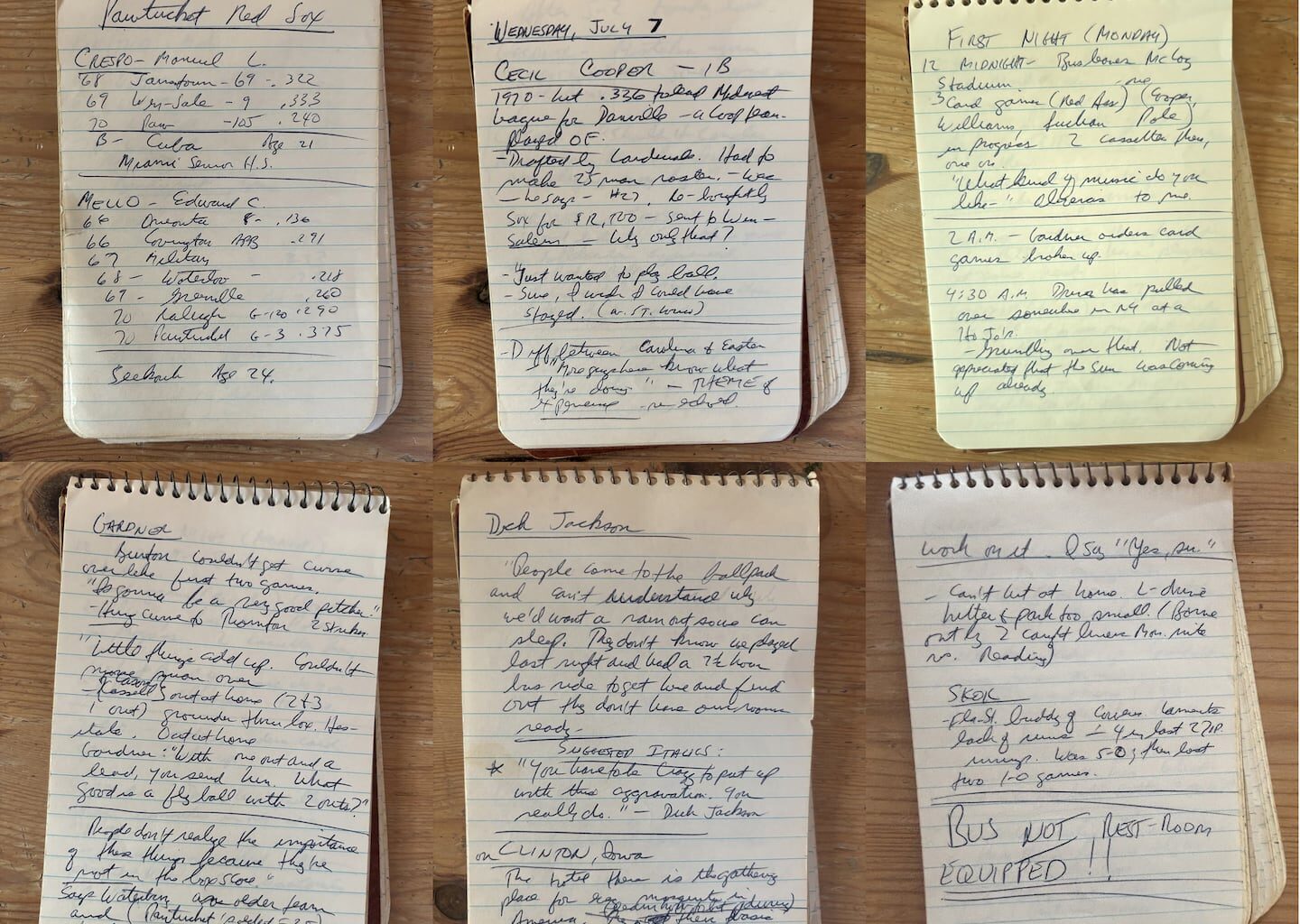
“You’ll get to see my whole pitching staff,” manager Billy Gardner informed me. (He was right about that.)
Get Starting Point
A guide through the most important stories of the morning, delivered Monday through Friday.
I know that’s a verbatim quote because, miraculously, I still have the little notebook in which I took all the notes for the story. It’s a classified artifact.
Players eyed me nervously as I walked down the aisle. I was young enough to look like a player and I felt it necessary to explain I wasn’t there to take anyone’s job, only to report. Thus assured, Max Oliveras asked me what kind of music I liked.
I already had demonstrated I was an amateur. After all, I had neglected to bring my own pillow. This was a rookie mistake.
Off we went to Elmira. At 2 a.m., Gardner broke up three card games and declared lights out. There being no restroom on the bus — welcome to the minors, indeed — we stopped somewhere in New York state at 4:30.
The real fun began when we arrived in Elmira and hit the Mark Twain Hotel. It seems their rooms weren’t ready, and you can imagine the dirty looks I got when they saw me heading to the elevator with my key. Things got worse. When the room assignments were finally arranged, some players were asked to triple up!
Minor league life was not exactly glamorous. Take the subject of meal money. Each player was given $18. For three days. I marveled that in the NBA each player received $19 per day!
Gardner was very accommodating. He had a 10-year career as an infielder, his peak season being 1957, when he led the American League in doubles with 36. He had the appropriate open door with his players and he couldn’t have been nicer to the nosy intruder with the ever-present notebook.
The manager had an unofficial lieutenant in backup catcher Dick Jackson. He was 25, and had been knocking around the Red Sox system since 1965. Let’s just say he had seen it all and was willing to share his thoughts.
Classic Jackson: “The hotel in Clinton, Iowa, is the gathering place for every mosquito in America. They learn how to bite during their basic training in Pensacola and then they all come to Clinton for assignment.”
More Jackson: “People come to the ballpark and can’t understand why we’d want a rainout so we can sleep. They don’t know we played last night and had a 7½-hour bus ride to get here and find out they don’t have our rooms ready.”
Among the pitchers on Gardner’s staff was a southpaw named Jim Burton. Yup, that Jim Burton, who never could have imagined he would contribute to the ongoing Curse of the Bambino four years later. Gardner had no doubts that Burton would make it to what everyone referred to as “The Show.”
Another pitcher who did make it to the big leagues was righthander Dick Pole. Fellow righty Dick Mills, a local boy makes good (Jamaica Plain, Weymouth, Thayer Academy), actually had a two-game cup of Red Sox coffee in 1970, but sadly never returned.
By far the player to watch was a 21-year-old first baseman named Cecil Cooper. He had been purchased from the Cardinals and was in the midst of a sensational campaign that began in Winston-Salem, where he earned a promotion after hitting .379. He played 98 games with the PawSox, batting .343 with 10 homers and 60 RBIs. The big club summoned him in September and he hit .310 in 14 games. He was very unhappy with the Cardinals for letting him go and he took it out on pitchers everywhere. I took note that he murdered the low ball, and we all know what happened to him.
One of the many things I learned was that playing and living conditions are not necessarily better as you advance. The Western Carolina League, for example, was appreciated because the longest bus ride was three hours. The Eastern League itself was anything but beloved. Bad travel. Some notoriously bad hotel conditions. Weather.
“You have to be crazy to put up with this aggravation; you really do,” declared Jackson.
Among the things I saw were players in uniform lining up at the concession stand between games of a doubleheader, and the amusing sight of players racing up the street following a game in order to hit the McDonald’s before closing time.
It is never a surprise to hear a batter complain that a park is too big, but Edward Mello had a novel excuse for not hitting very well at home.
“The park is too small,” he explained. “I’m a line-drive hitter and the park is too small.”
The ensuing Sunday Globe story ran in two parts and would lead to my first book. I consider the PawSox experience to be my master’s program in Diamondology and the book it inspired to be my PhD treatise.
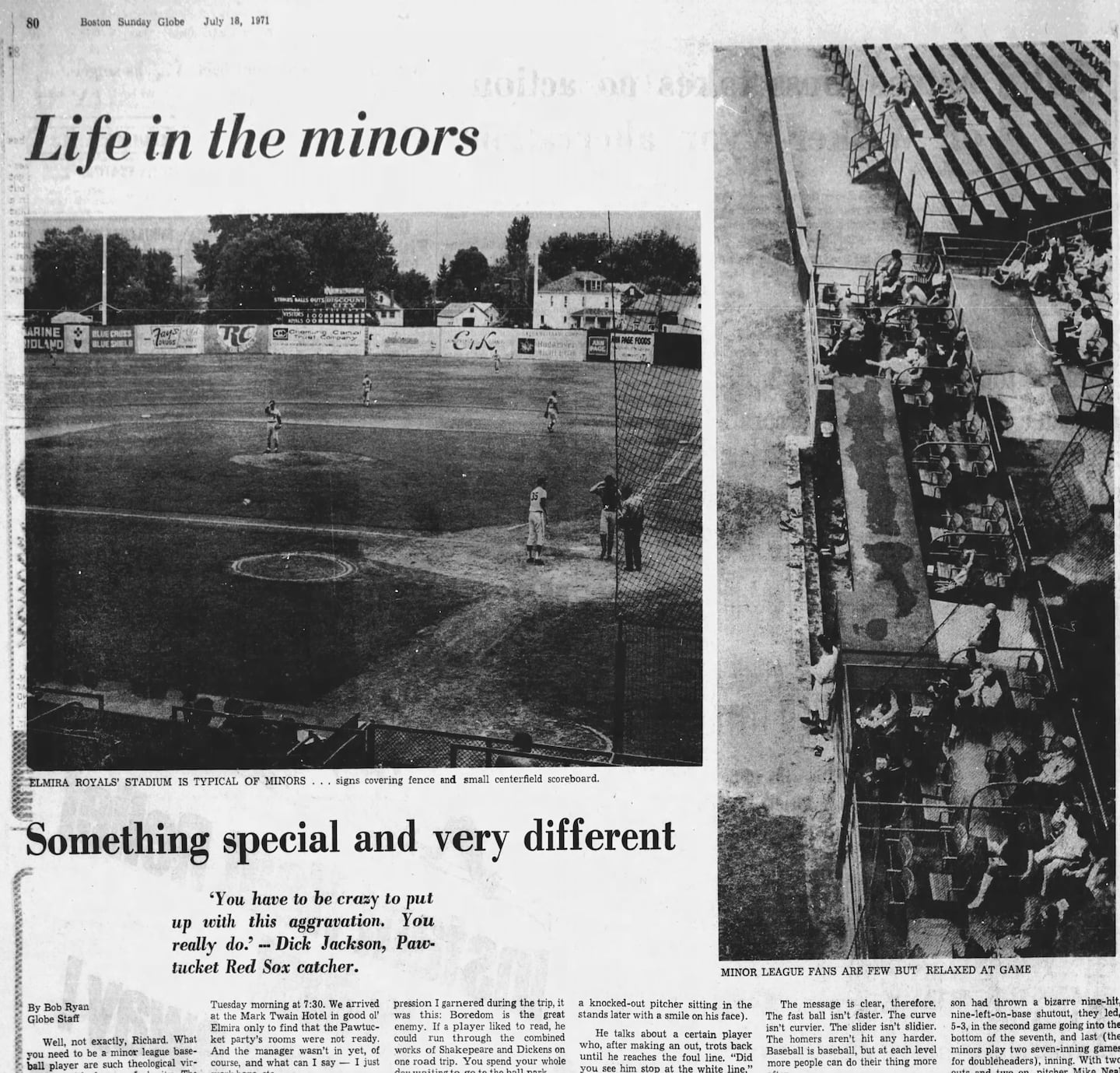 Bob Ryan’s 1971 road trip with the Pawtucket Red Sox resulted in a two-part story in the Boston Sunday Globe and led to his first book.Globe archives
It was a pretty good story idea, if I do say so myself.
Bob Ryan can be reached at robert.ryan@globe.com.