

ARLINGTON — The Rangers were a .500 team when we last gathered to discuss the week that was. They remain a .500 team this time around as well.
Believe it or not, though, there’s still plenty to discuss as the Rangers have officially completed the first calendar month of the regular season.
Advertisement
Here are five things we learned about the Rangers last week.
Has the offense actually improved?
So, technically yes, though that’s got as much to do with how low the bar to clear was. The Rangers have improved their batting average (by three percentage points), their on base percentage (by a dozen percentage points), their slugging percentage (by three percentage points), their walk rate (by one percentage point) and a number of situational figures (like, for example, their ability to produce when behind in games) year over year.
But, still, the Rangers remain a below-average offense by most metrics. Their .698 OPS, 113 total runs scored, 24.5% strikeout percentage and 9.4% walk percentage both rank in the bottom-third league wide. Their production with runners in scoring position and pitches seen per plate appearance — two offensive phases that can force opponent’s starters out of games early and disrupt an entire series — have hovered around league average.
 Texas Rangers’ Josh Smith, right, reacts after striking out during the ninth inning of a baseball game against the Athletics, Wednesday, April 15, 2026, in West Sacramento, Calif. (AP Photo/Scott Marshall) (Scott Marshall/AP)
It should be noted that 18 of their 28 games have been played against teams whose pitching staffs rank within the top-third league wide in WAR, per FanGraphs, and 15 games have been played against teams whose pitching staffs have posted a 3.69 ERA or better. They’ve played eight games against starters who’ve been named to an All-Star team within the last three seasons. Velocity is not everything, but, they’ve faced the third-fastest average fastball (94.3 mph) of any team in baseball. This does not inherently absolve the Rangers of their sins. It should, however, emphasize the fact they have not had a cakewalk open to the season.
Advertisement
The larger issue? The Rangers haven’t produced within their own ballpark. The previous week, in which they played six of their seven games at Globe Life Field, reflects the issue. Their .657 OPS (the seventh-worst in baseball) and 21 runs scored (third-worst) combined to provide the Rangers a .500 record through the first six installments of a nine-game homestand. The stadium’s park factor — which measures whether a field favors pitchers or hitters — suggests that it is baseball’s most pitcher-friendly venue this season for a second consecutive year. Could that be why the Rangers have hit just six home runs at home this season? Maybe, but it didn’t seem to slow down the Pittsburgh Pirates or Athletics, who combined to hit seven home runs at Globe Life Field this week alone.
“I think there’s a lot to learn,” right fielder Brandon Nimmo said Sunday of the offense. “I think we’re still feeling that out, but, we’re getting closer.”
Bunts are back in style
To connect a bridge between the previous thought and this one, Nimmo, whom Rangers manager Skip Schumaker recently qualified as one of the “smartest” hitters he’s ever been around, had this much to say about the club’s recent affinity for small ball.
Advertisement
“I think we’re going to need to rely on that a little bit,” Nimmo said, “especially playing at home in this ballpark.”
The Rangers bunted twice in Sunday’s loss vs. the Athletics. The first, via center fielder Evan Carter, scored a run when an errantly fielded ball allowed third baseman Josh Jung to dart from second base to home plate. The second, two at-bats later from second baseman Josh Smith, loaded the bases with no outs. They were the fourth and fifth bunt hits that the Rangers have executed this season, which places them near the top of the league leaderboard in that category, and the second and third of the series along. Saturday, in the third inning a 4-3 win, left fielder Sam Haggerty laid down a bunt single that advanced two runners who eventually scored into scoring position.
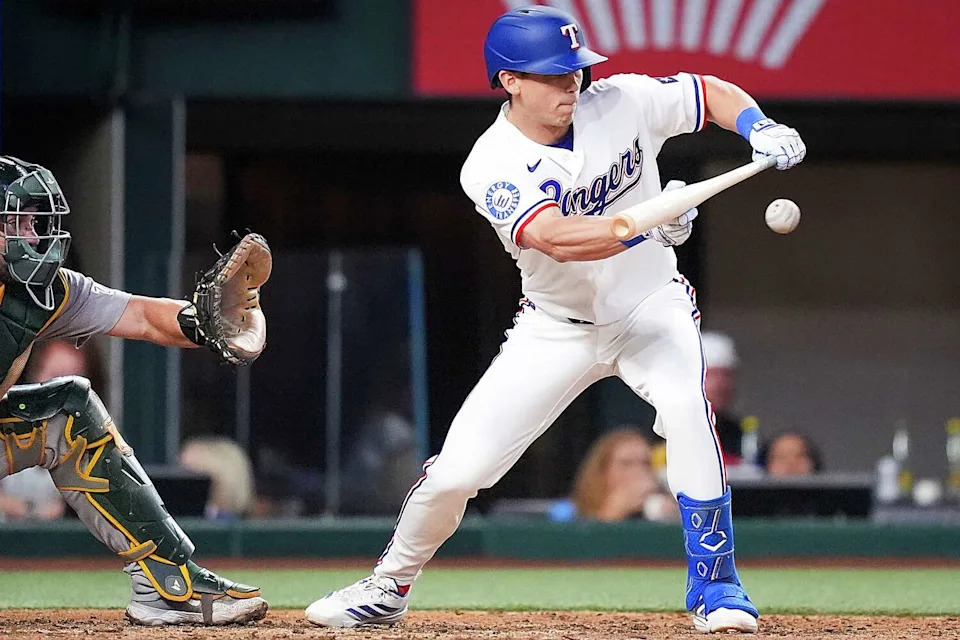
Texas Rangers outfielder Sam Haggerty drops a bunt for a single during the third inning of a baseball game against the Athletics at Globe Life Field on Saturday, April 25, 2026, in Arlington. (Smiley N. Pool/The Dallas Morning News)
Schumaker is pro-bunts, and with speedy personnel in his everyday lineup and on his bench, the Rangers have the facilities to employ small-ball more often. It gives players like Carter, whose Sunday bunt came against left-hander Jacob Lopez, tangible value against a handedness that remains his largest weakness. It gives the Rangers, who still struggle to leave the yard in their yard, another avenue to manufacture offense.
Advertisement
Gavin Collyer and Peyton Gray are here to play
In the last week-and-a-half, as bullpen injuries continued to pile up, the Rangers promoted two pitchers to the major leagues who weren’t entirely on their radar even just three months ago. Right-hander Gavin Collyer, who’d only pitched 14 games above Double-A before this season, came first. Right-hander Peyton Gray, a career journeyman who turned a non-roster invite this spring into a legitimate opportunity, came second.
They aren’t only here for depth.
The two have combined to pitch 6 ⅓ scoreless frames to begin their respective professional career. Collyer, who’s logged six-straight scoreless appearances, pitched a scoreless inning in Sunday’s loss and maintained a one-run deficit. Gray, who debuted Thursday, pitched a scoreless ninth inning in Sunday’s loss and struck out Athletics left fielder Tyler Soderstrom on three pitches to strand the bases loaded.
Advertisement
“They’re both pitching really well,” Schumaker said. “They don’t hurt themselves.”
It’s been quite the year (plus) for Jacob Latz
Left-handed pitcher Jacob Latz has a 2.60 ERA since the start of last season. That ranks 10th leaguewide of all pitchers who’ve thrown at least 100 innings in that span. The nine who’ve been better include last year’s Cy Young Award winners in each league, four players who received votes for award and Rangers right-hander Nathan Eovaldi. Latz is the only one of them who’s recorded both a quality start and a save.
It’s a testament to both his production and versatility. Latz spent spring in competition for the team’s fifth-starter job, and when he didn’t win it, he shifted into a high-leverage relief role. The results? The 30-year-old has a 1.23 ERA in 14 ⅔ innings. He’s pitched one or fewer innings in each of his last six appearances, and on Saturday, he earned his first save of the season in a win vs. the Athletics.
Advertisement
“I love it,” Latz said of his high-leverage role. “I’m just continuing to improve. ‘Don’t get complacent’ is going to be the next step.”
Something to monitor on the rotation front
The Rangers, in case you hadn’t heard, fielded an awfully decent rotation last season. Like, the best in baseball, and one of the best in the history of a franchise that’s admittedly been historically thin in that realm. It was the primary reason that the Rangers were able to remain somewhat competitive and finish with a .500 record despite a woeful offense last season.
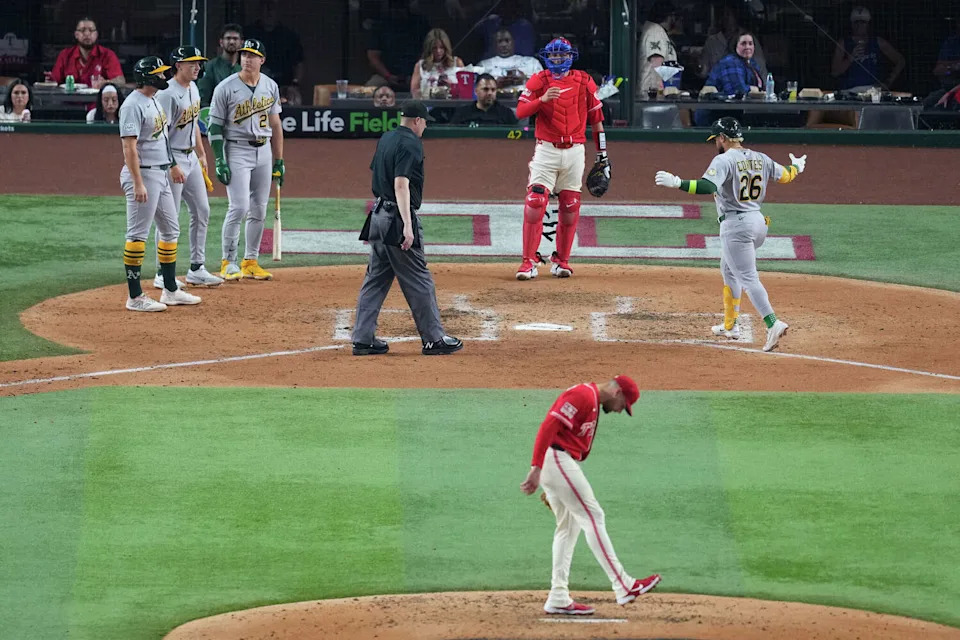 Texas Rangers starting pitcher Nathan Eovaldi, bottom, reacts after giving up a three run home run to Athletics’ Carlos Cortes (26) during the fifth inning of a baseball game Friday, April 24, 2026, in Arlington, Texas. (AP Photo/Julio Cortez) (Julio Cortez/AP)
We say all that to say this: the rotation, metrics-wise, has been only average this season. The club’s starters have yielded a 4.10 ERA through 28 games, the 16th-best in baseball, and have totaled 1.7 WAR, per FanGraphs, the 17th-best. This is in large part due to Eovaldi’s uncharacteristic start and the up-and-down rides that right-hander Jack Leiter and left-hander MacKenzie Gore have been on. There’s reason to believe that Eovaldi’s track record, Leiter’s continued development and Gore’s considerable upside can ultimately prevail, and that so long as right-hander Jacob deGrom remains an ace and right-hander Kumar Rocker continues to level up, the rotation shouldn’t develop into a serious concern.
Advertisement
It should be stated that natural regression from last year’s superb highs shouldn’t be entirely unexpected, and even if the unit takes a full step backwards, it can remain one of the team’s strengths. That puts more pressure on the offense to carry its weight, though, because if last season is proof, even a world-class staff can’t carry a net-negative lineup into the postseason.