

In Toronto, Kazuma Okamoto wakes up and wonders whether he’s in Tokyo. The Toronto Blue Jays third baseman feels at home there. He’s enjoying trying new foods. His favorites so far are sandwiches and quesadillas.
In Chicago, Munetaka Murakami is homering at a rate no Japanese-born player ever has to begin an MLB career. As Murakami rounds the bases, his third-base coach celebrates by sheathing an imaginary samurai sword. The White Sox have fallen for Murakami, and he loves them back.
Then there is the case of Houston Astros pitcher Tatsuya Imai.
Like Okamoto and Murakami, Imai signed with a major-league club this winter after establishing himself in Japan’s top league, Nippon Professional Baseball. Unlike them, he’s not having a great time.
Earlier this month, Imai made headlines for acknowledging he’s struggling to acclimate in the United States. “He’s not able to adjust to the American lifestyle,” his interpreter, Shio Enomoto, said. “Baseball and outside of baseball.”
Six decades after Masanori Murakami became the first Japanese-born player in the majors, there are 18 Japanese- and Korean-born players on 40-man MLB rosters. Most, due to the nature of the sport’s international posting system, were seasoned veterans overseas before becoming “rookies” again, adapting to a new league, language and life in North America.
Interest in the Japanese market intensified across the industry this past decade with the high-profile arrivals of Shohei Ohtani, Yoshinobu Yamamoto and Roki Sasaki, all of whom are now with the Los Angeles Dodgers. With the explosion in interest has come an increase in the parties involved in the transition — Japanese management companies, agents, trainers, sponsors, clubs in two continents, and MLB owners pressuring their operations departments to add a Pacific Rim star — all of which can further confuse an already complicated career move for a player.
Over the years, some MLB clubs have learned a lot about attempting to ease the transition, with teams like the Dodgers, Mariners, Cubs, Yankees and Red Sox becoming known and trusted as destinations. But others, like the Astros, have had far less experience with it.
Imai is the first Japanese player Houston has signed directly from NPB.
“If you haven’t had a good experience with a Japanese player already, you’re way behind,” said an MLB agent, who was granted anonymity in exchange for their candor. “If you’ve had a bad experience with a Japanese player — that could be just as simple as the player didn’t play well, and you traded him or released him; or the player was with your team and spoke badly about you to other players — word of mouth is everything in Japan.”
This winter, Munetaka Murakami toured the White Sox’s facilities on Chicago’s South Side and noted the home clubhouse had no bidets. The White Sox, a club attempting to revive its Pacific Rim scouting efforts, had crafted a thorough recruiting pitch for Murakami. They had not considered bidets.
“Well,” White Sox general manager Chris Getz recalled thinking, “that seems like something we can do, right?”
Installing bidets was a gesture that served to show Murakami the White Sox would go the extra mile to make him comfortable. From the outset, they told Murakami and his representatives they wanted honest feedback.
“We’re not going to have this perfect out of the gate,” Getz said. “But there is an intention and willingness to continue to improve what needs to be improved.”
The club’s attention to detail has already paid dividend, as his 12 homers are tied for the MLB lead. It could prove even more valuable in future free-agent pursuits if the White Sox burnish a reputation among Japanese players as a good landing spot. “When you’re in this world,” the agent said, “Japan is a small town. People know what goes on.”
When Masao Kida first stepped onto the pitcher’s mound at Tiger Stadium, he wore a samurai kimono. It was a gray December day in 1998, and the 30-year-old Japanese right-hander had just signed with the Detroit Tigers.
The Tigers’ roster was lacking. Their ballpark was on its last legs. Randy Smith, the club’s GM at the time, found little success attracting free agents to Detroit. “We were trying to find anyone we could,” Smith recalled, “from wherever in the world they came from.” He had sent special assistant Randy Johnson to Japan that summer to scout an Orix Blue Wave outfielder named Ichiro Suzuki.
Johnson returned home with a second recommendation: Kida, who was flourishing in relief.
Few MLB teams were scouting the Pacific Rim, even as a wave of pitchers came over to the U.S. — first Korean starter Chan Ho Park in 1994, then Japanese ace Hideo Nomo in 1995. Kida was the first Japanese-born player to sign with a team not located on the West Coast or in New York. “There weren’t a whole lot of examples to look at and say, ‘They did it right’ or ‘They did it wrong’ or ‘Let’s copy that,’” Smith said.
The Tigers hired a Japanese speaker in the front office and an interpreter who also served as Kida’s masseuse and chauffeur. But they soon discovered Kida could make himself comfortable almost anywhere. He grew up watching “Bewitched” reruns and old American films. (Upon first visiting Detroit, he joked he was disappointed he didn’t meet RoboCop.) At spring training, Kida taught teammates a Japanese word each day, and they taught him an English term — like eyewash. He read the biographies of Tom Seaver, Nolan Ryan and Sparky Anderson, and took a liking to the chicken burger at Bob Evans.
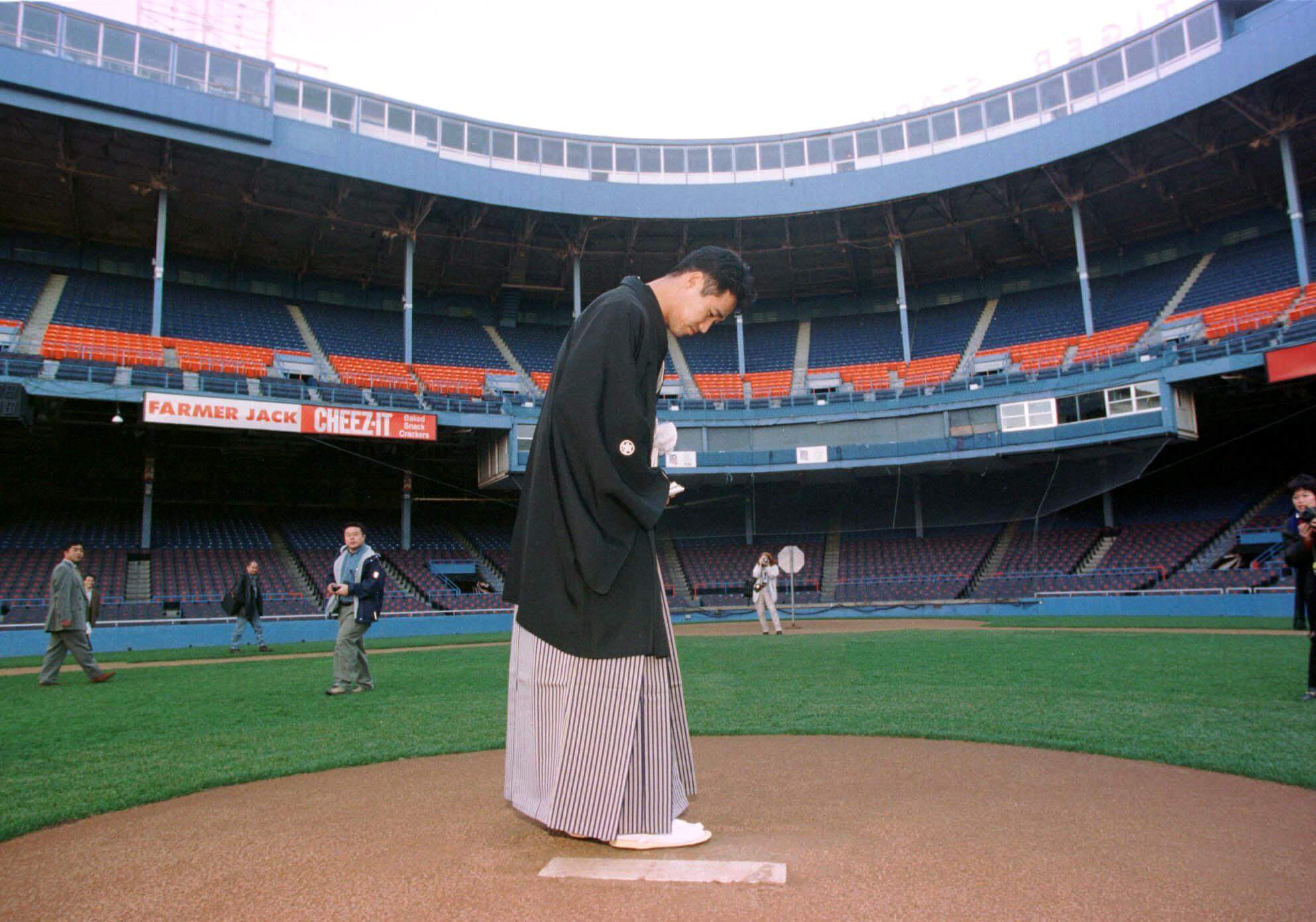
Masao Kida took to the Tiger Stadium mound in a kimono upon his arrival in Detroit. (JEFF KOWALSKY / AFP via Getty Images)
In Kida’s first Grapefruit League appearance, Smith phoned Johnson, who was in Arizona again scouting Suzuki, and said, “You’ve got to be here with us. We’re all nervous, so you’ve got to be nervous with us.” Kida’s splitter danced that day; he struck out Cleveland’s Jim Thome, Manny Ramirez and Russell Branyan. “That’s what he could do,” Johnson said.
The honeymoon phase was short-lived.
In the first week of the 1999 season, Kida recorded nearly as many earned runs (10) as outs (11). Then-Tigers manager Larry Parrish lamented how hard it was calming a pitcher when an interpreter was required: “I can’t just kibitz with him, shoot the bull.”
A quarter-century ago, MLB clubs onboarding Asian players were reliant on the player largely figuring things out on their own. Over time, certain teams have seen what works (and doesn’t) and have built out support structures: in some cases, hiring Japanese and Korean speakers for the training staff or allowing players the autonomy to bring along a personal trainer or interpreter with whom they are already close.
In recent years, as some front offices realized how far they are behind the Dodgers and others with prolonged investment in Pacific Rim scouting, they have asked agents for intel about how they can catch up. The advice they receive is often simple: Make an effort to understand the player culturally, and show a willingness to be flexible and tolerant.
The San Diego Padres are one of the clubs ahead of the curve. Their director of Pacific Rim operations, Acey Kohrogi, once helped bring Nomo and Park to the Dodgers. Padres GM A.J. Preller memorized several minutes of Japanese in an effort to woo Ohtani back in 2017. The idea, says Padres assistant GM Josh Stein, is to foster an organizational culture that supports each player — whether they’re from San Diego, Seoul or Santo Domingo — to allow them to focus fully on baseball.
That means remembering how difficult small tasks, such as checking into a hotel or navigating an airport, can be in a foreign language.
“The more that you’re having those expectations built in with whatever support staff is around the player — that you’re not just here to interpret in a media setting or a pre- or postgame interview, but you’re really here to support the player with every aspect of that transition,” Stein said, “I think you’ve got a better chance to get good results.”
Agent Alan Nero, who leads Octagon’s baseball division, said most Asian players transition remarkably well to major-league life, and the process has grown more streamlined as more players make the move. Agencies shoulder a large share of the responsibility for making a recent arrival comfortable. They might host dinners with teammates or ask other clients to help the new guy integrate into the clubhouse social scene.
Nero offered Chicago Cubs starter Shota Imanaga as an example. Imanaga has an interpreter, a Japanese teammate (Seiya Suzuki) and several Japanese speakers nearby at Octagon’s Chicago office.
“There’s a lot of support,” Nero said.
These days, many NPB players sign with a Japanese management company that supports them in their daily life, and, if that player plans to become an MLB free agent, quietly helps them find an agent. Some players continue to work with that management company after arriving in the U.S., which can ease the stress of settling into their living situation. But not all continue that relationship. Agent Scott Boras, who represents Imai, said he has his own management company in Japan, employing four people there.
Back when Kida landed in Detroit, none of that ecosystem was in place. And while he had a difficult time getting outs in the majors, he had a good time. Living in a hotel room in Novi, a Detroit suburb where a Kida fan club instantly sprouted, he frequented Japanese restaurants, sushi bars and grocery stores. He went to dinner at the Japanese consulate. He hosted champion sumo wrestlers. When Kida was released early in his second season in Detroit, teammates said they’d miss the beloved prankster.
“You look back and know there were things we could have done better,” Smith said. “I just don’t know exactly what that would have been. It was so new for everybody.”
Smith now scouts for the NPB’s Hokkaido Nippon-Ham Fighters. The club’s GM? Kida.
Hard times are harder when you can’t communicate clearly. Just ask Imai.
Los Angeles Angels left-hander Yusei Kikuchi, Imai’s former NPB teammate whose experience in Houston fueled Imai’s interest in the Astros, watched the Imai interview that made waves and said through an interpreter he felt something may have been “lost in translation.” Boras said he heard the same from Japanese speakers: “(They) said, ‘That’s really not what he was saying.’”
Whether or not Imai intended to deliver such a blunt assessment of his transition to the U.S. as he hit the injured list with arm fatigue, the quote rapidly gained attention. Scouts whispered about Imai’s makeup. Fans called into question Imai’s readiness to pitch in the majors. Agents wondered aloud whether the Astros had shared those concerns yet felt pressured to sign a Japanese player — their ballpark’s naming rights deal is owned by the Japanese HVAC company Daikin, after all.
That Astros owner Jim Crane introduced a Daikin executive during Imai’s post-signing news conference in January accentuated how the partnership played a role in Imai’s arrival. Crane later added the Astros would be “laser-focused” on the Asian market moving forward.
Kikuchi had delivered a positive review of his time in Houston, yet he was a six-year MLB veteran when he was traded there in 2024, not a rookie still grappling with some of the issues cited by Imai — slick baseballs, warm weather, changing gameday and travel routines.
Each player’s background is different, and temperament plays a key part in their transition to the majors. Kikuchi attributed his smooth acclimation with the Seattle Mariners in 2019 to the fact that he’d wanted to live in the U.S. since high school. He trained there in the offseason. He didn’t seek out Japanese food. He didn’t want to recreate Japanese life in America. He wanted to experience something entirely new.
When in Rome …
“Do as the Romans do,” Kikuchi said. “I had that mindset coming in.”
If anyone in the Astros clubhouse can relate to Imai’s quandary, it’s one of the starters now pressed into service with Imai injured.
Peter Lambert spent last season with the NPB’s Yakult Swallows, an experience that gave him a greater appreciation for the challenge of crossing the globe and changing leagues. In Japan, the baseballs, mounds and stadiums have a different feel. Travel is less taxing. Postgame meals are eaten at the hotel, not in the clubhouse. Starting pitchers have more rest between starts, and on days they’re not pitching, they head home after pregame workouts — a lot more downtime, a lot less dugout time.
“So many things are different between MLB and NPB,” Lambert said, “but I think one of the things that baseball across the world teaches all of the players is that you have to adjust quickly.”
But the experiences of the leagues in Japan and Korea could be instructive for MLB: Because foreign-born players are integral to the leagues, over time they have learned what works. David MacKinnon, an infielder who played in MLB, NPB and the Korean Baseball Organization, said Japanese clubs bring in so many foreigners each season they have the process “down to a T.” They provide an apartment. They send a translator to teach players how to use the train. They pick up family at the airport. They introduce Japanese culture with fun facts and info sheets.
“I think it’s a lot easier for foreign players to go to Japan than it is for Japanese players to come to the U.S.,” MacKinnon said.
In Houston, the Astros have made efforts to welcome Imai. This spring, they shared a Japanese word of the day. Teammate Ryan Weiss, who pitched the past two seasons in the KBO, organized a dinner for Imai. Manager Joe Espada consulted managers who had worked with Japanese players and understood the pressure they are under to perform.
Initially, Imai was eager to fly solo. In an interview last fall with Daisuke Matsuzaka, Imai said he’d enjoy playing with Ohtani, Yamamoto and Sasaki in Los Angeles, but “winning against a team like that and becoming a world champion would be the most valuable thing in my life. If anything, I’d rather take them down.”
Now, he’d settle for the quiet victory of finding his footing.
Imai will make his first rehab start Tuesday with Double-A Corpus Christi. Espada said Imai seems to be “in a much better place,” and the club has encouraged him to be open with them. Imai’s trainer, who was delayed by visa issues, is now with him. Boras stressed that Imai is settling into a routine and “is very happy in Houston, and very happy pursuing a dream.” Imai’s healthy return is vital to the Astros’ odds of salvaging this season. It could also be pivotal for their reputation in the Pacific Rim.
With contributions from The Athletic’s Chandler Rome, Dennis Lin and Mitch Bannon