
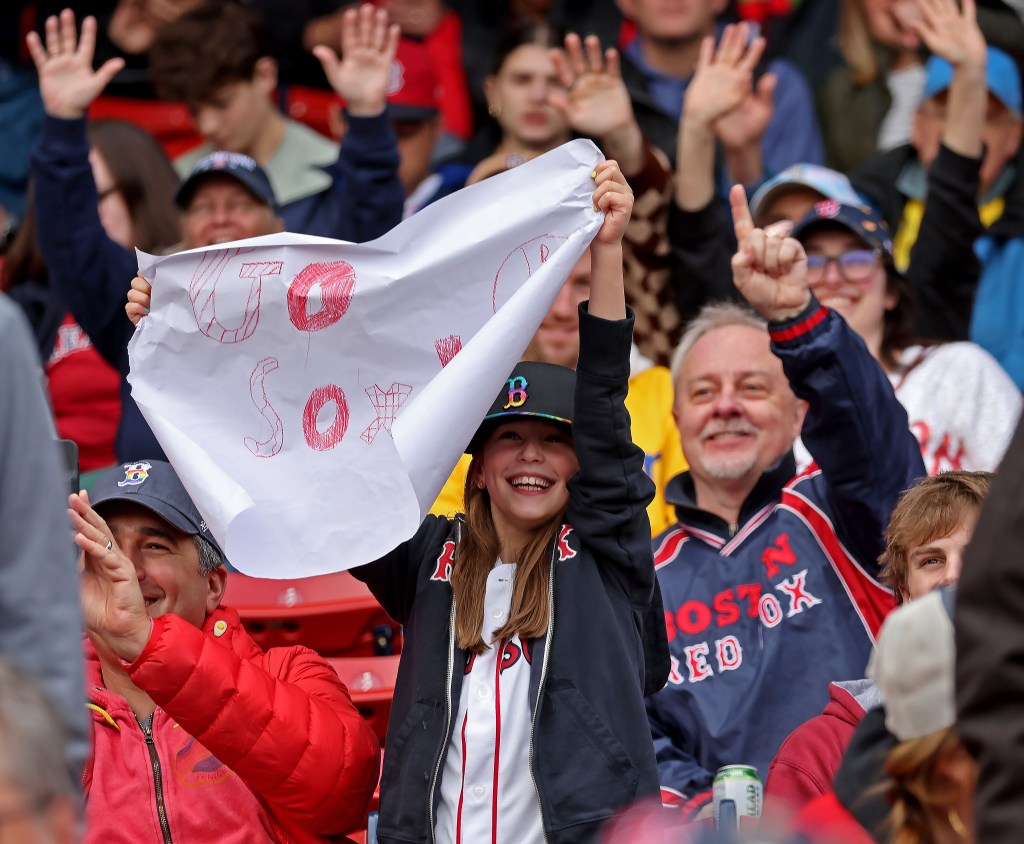
I didn’t expect a Red Sox game from a few weeks ago to stay with me the way it has. Reading the headlines, it is easy to focus on what is not working — whether it is the Red Sox or our world. That is the nature of sports, and of life. But sometimes, moments like these invite us to consider something else: what endures, beyond wins and losses, beyond the noise of the moment.
My wife and I had landed tickets from a colleague — great seats just beyond the on-deck circle — and what started as a simple date night became something more. Somewhere between the first pitch and the final out, I was reminded that something deeper is always unfolding around us.
We took an Uber to the park. The driver, from Westie, told us about his son, a student at Holy Name. He and his wife had relocated from the West Coast, building a new life here. He got us as close to Fenway as possible. That small, human effort set the tone.
We stopped at Game On, a place I had not been to since it first opened, when an old friend from Charlestown ran it. It was alive — families, couples, young people. On the walk in, I ran into a Boston police officer I had grown up with. A large city, yet somehow still small.
Inside Fenway, we found our seats across from a plaque honoring Lib Dooley, the fan who attended games for more than 50 years and was known for feeding players cookies as they warmed up. Her hospitality still lingers.
Our section was a cross-section of Boston: dads and sons, couples on dates, longtime fans, first-timers. Everyone leaning forward, hopeful. Two seventh-grade boys sat beside us, decked out in baseball jackets and caps. As teachers, we could not help but talk with them. They were locked in, hoping for a foul ball.
Truth be told, everyone was hoping for one — the teenage boy behind us, the two younger girls in front, all watching the ball boy like hawks.
At one point, a couple in the front row noticed the two boys near us, restless and hanging on every pitch. A few innings later, the husband returned with baseballs for each of them. No announcement. No expectation. Just a small act to make sure those kids went home with something to remember. It could have gone unnoticed. But it said something.
Then there was the ball boy, a quiet professional. Always ready with the right baseball, the right toss, the right instinct. In the sixth inning, he flipped one to a young boy wearing a “first game at Fenway” pin. In the eighth, another to the kid behind us. Earlier, he made sure the girls in front had their moment. It was not random. He understood something about joy — and who needed it most.
The game stretched into extra innings. With each frame, the energy built. Strangers became neighbors. High-fives crossed rows. Conversations started. Phones disappeared. My wife and I found ourselves watching not just the game, but the small acts that make it whole.
We often define cities by what they chase. Washington is about power. New York is about money. But Boston, at its best, is about something quieter and more enduring: relationships. This is a city of neighborhoods, of people who notice one another. Where a stranger sees two kids hoping for a ball and steps in. Where small gestures carry weight.
Boston has never been perfect — nothing is. But in moments that matter, ordinary people show up. Not for recognition, but because that is who they are. There is a lot wrong in the world, and it is easy to focus on what divides us. Maybe we need to spend more time talking about what is right.
A date night. A ballgame. A bag of peanuts. A cold beer. Strangers high-fiving across rows, sharing in something simple and good. For a few hours, people put down their phones, stepped out of themselves, and leaned into something larger.
When the Red Sox won in extra innings, the place erupted. We hugged people we had never met. Jumped like kids. For a few hours, the usual barriers fell away, replaced by something simpler: shared belief.
We sang “Sweet Caroline,” a little louder because it is our daughter’s name. And when “Dirty Water” played, it did not feel ironic. It felt true: Boston, you’re my home.
This city is not perfect, but nights like that remind you what it can be: generous, connected, alive. A place where people still show up for one another in small, meaningful ways.
Teams change. Leaders come and go. Seasons rise and fall. But what endures — what people carry with them long after the final out — is something quieter. It is found in the small moments, in how people show up for one another, in the habits of attention, generosity, and care.
That is the real legacy of a place like Fenway. Not just what happens on the field, but what happens in the stands, in the spaces between pitches, in the unnoticed acts that form us over time. And maybe that is the essence of Boston at its best: not perfect, but deeply human. A place where people still choose to show up for one another.
I am grateful for that reminder — that it is the small, human moments that stay with us long after the final out.
Dr. Peter F. Folan is the Head of School at Dexter Southfield in Brookline