
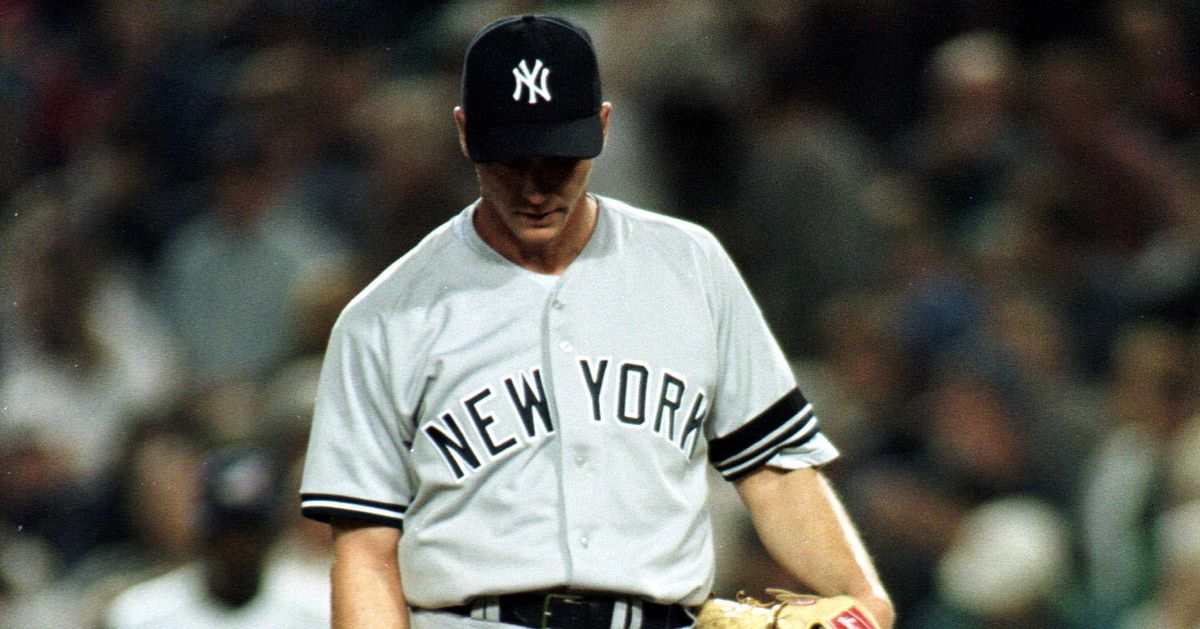
There is an entire generation of Yankees fans, and baseball fans for that matter, who may only know David Cone as one of the best and smartest broadcasters in the game, with his work for the YES Network and ESPN.
But before he got into the booth, he was a heck of a pitcher. His time as a Yankee was no exception. When Pinstripe Alley compiled our list of the 100 greatest Yankees of all-time, Coney is smack dab in the middle, sitting at 43.
But by the time 2000 rolled around, Father Time, merciless and undefeated villain that he is, was catching up to Coney, who entered this tilt with a 1-4 record and a 5.68 ERA. That last figure was bloated by a couple of awful starts early in the season. Cone had been better of late, pitching deep into games. Unfortunately, facing the Athletics, he delivered another clunker, and the Yankee offense couldn’t quite climb out of the hole.
May 31: Yankees 7, Athletics 8 (box score)
Record: 28-21, .571 (1.5 GB)
Oakland wasted no time punishing Cone, though he was tantalizingly close to escaping without damage. Coney retired the first two men in the first frame. But he gave up a hit to future Yankee Jason Giambi before walking Ben Grieve. Then, with one swing of the bat, Matt Stairs made it a 3-0 game with a home run. The Yanks were in an early hole.
Another Oakland run in the top of the second made it a 4-0 game before the Bronx Bombers climbed off the mat. For as rough a start as this was for Cone, the bats did their absolute best to get him off the hook, continuously fighting back. In the home second, with a pair of ducks on the pond, Chuck Knoblauch launched a dinger of his own, cutting the Oakland lead to 4-3.
After an uneventful third inning, it all fell apart for Cone in the fourth. He gave up a leadoff shot to Eric Chavez to extend the Oakland lead to 5-2. From there, two more Athletics singles meant the end of Cone’s day, as Joe Torre came to get him. Buster Olney summarized Coney’s performance in the next day’s New York Times:
“Cone was battered and bruised because he could not summon a decent fastball, a decent slider or a decent anything. The 37-year-old pitcher allowed six earned runs on six hits and four walks in three and one-third innings and jogged to the dugout amid some cheers and some boos. He had a look of resignation across his reddened face.”
Allen Watson came in for Cone and promptly walked the bases loaded. A sacrifice fly and a run-scoring E2 put two more across for Oakland. Once again, the Yankees faced a four-run deficit.
That’s where the game stayed until the home sixth. Facing Twins starter Gil Heredia, Ricky Ledée stepped into the box with a pair of runners on. He worked himself into a 3-1 hitter’s count and when he got his pitch, he didn’t miss it. His three-run blast to right field again trimmed the Athletics’ lead to one run.
Oakland scored in the top of the eighth, this time via a Giambi RBI single. But in the bottom half, the Yankees looked like they might complete the comeback. First, Ledée knocked in his fourth run of the game to make it 8-7. Then, with two on and two out, Derek Jeter worked the count full before taking what he sure thought was ball four inside. Alas, home plate umpire Rick Reed disagreed and rung Jeter up. The normally stoic Jeter immediately turned around to argue with Reed.
What could have been. A Jeter walk would have loaded the bases for Paul O’Neill and given Paulie a chance to give the Yankees the lead with a base hit. Instead, the Yankees’ last, best chance went by the wayside.
Losing is never fun. But the level of concern over Cone had to be both high and rising. He looked much more like the early season version of himself that got shelled early and often, rather than in his most recent starts when he’d been giving the Yankees some length.
Unfortunately, things would get worse for Coney before they got better.
Read the full 2000 Yankees Diary series here.