
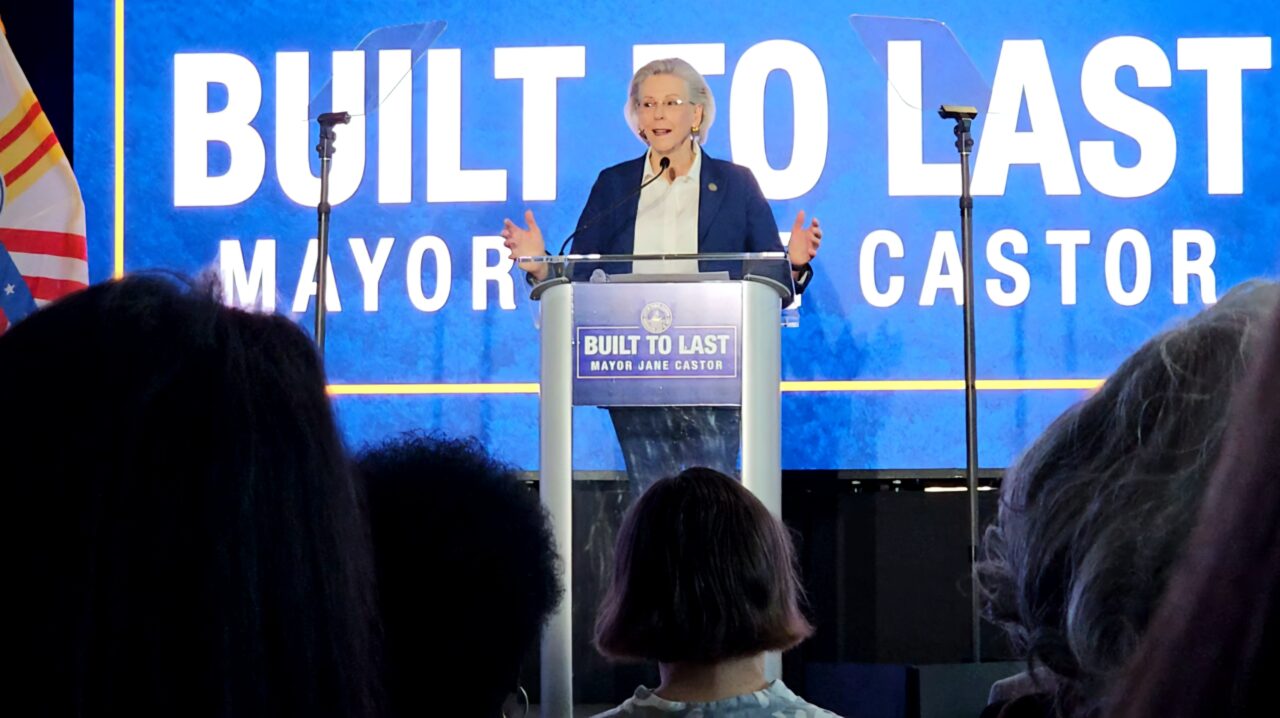
Tampa Mayor Jane Castor made some deliberate choices during her State of the City address, where she avoided talk about a potential deal with the Tampa Bay Rays in favor of focusing on investments made into city neighborhoods.
She even walked off the stage to “We Built This City” by Starship.
Castor said that sustaining Tampa’s rapid growth will require long-term investment in infrastructure, housing and resiliency. Speaking from the Fair Oaks Recreation Complex in East Tampa, Castor said the new facility is symbolic of the city’s investment into Tampa neighborhoods.
“A city doesn’t become strong by accident. It becomes strong because people invest in it — their time, their work, and their lives — and our responsibility is to match that investment. Generations who’ve called east Tampa home helped build our city into what it is today,” Castor said.
Castor said east Tampa is “rich with culture, rich with history, and rich with talent,” but said the city has never lived up to its end of the bargain.

“Residents invested in East Tampa and made our city stronger for it, but for too long the city didn’t match that investment. Today we are,” Castor said.
“The Fair Oaks Recreation Complex is a $34 million investment in the heart of East Tampa, and thank you to our Congresswoman Kathy Castor for securing $1 million for this project. But more importantly, it’s a commitment to investing in the people and places that built this city. Fair Oaks is more than a neighborhood park — it’s a 10-acre, regional jewel in our park system.”
Castor has focused heavily on infrastructure during her tenure, particularly the city’s multibillion-dollar investment in water, wastewater and stormwater systems. Castor pointed to the PIPES program — a $3 billion effort started in 2019 under Castor’s leadership — as one of the largest infrastructure initiatives in Tampa’s history.
The city has since undertaken more than 100 projects through the program, replacing about 78 miles of aging water lines and rehabilitating more than 210 miles of wastewater lines to improve reliability and prevent costly failures.
“This work may be underground, but it’s what it looks like when a city is built to last,” she said.

Castor also highlighted forward-looking investments in water quality, including construction of a large-scale treatment facility designed to remove harmful “forever chemicals” from drinking water.
“Right here in Tampa, we are building the largest Suspended Ion Exchange, or SIX, facility in the entire world. This new facility will remove forever chemicals, cut chemical use, improve water quality, and save taxpayers nearly $2 million a year,” Castor said.
She also noted that the city still plans an additional 17 miles of water and wastewater lines, along with major upgrades at its water and wastewater treatment plants.
“As this severe drought has reminded us, water is a finite resource and it’s critical that we continue working together to ensure a sustainable supply for generations to come,” she said.
Castor reminded residents that preparing for major storms is an annual routine, and said preparation starts with city infrastructure. She emphasized the city’s commitment to the South Howard stormwater project in South Tampa despite controversy.
“This project will protect future generations of Tampanians. It would be far easier to shelve that project for years of additional study and delay. But floodwaters don’t wait for consensus; any delay is a decision to stay vulnerable,” Castor said.
Castor also noted that the city removed about 24,000 tons of debris from pipes and inlets last year alone.
“That’s the equivalent weight of over 16,000 cars, because while we cannot stop hurricanes we can build a city that is prepared to withstand them. So when the storm comes we are ready,” she said.
Castor said the city’s growth also requires a mobility and connectivity strategy. She highlighted transportation investments that include expanded road resurfacing, sidewalk repairs and bike infrastructure, and other efforts to expand transit options.
She pointed to continued work to extend the TECO Line Streetcar and develop regional transit connections linking downtown Tampa, Westshore, Tampa International Airport and the stadium area.
“The TECO Line Street Car has grown into a vital transportation option connecting downtown, Channel District and Ybor City,” Castor said. “The groundwork to fund and operate the street car is being developed today so that construction can begin soon. With the extension into Tampa Heights, it will play an even larger role in connecting neighborhoods and supporting economic development.”
Castor also welcomed the planned relaunch cross-bay ferry service to the Riverwalk, which is also undergoing renovation itself. The West Riverwalk extension includes 2 miles of new Riverwalk along the west side of the Hillsborough River, as well as 3 miles of road upgrades in surrounding neighborhoods.
“That’s one of the most successful quality-of-life investments in Tampa’s history, and now we’re expanding it to the west side of the river,” she said.
Castor added that plans by the Pinellas Suncoast Transit Authority (PSTA) to relaunch the ferry service add another way to improve mobility between Tampa and St. Petersburg while providing an amenity for residents and visitors to enjoy.
Development is also booming. Castor noted that the city has permitted nearly $22 billion in permits since she took office.
“More than 23,000 residential units have been added since 2019, and more than 8,300 affordable units have been completed or are underway,” she said.
The city has invested more than $100 million in housing and assistance programs aimed at expanding access and stabilizing communities amid rising costs.
“This isn’t just about buildings,” Castor said. “It’s about stability. It’s about opportunity. It’s about making sure that people can stay, work, build, and grow here in our city. Tampa’s strength has always come from people who take a chance, who open up a business, create something new, and invest in our community.”
Castor also pointed to Tampa’s growing national profile, citing economic activity tied to Port Tampa Bay, Tampa International Airport and local universities as signs of continued momentum.
“Port Tampa Bay is booming, with a $34.6 billion economic impact and supporting more than 192,00 jobs in our city,” Castor said. “Tampa International continues its world-class expansion, and today has more nonstops to more places than ever before.”
Castor said the city’s financial position — including strong bond ratings and relatively low per-capita debt — allows Tampa to continue investing in future projects while maintaining fiscal discipline.
“We have the second highest bond rating of any comparable city in the nation and one of the lowest per capita municipal credit levels,” she said.
A former Tampa Police Chief herself, Castor also highlighted the work of public safety officials. She noted a decline in crime, including a 21.4% reduction over the past year.
“That happened through strategic policing, community partnership, proactive crime prevention and smart investment in technology,” Castor said.
Castor notably avoided the Tampa Bay Rays during Tuesday’s speech, choosing not to mention ongoing negotiations with the team for a new ballpark during the nearly 20-minute address — despite the project dominating much of the public conversation in recent months. The proposed ballpark at the Hillsborough Community College Dale Mabry campus would relocate the team from St. Petersburg to Tampa to create a broader entertainment district, often compared to The Battery in Atlanta.
The proposal carries a price tag that could exceed $1 billion in public funding from the city and Hillsborough County, positioning it as one of the most significant economic development bets under consideration. Supporters argue the project would create a major economic engine near Tampa International Airport and existing sports venues, while critics have raised concerns about the cost to taxpayers and competing funding priorities — such as plans by the Tampa Bay Buccaneers to renovate Raymond James Stadium, likely to include a new but pricy roof.
Castor, however, appeared elated to highlight a track record of successful investment throughout Tampa’s many communities. She followed remarks during Tuesday’s address with a ceremonial ribbon cutting for the Fair Oaks complex, an investment into a historically underserved area in East Tampa that is already making use of community programs offered there.
“The story of Tampa has always been the story of people who believe in this city and work together to make it stronger. We are honoring our past, we are embracing our future, and together we are building the greatest Tampa yet,” she said before walking off the stage to Starship’s famed tune.