
He’s both superpowered and humble. He wears blue and red. He is adored by all the residents of his fair city. This summer, countless thousands will buy tickets to see him in action. Are we talking about Superman? Or Bryce Harper? Harper’s hometown of Las Vegas isn’t exactly the planet Krypton, though those walking the strip at high noon in summertime might indeed feel as if they’ve found themselves on the surface of an exploding planet. But in all other respects, Bryce seems to be more than a fair stand-in for the Man of Tomorrow (we can’t use his more common nickname for a baseball comparison; Rickey got there first). That includes having a weakness. For Superman, it’s kryptonite (and, canonically, magic, though to a lesser degree, and also that’s unnecessary for the metaphor; I mention it only because I spent my lunch hours in middle school reading the DC Comics Encyclopedia in the library. One of these days I’ll find a way to jam in a reference to the Doom Patrol and then I’ll finally be happy. Back to the point.).
What’s Bryce’s weakness? Unlike Lex Luthor, we needn’t hire expensive and ethically dubious scientists and snoops to get to the bottom of it. We can just look at Baseball Savant’s percentiles.

via Baseball Savant
Like the Phillies’ home uniforms, that’s a whole lot of red, with just a little blue. But that blue contains something worrying. What’s with that whiff rate? Harper is whiffing 35.5% of the time, putting him among the league’s very most whiff-prone. He’s still performing at a high level at the plate (though his batting average and slugging are a bit down), so there’s no reason to panic. But there is reason to take a deeper look: his year-over-year increase of 8.8% is the 2nd biggest across all of baseball.
It must be noted that Harper has been a whiff-happy hitter for his entire career. In every season since the dawn of the Statcast era (2015) he’s been more likely to whiff than the average hitter, and typically by a lot. The average Whiff % across MLB in that time period was 25%. Harper has only been beneath that figure for one season (2016). Harper’s current whiff rate would be the highest of his career, though it’s not terribly different than the 33.5% he posted in 2023, or the 33.8% in 2019, etc. It is, however, terribly different than the 26.7% he posted in 2024. So the question we have is really twofold. Why did Harper’s whiff rate drop so much in 2024, and why has that trend reversed so sharply in 2025?
Going into the 2024 season, the talk of the town was chases. Steel your hearts as you recall those nervous days, with the Phillies still smarting from their unexpected exit from the NLCS at the hands of the Diamondbacks and a series of pitchers whose names still inspire queasiness in Phillies fans everywhere (it is said that Philadelphian children from Moyamensing to Manayunk still scatter in terror when the dread name of Ginkel is invoked). The Phillies had spent a whole offseason thinking about the way they flailed, and how not to let it happen again. Bryce Harper did not, however, chase less in 2024. In fact, he managed to chase exactly as much in 2024 as he had in 2023, down to a tenth of a percent.
What he did do, however, is make more contact. Maybe that was in response to the concerns about the way the Phillies’ 2023 campaign concluded, maybe not: either way, his contact rate for pitches in the zone rose from 78.6% to 84.9%, and his contact rate on pitches out of it rose from 46.7% to 52.4%. Naturally, his whiff rate fell correspondingly. The tradeoff was that he was no longer swinging as fast, with his bat moving a full mile and a half slower than it did the year before. But that didn’t seem to be a problem: his batting average dropped a bit, as did his on-base percentage, but his slugging percentage soared, and he had another all-star campaign. No problems. Then again, maybe some problems: his actual batting average and slugging percentage were much better than his expected BA and SLG, which suggests his new, more contact-oriented approach wasn’t going to keep working as well as it seemed to be.
So perhaps that’s why he’s seemed to switch back to the old approach in 2025. His zone contact rate has dropped 5.5%, and his chase contact rate has dropped by a whopping 12.3%. His whiff rate is up by 8.8%. If Harper took a more contact-oriented approach in 2024, but abandoned it prior to the start of the 2025 campaign, it would explain why his whiff rate dropped, then spiked again.
But there’s something else going on, too.
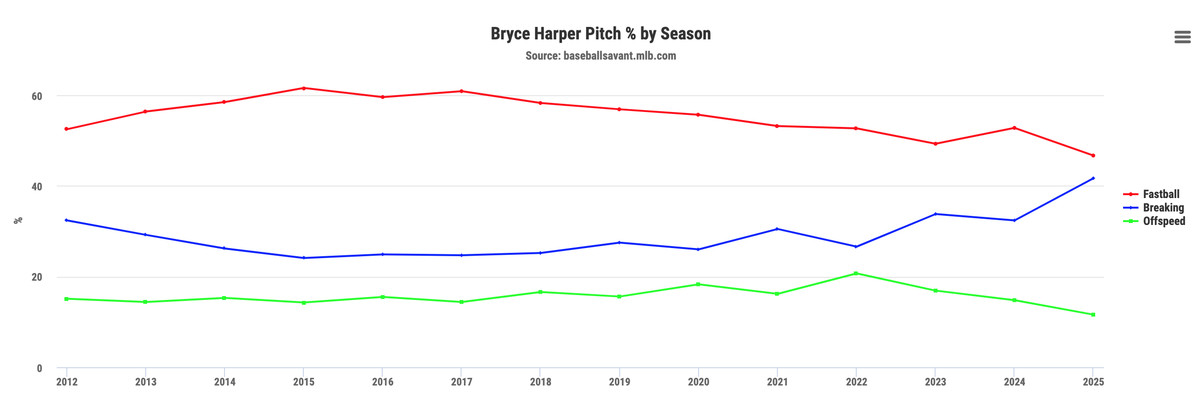
This season, Harper is seeing breaking balls at a greater rate than he’s ever seen before: 41.7%, up from 32.4% the year prior. At the same time, he’s seeing fastballs and offspeed pitches at a lower clip than ever. Harper is particularly prone to whiffing against breaking balls, and the heavier diet of them he’s been consuming this year can partially explain why his whiff rate is up. Combine his return to a less contact-oriented style with the increasing recognition from opposing moundsmen that breaking balls are the weapon of choice against him, and you have his bat slicing outlines in the air like the Scissormen from Doom Patrol Vol. 2, Issue 21 (there we go). The fact that his whiff rate against breaking balls by themselves is up year-over-year (34.5% to 46.9%) indicates that it’s more than just the change in offerings, that something changed in his approach as well.
This is not cause for terrible concern. His whiff rate is sky high, but he’s still highly effective at the plate. But breaking balls have a habit of breaking hearts, especially in October. The hurlers that the Phillies face in the postseason will certainly present him with all-you-can-whiff diet of moving stuff. Will Harper have an appetite for it?