
It shouldn’t work this way, but there always tends to be a “winner” and a “loser” in a trade between two teams. The ideal should be a “win-win” for both sides. However, in reality, there’s always a team that seems to get a little more value in a trade, whether in the short term or the long term.
When the Royals traded away reliever Angel Zerpa to the Brewers for outfielder Isaac Collins and reliever Nick Mears, it seemed to make sense for both the Brewers and Royals. The Royals not only got some bullpen depth, but also an outfielder who could get on base and play decent defense. As for the Brewers, they got a lefty reliever with some high-leverage setup man upside.
Jack Stern of Brewers Fanatic seemed more optimistic about the Brewers’ return in the deal, even though they gave up two MLB players to Kansas City. Here’s what he said about Zerpa in his piece.
Quote
Zerpa, meanwhile, is trending more clearly in a positive direction. Whereas Collins’s and Mears’s peripherals suggested their performance was actually slightly below average at the plate and on the mound, Zerpa’s well-above-average 3.38 SIERA and 3.36 DRA (74 DRA-) were career bests. His 117 Stuff+ tied him with new teammate Abner Uribe for 16th among qualified relievers, pointing to his greater potential to be a significant piece moving forward than the players the Brewers gave up.
Unfortunately, the Brewers received some difficult news today regarding Zerpa. It was announced that he would be receiving Tommy John surgery.
data:image/gif;base64,R0lGODlhAQABAPABAP///wAAACH5BAEKAAAALAAAAAABAAEAAAICRAEAOw==
Not only will surgery end Zerpa’s 2026 season, but it will also cause him to start the 2027 season late. That’s not exactly what the Brewers envisioned when they acquired the Venezuelan pitcher from Kansas City.
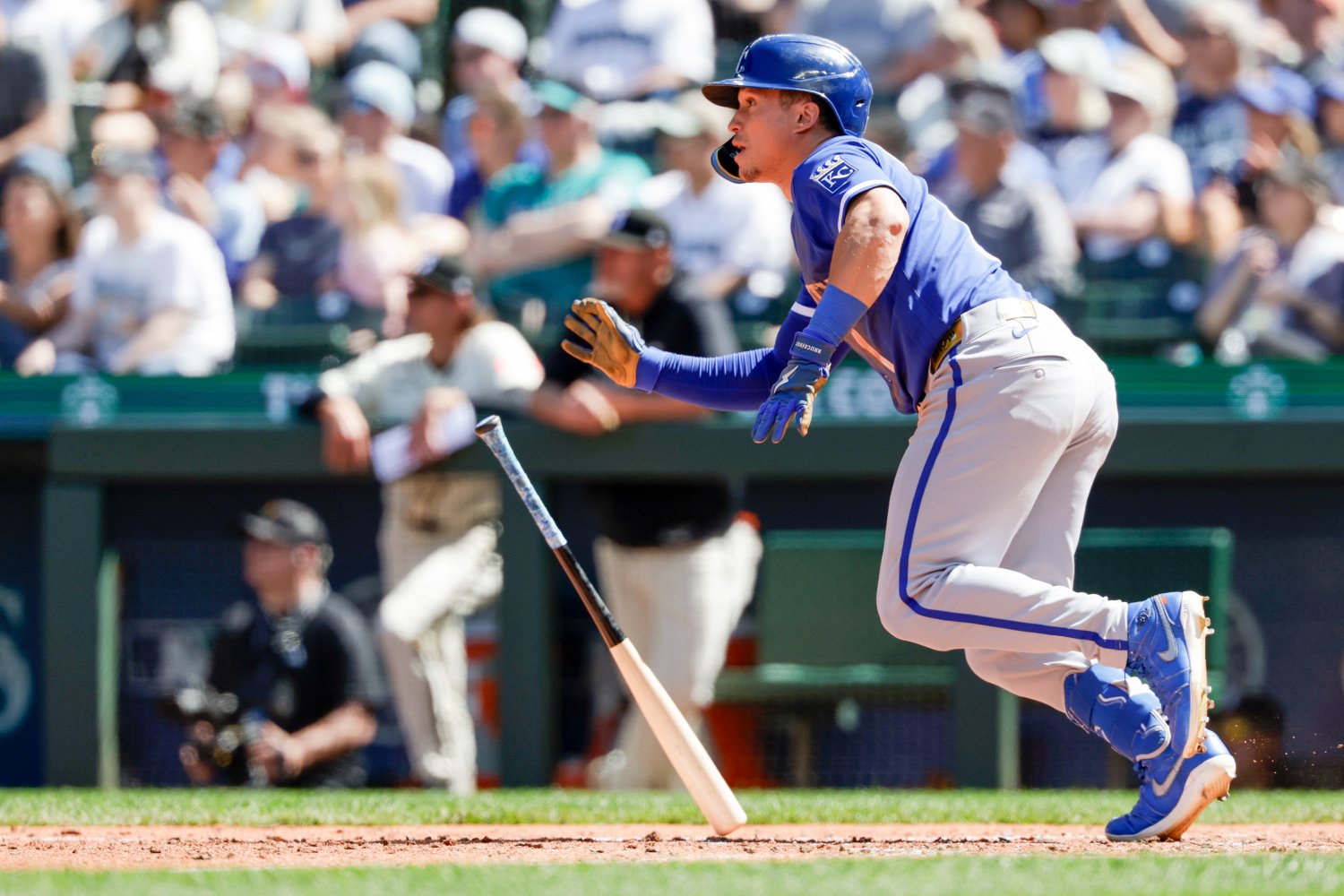
On the flip side, Mears and Collins both contributed to the Royals’ 5-3 win over the Guardians, Kansas City’s fifth straight. Mears pitched an inning in relief and struck out one while allowing no hits and no walks on eight pitches. As for Collins, he went 3-for-3 with two runs scored and hit his third home run of the season.
data:image/gif;base64,R0lGODlhAQABAPABAP///wAAACH5BAEKAAAALAAAAAABAAEAAAICRAEAOw==
While we know Zerpa is out for the rest of the year, what have the Royals gotten in Mears and Collins so far this season? Furthermore, what could Royals fans expect from them for the remainder of the year, and perhaps in 2027?
Let’s break down those questions and why the Royals have come out well in this trade.
Collins Heating Up After A Slow Start
Things weren’t initially looking good for Collins at the plate, prompting many Royals fans to ask whether Milwaukee knew a serious decline was on the horizon for the former Creighton product. After his April 21st game against the Orioles, Collins was hitting .183 with a .513 OPS. The latter was his lowest OPS of the season.
Over the past 15 days, Collins has been hitting .288 with a .397 OBP and .462 slugging in 52 at-bats. Over that time frame, he has 15 hits, two home runs, eight RBI, nine walks to 17 strikeouts, and two stolen bases.
Over the past seven days, his numbers have been even better.
In his last 22 at-bats, he is hitting .364 with a .444 OBP and .636 slugging. He also has four walks to five strikeouts over the past seven days, showing that he’s locked onto opposing pitchers better than ever. For the season, Collins is hitting .255 with a .366 OBP and .760 OPS in 94 at-bats. He has also seen a strong upward trend in xwOBA, as shown below via Savant.
.png.fde4d1be612d1177b5a3846284263b57.png)
When looking at his Statcast percentiles, the 28-year-old outfielder has been questionable in a few categories, especially when it comes to whiff and Z-Contact%. That said, he’s been excellent in O-Swing% and BB%, and has been showing promising trends in bat speed, pull air%, and max EV. Those trends can all be seen via his TJ Stats Statcast summary.
.png.b2838365ca2b1cf7babe657d72bf3314.png)
While the 90th EV and Max EV rank in the 63rd and 69th percentiles, respectively, his barrel rate ranks in the 43rd percentile, and his hard-hit rate ranks in the 38th percentile. Furthermore, Collins’ .301 xwOBA ranks in the 38th percentile, and his TJBat+ of 89 ranks in the 47th percentile.
Thus, Collins has been good, but he’s probably not much more than a good bottom-of-the-order hitter. Thankfully, the Royals have been utilizing him just as that. 97 of his 111 plate appearances have come in the 7th or 8th spot in the batting order.
Mears Getting By With Solid Stuff (And Batted-Ball Luck)
Mears has been an interesting bullpen arm for manager Matt Quatraro this season.
On one end, the former Brewers reliever is posting a 2.13 ERA and 1.03 WHIP in 14 appearances and 12.2 IP. However, he has a .182 BABIP, and his K% and K-BB% have been lackluster, evidenced by rates of 20% and 6.0%, respectively. Thus, it’s no surprise that Mears’ 3.18 FIP is much higher than his ERA, and his Stacast percentiles haven’t been too great either, per TJ Stats.
.png.55bea3d29fd9ae73eb685943e54faba3.png)
When looking at this Statcast profile, it’s easy for Royals fans to get discouraged and think that major regression is on the way for Mears. And honestly, some regression is probably to be expected. That said, there are two categories that should make Royals fans hopeful: GB% and TJ Stuff+.
Mears is generating a GB% of 48.4%, which ranks in the 71st percentile. That ability is key for a reliever like him to get out of jams when the whiffs and strikeouts aren’t happening. Based on his 27th percentile whiff rate and 31st percentile K rate, he will need to keep that GB% high to remain effective as a reliever, especially in medium to high leverage opportunities.
Even though the whiff, K%, and CSW% (25th percentile) aren’t impressive, there’s reason to believe that they could get better, especially considering his TJ Stuff+, which ranks in the 74th percentile with a 105 mark. When looking at his overall TJ Stuff+ summary this year, even though the chase and whiff haven’t been great, all his pitches have sported great TJ Stuff+ marks so far with the Royals.
.png.93d78dc17d11520637e8a118c02663c2.png)
Mears’ four-seamer, slider, and changeup have been borderline elite in terms of TJ Stuff+. They all sport marks of 106 or higher, which is solid, especially for a reliever. That said, he’s struggled to throw those pitches in the zone. The four-seamer has a zone rate of 44.3%, his slider has a 38.6% zone rate, and his changeup has a 20.7% zone rate. If Mears is able to improve the control on those three pitches and find the strike zone more, it’s likely that his chase and whiff will improve as a result.
Here’s an example of Mears pumping the four-seamer on the edge of the strike zone to generate a swing-and-miss from the White Sox’s Colson Montgomery back on April 12th. It’s obvious in the video clip below that the four-seamer has good enough shape and velocity to be successful.
TDY1Tk9fWGw0TUFRPT1fQndjRVhGMVFBZ1lBREZVR1VnQUhWd0lIQUZsVVd3TUFCbEFDQmd0UkFsRlRCd0VD.mp4
Let’s hope that Mears is starting to gain some much-needed control over those three pitches going forward. If he does, he could be in line to get some more setup innings in the near future.
Looking at Zerpa and Overall Thoughts From the Deal
Even before the injury, Zerpa’s first season in Milwaukee wasn’t looking good.
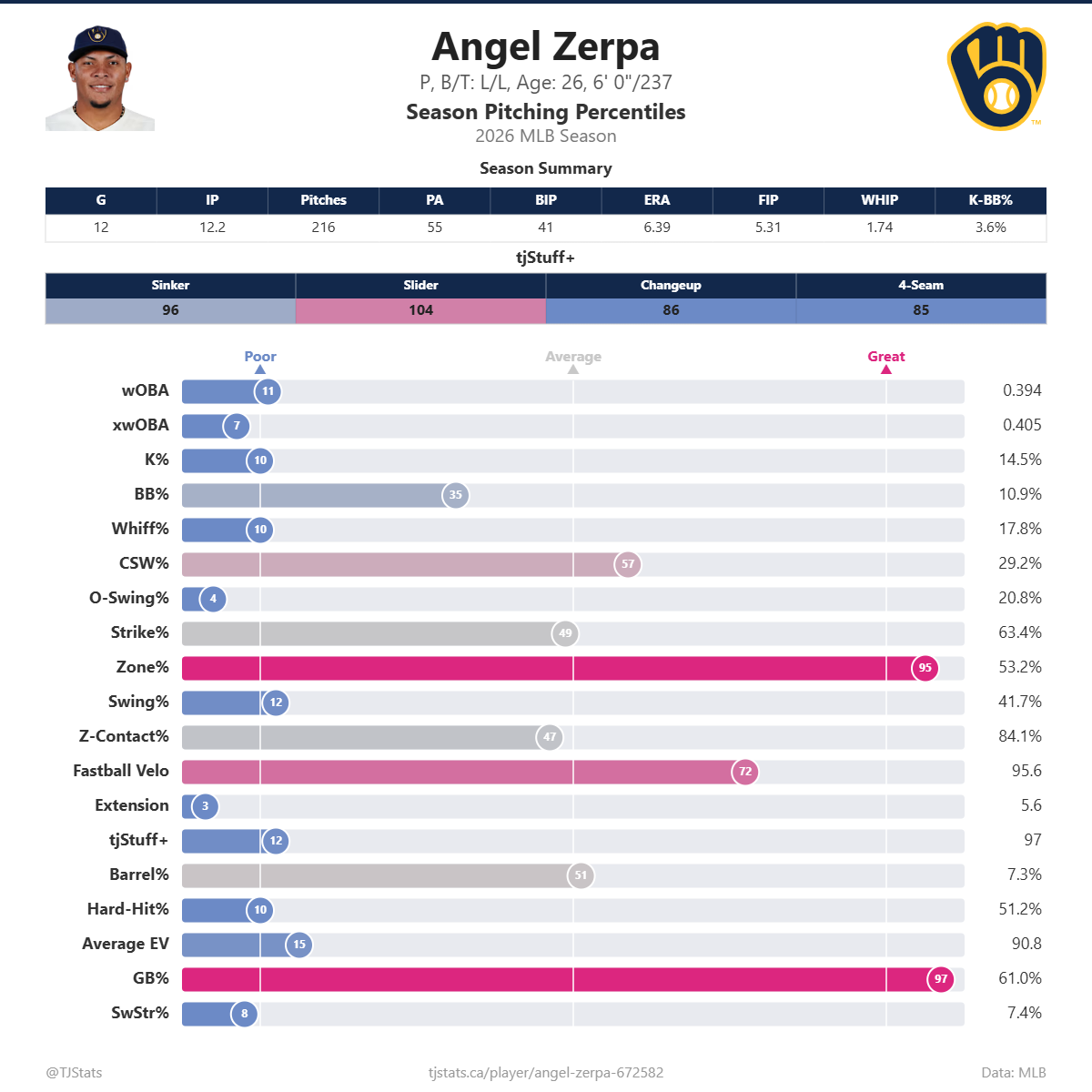
In 12.2 IP, he had a 6.39 ERA and 1.74 WHIP. His K% was just 14.5%, and his K-BB% was 3.6%. In terms of his Statcast percentiles, he did a good job of flooding the strike zone and generating groundballs, which is what he did well in Kansas City, too. Unfortunately, that was just two of the few areas where he succeeded with the Brewers pre-injury.
The positive aspect of Zerpa for the Brewers is that he isn’t arbitration-eligible until next year, and his price tag should be low thanks to injury. He also won’t be a free agent until 2029, so the Brewers still have some time to see what Zerpa could turn into post-Tommy John surgery.
Still, it isn’t exactly the start the Brewers were hoping for with the talented lefty reliever. Conversely, the Royals are probably happy that they didn’t just trade Zerpa at the peak of his value, but have received two players who have made an immediate impact on this Royals roster.
Granted, not every Royals trade has turned out like this under GM JJ Picollo.
While Brady Singer has struggled this year (5.57 ERA and 5.74 FIP in 32.1 IP), the Royals have gotten one sub-par full season from Jonathan India (-0.3 fWAR in 2025) and another season cut short by injury (only 58 PA this season before getting surgery on his shoulder). The Royals may have preferred the innings Singer would have given them instead of the lackluster production from India, even if Singer may never be more than a No. 3 or 4 starter at the MLB level.
Still, it’s nice to see a trade like the one for Collins and Mears working out. It’s also nice to see a former Royal NOT demonstrate their best self after they left Kansas City. Seeing players like Ryan O’Hearn, Brent Rooker, Gabe Speier, and Brad Keller find success with other teams is bittersweet, especially since their talent never felt fully realized with the Royals (I’m not ready to put MJ Melendez in that category).
Maybe Zerpa will add to that list by bouncing back from injury in 2027 or 2028.
For now, Royals fans can enjoy the production the club received from Collins in the outfield and Mears in the bullpen.